On eBird ↗
Rüppell's Warbler
Live sightings near you, the range map, bar charts of when it is seen, and Macaulay Library photos and recordings.
Rüppell's Warbler
Curruca ruppeli
Rüppell's warbler (Curruca ruppeli) is a typical warbler of the genus Curruca. It breeds in Greece, Turkey and neighbouring islands. It is migratory, wintering in northeast Africa. This is a rare vagrant to western Europe. The name is occasionally cited as "Rueppell's warbler".
From the article Rüppell's warbler on Wikipedia (CC BY-SA), quoted section by section
Description
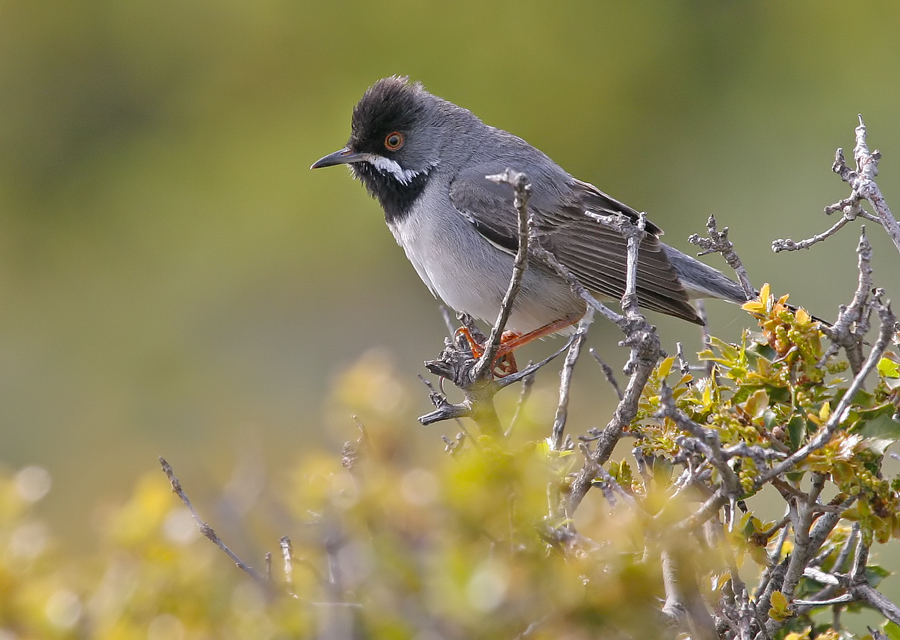
It is a typical Curruca warbler, similar in size but slimmer than the Sardinian warbler. The adults have a plain grey back and paler grey underparts. The bill is fine and pointed, with brown legs and red eyes. The striking male has a black head and, usually, a black throat, separated by a white malar streak ("moustache"). Females have a pale throat, and the head is grey rather than black. Their grey back has a brownish tinge. The song is a slower, deeper rattle than that of the Sardinian warbler.
Range & habitat
It breeds in dry and warm environments, including rocky areas, hillsides covered with scrub and maquis, and from sea level to altitudes of approximately 800–1000 meters. In some regions, such as southeastern Turkey, it has been observed at higher elevations up to 1500 meters, and on Crete, up to 1600 meters. This species occupies a diverse range of dry Mediterranean habitats, from forested areas with sufficient undergrowth to maquis with sparse tree cover. It favors open bushy woods of oak and cypress, as well as grassy and rocky terrain with varying densities of scrub cover. Compared to the closely related Sardinian warbler, Rüppell's warbler is less reliant on tall and dense vegetation. During the non-breeding season, it frequents scrubby arid areas, as well as gardens, canebrakes, and hedgerows. On migration, it can be observed on bushy hillsides, mountain slopes, and in desert wadis with Acacia trees.
Wikipedia: “Habitat”
What it does
This Insectivore passerine primarily feeds on adult and larval insects. However, its diet likely includes other arthropods as well. During the non-breeding season, it also enriches its diet with berries.
Wikipedia: “Diet”
In human culture
Together with the Cyprus warbler it forms a superspecies with dark throats, white malar streaks and light remigial fringes. This in turn is related to the species of Mediterranean and Middle East Sylvia warblers that have a naked eye-ring, namely the eastern subalpine warbler, Sardinian warbler and Ménétries's warbler. Both groups have a white malar area, but this may not form a clear streak in the latter group; above the white, the heads of males are uniformly dark. The English name and the specific ruppeli commemorate the German zoologist and explorer Eduard Rüppell (1794–1884). This is a monotypic species, meaning there are no recognised subspecies.
Wikipedia: “Taxonomy and etymology”
Listen
Looking for field recordings…
Where it lives
Recorded sightings
—
geo-referenced records in GBIF, from museums, herbaria and field observers.
Drag the globe to turn it. Dots are where records exist, not a range map; darker means more records.
In the stacks
Searching the stacks…
Every page naming Curruca ruppeli in the Biodiversity Heritage Library →
This page is assembled live from iNaturalist, GBIF, Wikipedia, the Source Library and the Internet Archive. It is not yet part of the hand-edited codex. iNaturalist taxon 1289474.