On eBird ↗
Arabian Babbler
Live sightings near you, the range map, bar charts of when it is seen, and Macaulay Library photos and recordings.
Arabian Babbler
Argya squamiceps
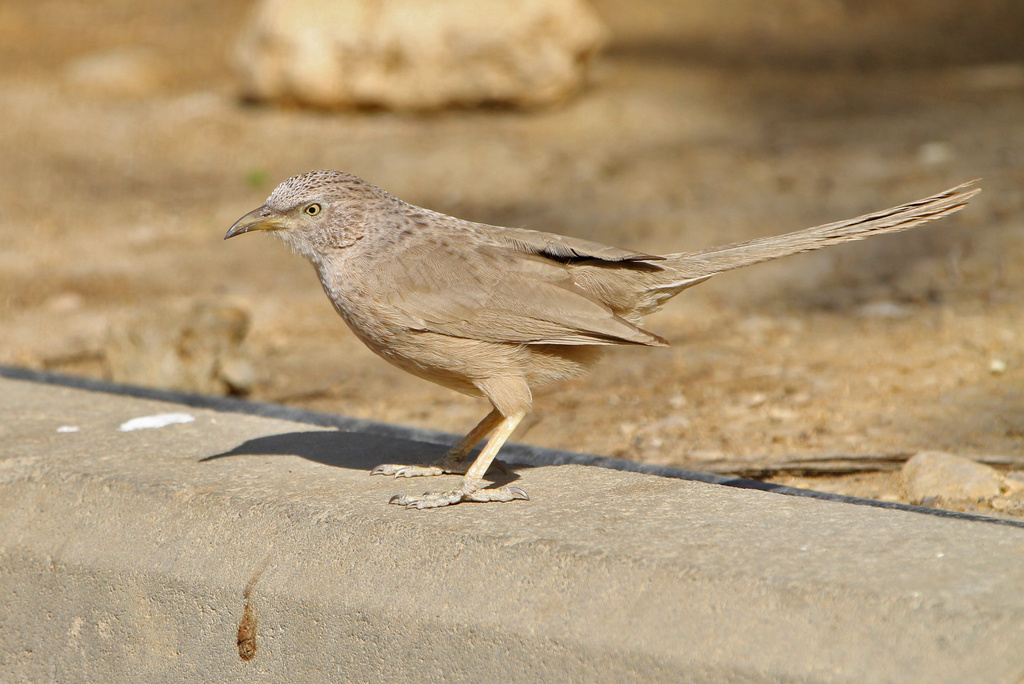
The Arabian babbler (Argya squamiceps) is a passerine bird until recently placed in the genus Turdoides. It is a communally nesting resident bird of arid scrub in the Middle East which lives together in relatively stable groups with strict orders of rank.
From the article Arabian babbler on Wikipedia (CC BY-SA), quoted section by section
Description
It is 26 to 29 cm (10 to 11 in) long with a wingspan of 31 to 33.5 cm (12.2 to 13.2 in) and a weight of 64 to 87.9 g (2.26 to 3.10 oz). It has a fairly long curved bill, a long tail, rounded wings and strong legs and feet. The plumage is grey-brown above, paler below. There are dark streaks on the back and the throat is whitish. It has a variety of calls including whistles, trills and chattering.
Range & habitat
The Arabian babbler prefers to settle along dry river beds with few trees and bushes. It is found in eastern, southern and western Arabia, occurring in the United Arab Emirates, Oman, Yemen and western Saudi Arabia but absent from the central and north-eastern parts of the peninsula. Its range extends north to Jordan, Israel and eastern Sinai. It inhabits arid scrubland and savanna, occurring up to 2800 metres above sea-level in Yemen.
Wikipedia: “Distribution and habitat”
What it does
Babblers dance and take baths together, offer each other gifts, clean themselves, and sometimes enter into conflict with each other for the privilege of helping another babbler. They may also feed their counterparts. This peculiar behaviour made them a privileged example for ethological theories concerning altruism among animals. Starting in the 1970s, Amotz Zahavi observed the babbler at length, giving rise to his theory of signal and its correlative, the handicap principle. Although babblers were considered particularly altruistic animals, Zahavi reinterpreted their behaviour according to his theory. Thus, Zahavi (1974) theorised that chick feeding by Arabian babbler helpers acts as a signal by the helper to gain social prestige within the group. Yitzchak Ben-Mocha of the Max Planck Institute for Ornithology has studied Arabian babblers in Israel's Shezaf Nature Reserve. He has found evidence of intentional communication in the process used by adult babblers to encourage fledglings to move to a new shelter through calls and movement. Ben-Mocha and colleagues later found that dominant pairs conceal their copulations and mating solicitations from other adult group members. This makes the Arabian babbler the only known non-human species in which dominant individuals habitually conceal mating. …
Wikipedia: “Behaviour”
Listen
Looking for field recordings…
Where it lives
Recorded sightings
—
geo-referenced records in GBIF, from museums, herbaria and field observers.
Drag the globe to turn it. Dots are where records exist, not a range map; darker means more records.
In the stacks
Searching the stacks…
Every page naming Argya squamiceps in the Biodiversity Heritage Library →
This page is assembled live from iNaturalist, GBIF, Wikipedia, the Source Library and the Internet Archive. It is not yet part of the hand-edited codex. iNaturalist taxon 1289415.