On eBird ↗
Band-tailed Sierra Finch
Live sightings near you, the range map, bar charts of when it is seen, and Macaulay Library photos and recordings.
Band-tailed Sierra-Finch
Rhopospina alaudina
The band-tailed sierra finch (Rhopospina alaudina) is a species of bird in the family Thraupidae and is found in Argentina, Bolivia, Chile, Ecuador, and Peru. Its natural habitats are subtropical or tropical dry shrubland and subtropical or tropical high-altitude shrubland.
From the article Band-tailed sierra finch on Wikipedia (CC BY-SA), quoted section by section
Description
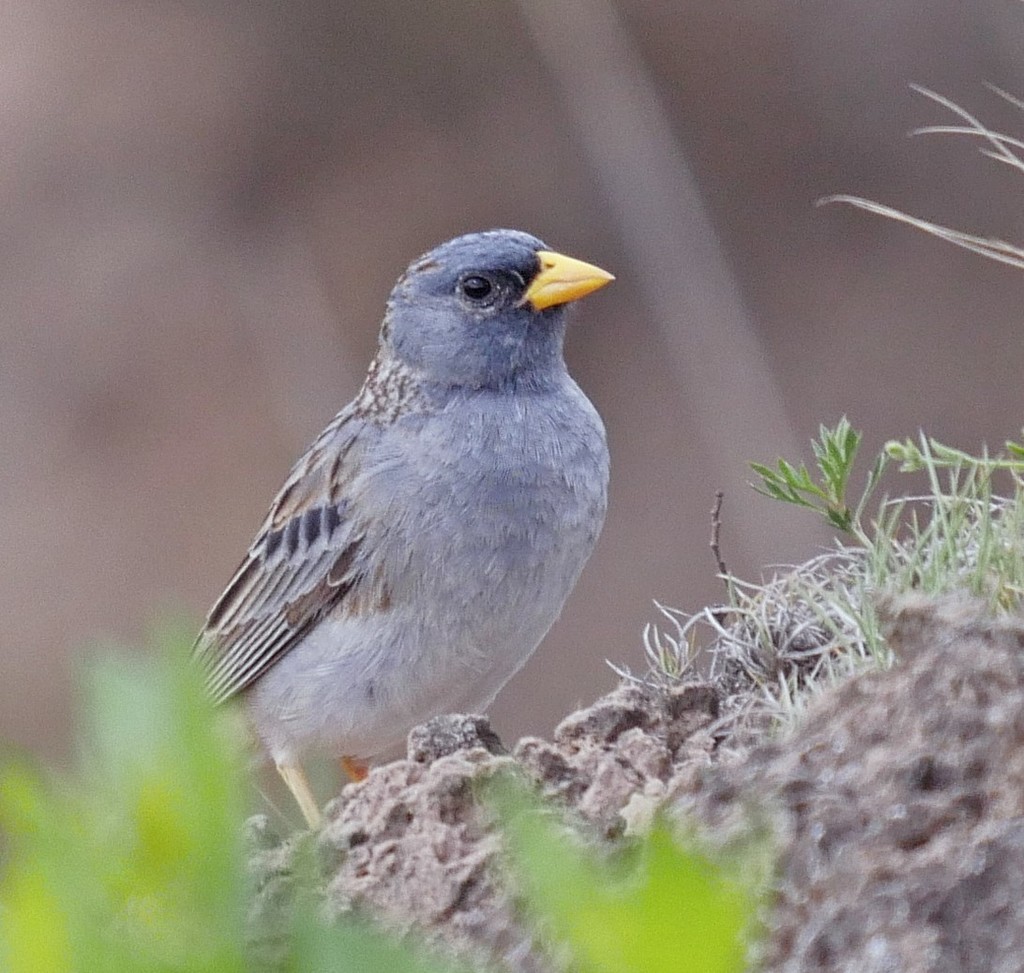
The band-tailed sierra finch is 13.5 to 14.5 cm (5.3 to 5.7 in) long and weighs 17 to 30 g (0.60 to 1.1 oz). It is a slim bird with a long tail and a long pointed bill. The species is sexually dimorphic. Adult males of the nominate subspecies R. a. alaudina have a gray head and breast with slightly darker lores and thin darker streaks on the crown. Their upperparts are mostly lead-gray with wide blackish streaks and their rump is plain gray. Their wings are mostly blackish with a gray shoulder and gray feather edges. Their tail is partly blackish with a wide white band in the middle of all feathers except the central pair. Their breast is gray, their flanks whitish with a buffy gray tinge, and their belly and vent whitish. They have a dark brown iris, a bright orange-yellow bill, and bright orange-yellow legs and feet. Adult females have a mostly brown head heavy with darker streaks on the face and crown. Their upperparts are also brown with darker streaks. Their throat and breast are whitish buff with darker streaks on the lower throat and breast. Their flanks are buff with darker streaks and their belly and vent are off-white. Their wings are mostly brownish with cinnamon-edged tertials and buffy edges on the other flight feathers. Their tail is like the male's but with smaller white areas. …
Range & habitat
The band-tailed sierra finch has a highly disjunct distribution, with most subspecies' ranges not adjoining another and with gaps within the ranges of some subspecies. The map does not fully match the available range descriptions. The subspecies are found thus:
R. a. bipartita: highlands of Ecuador from southern Carchi Province south to northern Loja Province and perhaps beyond; Peru in Andes from northern Cajamarca Department to northern Lima Department and then highlands to coast from there south just into far northern Chile's Arica y Parinacota Region R. a. humboldti: in southwestern Ecuador's western Guayas Province and southwestern El Oro Province and into far northwestern Peru's Tumbes and northern Piura departments R. a. bracki: Peru in upper valley of the Huallaga River, mostly in Huánuco Department R. a. excelsa: highlands from southern Peru's Arequipa and Puno departments into western Bolivia R. a. alaudina: central Chile from southern Antofagasta Region to Los Ríos Region R. a. venturii: northwestern Argentina from Jujuy Province south to Mendoza Province; Córdoba and San Luis provinces The band-tailed sierra finch inhabits somewhat different landscapes among its subspecies, though all are mostly open. In the highlands of Ecuador and Peru it mostly inhabits relatively dry montane scrublands; the habitat in the Huallaga Valley is similar. …
Wikipedia: “Distribution and habitat”
What it does
The band-tailed sierra finch feeds on mostly on seeds and smaller amounts of invertebrates. It forages on the ground and mostly singly or in pairs. It sometimes flocks with sparrows and other finch-like tanagers.
Wikipedia: “Feeding”
Listen
Looking for field recordings…
Where it lives
Recorded sightings
—
geo-referenced records in GBIF, from museums, herbaria and field observers.
Drag the globe to turn it. Dots are where records exist, not a range map; darker means more records.
In the stacks
Searching the stacks…
Every page naming Rhopospina alaudina in the Biodiversity Heritage Library →
This page is assembled live from iNaturalist, GBIF, Wikipedia, the Source Library and the Internet Archive. It is not yet part of the hand-edited codex. iNaturalist taxon 1289358.