- Plants
- ›Vascular Plants
- ›flowering plants
- ›Dicots
- ›pepper plants, birthworts, and allies
- ›birthwort family
- ›Asaroideae
- ›Asarum
- ›Asarum
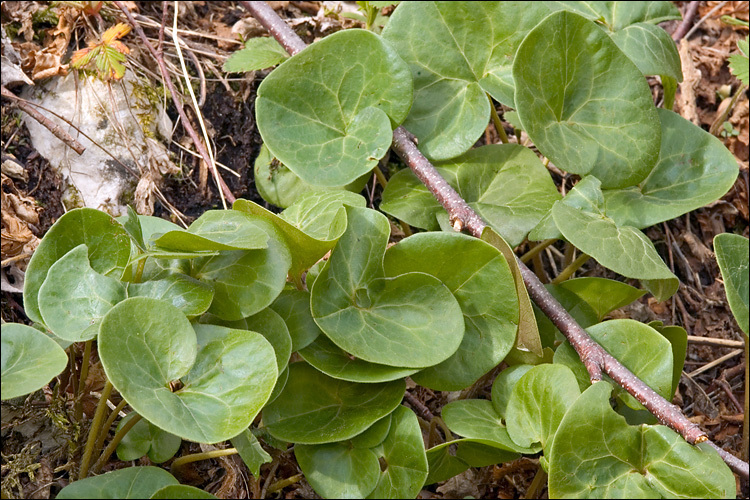
Asarabacca
Asarum europaeum
Asarum europaeum, known as asarabacca, European wild ginger, hazelwort, and wild spikenard, historically cabarick, is a species of flowering plant in the birthwort family Aristolochiaceae, native to parts of temperate Europe, and also cultivated in gardens. It is a creeping evergreen perennial with glossy green, kidney shaped leaves and solitary dull purple flowers hidden by the leaves. Though its roots have a ginger aroma, it is not closely related to the true culinary ginger Zingiber officinale. European wild ginger is sometimes harvested for use as a spice or a flavoring. In former days, it was used in snuff and also medicinally as an emetic and cathartic.
The FDA warns against consuming Asarum, as it is nephrotoxic and contains the potent carcinogen aristolochic acid.
From the article Asarum europaeum on Wikipedia (CC BY-SA), quoted section by section
Description
The prostrate stems are 10–15 centimetres (3.9–5.9 in) long, each bearing two reniform leaves with long petioles. The leaves are about 10 cm wide. The upper surface of the leaves is shiny, and they have a pepper-like taste and smell. There are also 2 to 3 stipules present that occur in two rows opposite each other on the stem. The flowers are solitary, terminal and nodding. The flower tube is composed of fused tepals that ends with 3 petal-like projections that are brownish towards their ends and dark purple toward the centre. There are 12 stamens present. The flowers emerge in the late winter and spring.
Range & habitat
Asarum europaeum has a wide distribution in Europe. It ranges from southern Finland and northern Russia south to southern France, Italy, the former Yugoslavia, and Bulgaria. It is absent from the British Isles and Scandinavia, and also from northwestern Germany and the Netherlands. Within Europe, the plant is grown outside of its range in the United Kingdom, Denmark, Sweden, Norway and the Netherlands. It occurs mostly in deciduous woodland or coniferous forests, especially in calcareous (chalky) soils.
Wikipedia: “Distribution and habitat”
What it does
Yaroshenko, Nataliia; Skliar, Viktoriia (6 December 2022). "Onthogenetic and Vitality Structure of Asarum Europaeum in Terms of Forest Management in Goettingen Forest, Low Saxony, Germany". 22nd SGEM International Multidisciplinary Scientific GeoConference Proceedings 2022, Water Resources. Forest, Marine and Ocean Ecosystems, VOL 22, ISSUE 3.2. Vol. 22. pp. 397–404. doi:10.5593/sgem2022V/3.2/s14.46. ISBN 978-619-7603-54-5. {{cite book}}: |journal= ignored (help) Kovalenko, I. M.; Klymenko, H. O.; Hozhenko, K. H. (30 July 2017). "Population analysis of Asarum europaeum in the Northeast of Ukraine". Biosystems Diversity. 25 (3): 210–215. Bibcode:2017BiDiv..25..210K. doi:10.15421/011732.
Wikipedia: “Ecology”
In medicine
Liu, Hanze; Wang, Changhong (10 January 2022). "The genus Asarum: A review on phytochemistry, ethnopharmacology, toxicology and pharmacokinetics". Journal of Ethnopharmacology. 282 114642. doi:10.1016/j.jep.2021.114642. PMID 34537281. Reddy, K. S.; Reddy, V. B.; Yao, Z. P. (2020). "Asarone: A review of its phytochemistry, pharmacology, and toxicology". Journal of Ethnopharmacology. 258 112836. doi:10.1016/j.jep.2020.112836. PMID 32344160. Saeedi, Mina; Vahedi-Mazdabadi, Yasaman; Rastegari, Arezoo; Soleimani, Mahdieh; Eftekhari, Mahdieh; Akbarzadeh, Tahmineh; Khanavi, Mahnaz (2 June 2020). "Evaluation of Asarum europaeum L. Rhizome for the Biological Activities Related to Alzheimer's Disease" (PDF). Research Journal of Pharmacognosy. 7 (3): 25–33. doi:10.22127/rjp.2020.223143.1565.
Wikipedia: “Pharmacology”
Toxicity
Han, Jiayin; Xian, Zhong; Zhang, Yushi; Liu, Jing; Liang, Aihua (11 June 2019). "Systematic Overview of Aristolochic Acids: Nephrotoxicity, Carcinogenicity, and Underlying Mechanisms". Frontiers in Pharmacology. 10 648. doi:10.3389/fphar.2019.00648. PMC 6580798. PMID 31244661. Cartus, Alexander T.; Stegmüller, Simone; Simson, Nadine; Wahl, Andrea; Neef, Sylvia; Kelm, Harald; Schrenk, Dieter (14 August 2015). "Hepatic Metabolism of Carcinogenic β-Asarone". Chemical Research in Toxicology. 28 (9): 1760–1773. doi:10.1021/acs.chemrestox.5b00223. PMID 26273788. Jaspersen-Schib, R.; Theus, L.; Guirguis-Oeschger, M.; Meier, Peter J. (July 1996). "Serious plant poisonings in Switzerland 1966-1994. Case analysis from the Swiss Toxicology Information Center". Schweizerische Medizinische Wochenschrift. 126 (29): 1277–1284. Hasheminejad, G.; Caldwell, John (April 1994). "Genotoxicity of the alkenylbenzenes alpha- and beta-asarone, myristicin and elimicin as determined by the UDS assay in cultured rat hepatocytes". Food and Chemical Toxicology. 32 (4): 321–330. doi:10.1016/0278-6915(94)90003-8 (inactive 1 July 2025).{{cite journal}}: CS1 maint: DOI inactive as of July 2025 (link) Brändle, W.; Gurtner, B.; Wegmann, T. (August 1969). "Hemiparesis in an abortion attempt with hazelwort tea decoction (Asarum europaeum)". Schweizerische Medizinische Wochenschrift. 99 (32): 1161–1163.
Wikipedia: “Toxicology”
How it is grown
A. europaeum is quite shade-tolerant and is often employed as groundcover where little else will grow. This plant has gained the Royal Horticultural Society's Award of Garden Merit.
Wikipedia: “Cultivation”
Where it lives
Recorded sightings
—
geo-referenced records in GBIF, from museums, herbaria and field observers.
Drag the globe to turn it. Dots are where records exist, not a range map; darker means more records.
In the old herbals & bestiaries

On the Virtues of Herbs
Macer Floridus (Odo of Meung) · 1090 · p.88

Herbarius latinus (with Dutch synonyms)
1486 · p.39

Garden of Health (Hortus Sanitatis)
Jacob Meydenbach · 1491 · p.43

The Book of Health: The Art of Distillation
Brunschwig, Hieronymus · 1505 · p.154

Notable Commentaries on the History of Plants
Leonhart Fuchs · 1542 · p.44

Book of Herbs
Hieronymus Bock (Tragus) · 1546 · p.85

Notable Commentaries on the History of Plants
Leonhart Fuchs · 1549 · p.42

On the Names of Plants
Hieronymus Bock (Tragus) · 1552 · p.136

The Dutch Herbarium or Herbal
Petrus Nylandt · 1670 · p.206

Herbarium Portatile, Oder Behendes Kräuter- und Gewächs-Buch: Darinn nicht allein 1363. so wol Einheimische als Außländndische Kräuter mit Lateinisch und Deutscher Benennung abgebildet, sondern auch die meisten, so in der Medicin gebräuchlich, kürtzlich erkläret werden
Panckow, Thomas · 1656 · p.300
In the stacks
Searching the stacks…
Every page naming Asarum europaeum in the Biodiversity Heritage Library →
This page is assembled live from iNaturalist, GBIF, Wikipedia, the Source Library and the Internet Archive. It is not yet part of the hand-edited codex. iNaturalist taxon 128901.