On eBird ↗
Slaty-backed Nightingale-Thrush
Live sightings near you, the range map, bar charts of when it is seen, and Macaulay Library photos and recordings.
Slaty-backed Nightingale-Thrush
Catharus fuscater
The slaty-backed nightingale-thrush (Catharus fuscater) is a species of bird in the family Turdidae, the thrushes and allies. It is found in Bolivia, Colombia, Costa Rica, Ecuador, Panama, Peru, and Venezuela.
From the article Slaty-backed nightingale-thrush on Wikipedia (CC BY-SA), quoted section by section
Description
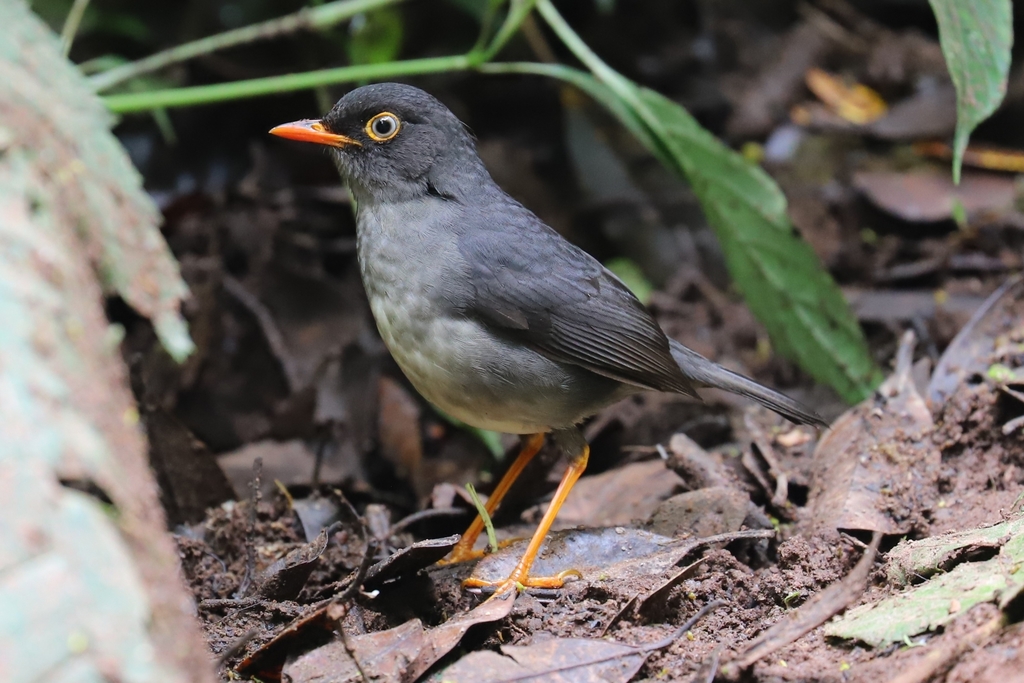
The slaty-backed nightingale-thrush is 17 to 18 cm (6.7 to 7.1 in) long. Specimens from Ecuador and Colombia weighed 30.5 to 38 g (1.1 to 1.3 oz). The sexes have the same plumage. Adults of the nominate subspecies C. f. fuscater have a dark slate gray head with a bright orange to yellowish orange eye-ring and a white to gray throat. Their upperparts are dark slate gray. Their underparts are mostly dark slate gray; the center of the breast and belly have varying amounts of white mixed in and sometimes a yellowish tint to the white. The other subspecies of the slaty-backed nightingale-thrush differ from the nominate and each other thus:
C. f. hellmayri: more blackish upperparts than nominate, mouse gray throat, darker underparts C. f. mirabilis: essentially like the nominate C. f. sanctaemartae: upperparts like nominate but less white on underparts C. f. opertaneus: the limited number of specimens are browner than nominate C. f. caniceps: somewhat lighter upperparts than nominate and less white on underparts C. f. mentalis: brownish wash on upperparts and darker underparts than nominate All subspecies usually have a white iris though it is sometimes cinnamon brown. They have bright orange bills.
Range & habitat
The slaty-backed nightingale-thrush has a disjunct distribution. Sources differ widely on the subspecies' ranges, in part due to the additional subspecies listed by Clements. The IOC places the subspecies thus:
C. f. hellmayri: Costa Rica and western Panama C. f. mirabilis: eastern Panama C. f. sanctaemartae: northern Colombia C. f. fuscater: eastern Panama, Colombia to western Ecuador, and western Venezuela C. f. opertaneus: western Colombia C. f. caniceps: northwestern and central Peru C. f. mentalis: southeastern Peru and northwestern Bolivia Clements provides more detail and several differences. The four additional subspecies are also included here:
C. f. hellmayri: mountains of Costa Rica and western Panama's Chiriquí and Veruagas provinces C. f. mirabilis: eastern Panama's Cerro Pirre and vicinity C. f. arcanus: "Serranía de Majé eastward to Cerro Tacarcuna (eastern Panama)" C. f. sanctaemartae: Sierra Nevada de Santa Marta in northern Colombia C. f. fuscater: Serranía del Perijá on the Colombia-Venezuela border and eastern Andes of Venezuela southward to Bogotá in Colombia C. f. opertaneus: "western Andes of Colombia (Antioquia southward to Tolima), and east-central Andes in Napo, Ecuador" C. f. tenebris: "Rio Chinchipe watershed of southeastern Ecuador and northern Peru" C. f. berlepschi "western Andes of Ecuador from Carchi to El Oro" C. f. …
Wikipedia: “Distribution and habitat”
What it does
The slaty-backed nightingale-thrush is described as omnivorous. It has been noted feeding on beetles, ants, other small insects, spiders, and berries. It forages in understory vegetation and on the ground. In Costa Rica it has been seen following army ant swarms.
Wikipedia: “Feeding”
Listen
Looking for field recordings…
Where it lives
Recorded sightings
—
geo-referenced records in GBIF, from museums, herbaria and field observers.
Drag the globe to turn it. Dots are where records exist, not a range map; darker means more records.
In the stacks
Searching the stacks…
Every page naming Catharus fuscater in the Biodiversity Heritage Library →
This page is assembled live from iNaturalist, GBIF, Wikipedia, the Source Library and the Internet Archive. It is not yet part of the hand-edited codex. iNaturalist taxon 12886.