- Animals
- ›Chordates
- ›Vertebrates
- ›Birds
- ›Perching Birds
- ›Old World Flycatchers, Robins, and Chats
- ›Oenanthe
On eBird ↗
Desert Wheatear
Live sightings near you, the range map, bar charts of when it is seen, and Macaulay Library photos and recordings.
Desert Wheatear
Oenanthe deserti
The desert wheatear (Oenanthe deserti) is a wheatear, a small passerine bird that was formerly classed as a member of the thrush family Turdidae, but is now more generally considered to be an Old World flycatcher (Muscicapidae). It is a migratory insectivorous species, 14.5 to 15 cm (5.7 to 5.9 in) in length. Both western and eastern forms of the desert wheatear are rare vagrants to western Europe. The western desert wheatear breeds in the Sahara and the northern Arabian Peninsula. The eastern race is found in the semi-deserts of Central Asia and in winter in Pakistan and northeast Africa.
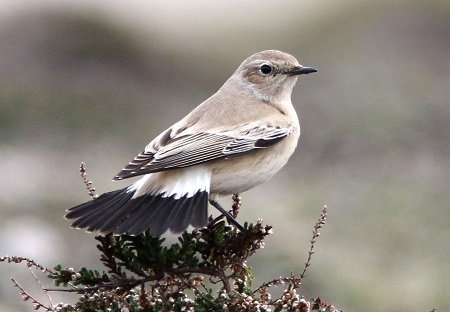
The plumage of the upper parts of the male in summer is buff. The underparts are white with a buff tinge on the breast. The black on the face and throat extends to the shoulders, and there is distinct white superciliary stripe. The female is greyer above and buffer below and has no black on the throat, and in the winter plumage the black on the throat of the male is partially obscured by the white tips of the feathers. A distinguishing characteristic, in both sexes of all ages, is that the entire tail is black to the level of the upper tail-coverts.
From the article Desert wheatear on Wikipedia (CC BY-SA), quoted section by section
Description
The head and nape of the adult male desert wheatear are a pale sandy-grey colour with the feathers tipped grey. The mantle, scapulars and back are a similar but rather richer colour. The rump and upper tail-coverts are pale buff. The basal third of the tail feathers are white and the rest black with a pale buff tip. A curved stripe over the eye is pale buff and extends backwards. The feathers of the chin, throat, lores and ear-coverts are black tipped with white. The breast and flanks are sandy-buff and the belly and under tail-coverts are creamy-white tinged with buff. The axillaries and under wing-coverts are black tipped with white. The primaries have black outer webs, tipped and edged with white and inner webs pale brown edged with white. The secondaries are similar but have broader white edges to both webs. Its length is about 15 centimetres (5.9 in) and it weighs between 15 and 34 grams (0.53 and 1.20 oz).
The female has similar plumage but the rump and upper tail-coverts are more sandy brown, the lores, chin and throat pale buff and the dark parts of the tail brownish-black. The juvenile is similar to the adult female but the feathers on the upper parts of the body have pale centres and brown tips which gives the bird a more speckled appearance. …
Range & habitat
The eastern race of the desert wheatear breeds in a great swathe of Asia extending from the Middle East and Saudi Arabia through Iran, Baluchistan, Afghanistan, the south Caucasus, Turkestan, the Tarbagatai Mountains, the Altai Mountains and north western Mongolia. Birds from this region migrate southwards to overwinter in northeastern Africa, the Arabian peninsula, Iraq and Pakistan. The western race breeds in North Africa from Morocco and Rio de Oro to the part of Egypt west of the River Nile. This population is largely resident but in Morocco, birds in the south and east part migrate while those in the south west tend not to. The habitat of the desert wheatear is barren open countryside, steppes, deserts, semi-arid plains, saltpans, dried up river beds and sandy, stony and rocky wasteland. It is found at altitudes of up to 3,500 metres (11,500 ft). During the winter it may also visit cultivated land when this is interspersed with bare areas of countryside. The desert wheatear is an occasional vagrant to the United Kingdom, and a female got blown off course in October 2012 during its autumn migration and was seen in a sandpit in Essex. Only a few weeks later, another was seen in the RSPB Loch of Strathbeg reserve in Scotland.
Wikipedia: “Distribution and habitat”
What it does
The desert wheatear tends to perch on a bush, tussock or grass or other eminence and dart to the ground beneath to pounce on insects and other small invertebrates, though it can also catch insects in the air. The diet usually consists of ants, beetles, caterpillars and flies and the larvae of various insects including ant-lions. In addition to these, seeds have also been found in its stomach. It is able to hover for short periods and when it finds a large prey insect, with which it is unable to cope, it sometimes displays in front of it by fluttering its wings. The desert wheatear breeds during late April or May over most of its range. It nests on rocky hillsides, on steppes, on sandy plains, in crevices in walls or in hollows under rocks. The nest is often concealed behind gorse (Ulex europaeus) bushes or other bushy vegetation and is a tidily-built cup made of grasses, mosses and stems, lined with fine roots and hairs, and sometimes small feathers. A clutch of four (occasionally five) eggs are laid. These are pale bluish with fine rusty speckles, usually forming a distinct zone at the wider end. They measure approximately 20.1 by 15 millimetres (0.79 in × 0.59 in). Incubation is done mainly by the female and both sexes help care for the young.
Wikipedia: “Behaviour”
In human culture
The genus name Oenanthe is derived from the Ancient Greek oenos (οίνος) "wine" and anthos (ανθός) "flower". It refers to the northern wheatear's return to Greece in the spring just as the grapevines blossom. The specific deserti is Latin for "desert". "Wheatear" is not derived from "wheat" or any sense of "ear", but is a 16th-century linguistic corruption of "white" and "arse", referring to the prominent white rump found in many species. Four subspecies are recognised; Oenanthe deserti deserti is found in the Levant; Oenanthe deserti atrogularis is found in Transcaucasia, Iran, Afghanistan and Mongolia; Oenanthe deserti homochroa is found from Western Sahara to the west part of Egypt; Oenanthe deserti oreophila is found in West China, Kashmir, Tibet, and Pakistan and north eastern Africa.
Wikipedia: “Taxonomy and etymology”
Listen
Looking for field recordings…
Where it lives
Recorded sightings
—
geo-referenced records in GBIF, from museums, herbaria and field observers.
Drag the globe to turn it. Dots are where records exist, not a range map; darker means more records.
In the stacks
Searching the stacks…
Every page naming Oenanthe deserti in the Biodiversity Heritage Library →
This page is assembled live from iNaturalist, GBIF, Wikipedia, the Source Library and the Internet Archive. It is not yet part of the hand-edited codex. iNaturalist taxon 12842.