- Plants
- ›Vascular Plants
- ›flowering plants
- ›Dicots
- ›Mints, Plantains, Olives, and Allies
- ›broomrape family
- ›Pedicularideae
- ›Castilleja
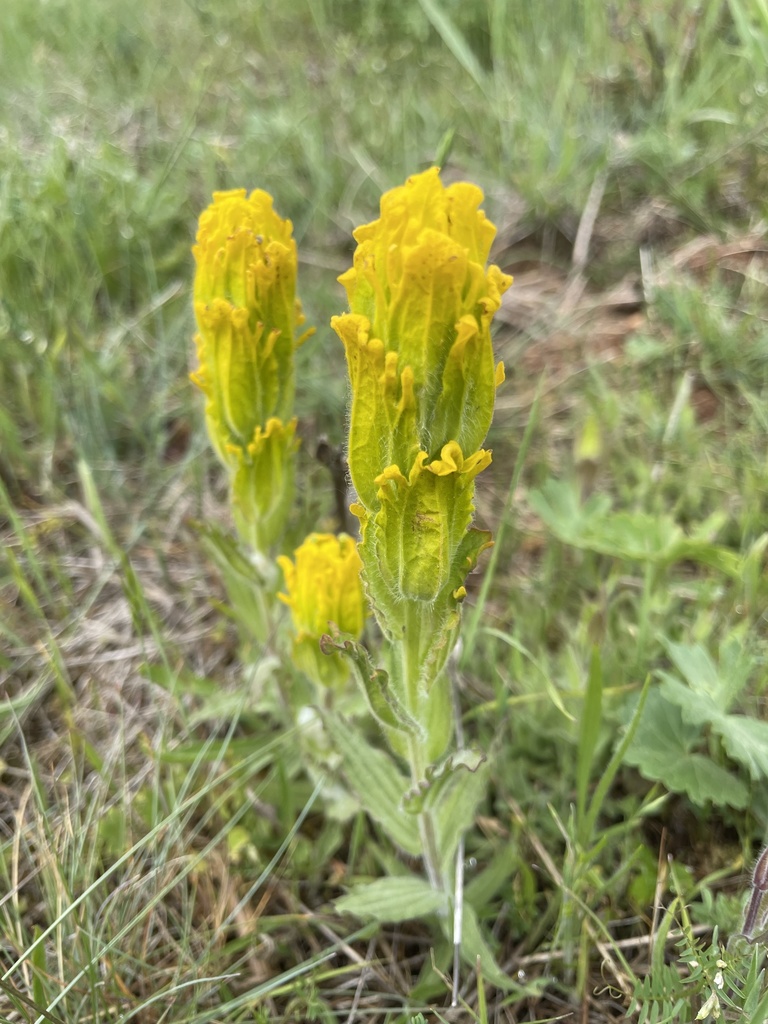
Golden Paintbrush
Castilleja levisecta
Castilleja levisecta is a rare species of flowering plant in the family Orobanchaceae known by the common name golden paintbrush, or golden Indian paintbrush, listed under the Endangered Species Act in 1997. It is native to British Columbia and Washington, where it is known from eleven remaining populations. It occurred in Oregon but all natural occurrences there have been extirpated. It has been reintroduced to a few areas in Oregon, but it remains to be seen if the plants will survive. The plant is a federally listed endangered species of Canada and was listed as threatened in the United States in 1997. On June 30, 2021, the plant was proposed for delisting due to recovery. Effective August 18, 2023, the U.S. Fish and Wildlife Service issued a rule removing golden paintbrush from the Federal List of Endangered and Threatened Plants.
From the article Castilleja levisecta on Wikipedia (CC BY-SA), quoted section by section
Description
Castilleja levisecta (golden paintbrush) was first collected as a modern botanical specimen near Mill Plain, Washington, by Thomas Jefferson Howell in 1880 and was described by Jesse More Greenman in 1898 (Greenman 1898). This is a perennial herb growing in clumps of up to fifteen stems. The leaves are green, containing chlorophyll to undergo photosynthesis, but like other Castilleja it is a hemiparasite, capable of tapping the roots of other plants via haustorial connections to obtain nutrients and water.
The inflorescence contains bright golden yellow bracts with small green flowers tucked between them. It is the only Castilleja with yellow bracts within its range in the Pacific Northwest. The plant is thought to be pollinated by bumblebees, including Bombus californicus. The species is nearly self-incompatible, and a plant produces many more seeds when crossed with a less closely related individual, such as a plant from a separate population. It is known to hybridize and produce viable seed with Castilleja hispida (harsh paintbrush) in laboratory and experimental grassland settings. Golden paintbrush grows in prairie habitat at low elevations, generally in soils of gravelly, glacier-carved sediment. It often occurs alongside Idaho fescue (Festuca idahoensis) and red fescue (F. rubra), and it is a member of the Garry Oak ecosystem. …
What it does
Golden paintbrush plays an important role in grassland community dynamics and multitrophic interactions. For example, its hemiparasitic reliance on other plant species in its habitat is thought to affect competition and dominance among other plant species in its community. Additionally, its foliage naturally contains defensive compounds called iridoid glycosides that are sequestered in the tissues of the endangered Taylor's checkerspot butterfly larvae, which have developed a tolerance for these compounds and are able to consume golden paintbrush foliage. These sequestered iridoid glycosides then confer chemical protection against bird predators to the butterfly larvae. The grassland habitats in which golden paintbrush grows have traditionally undergone periodic wildfires, and the golden paintbrush appears to thrive in this fire regime, possibly because fires clear out taller vegetation that would otherwise compete with it, or provide it nutrients in the ash. Fire frequency may also have effects on golden paintbrush's defensive phytochemistry. If the paintbrush is fire-adapted, it would experience negative effects from fire suppression efforts. …
Wikipedia: “Ecology and conservation”
Where it lives
Recorded sightings
—
geo-referenced records in GBIF, from museums, herbaria and field observers.
Drag the globe to turn it. Dots are where records exist, not a range map; darker means more records.
In the stacks
Searching the stacks…
Every page naming Castilleja levisecta in the Biodiversity Heritage Library →
This page is assembled live from iNaturalist, GBIF, Wikipedia, the Source Library and the Internet Archive. It is not yet part of the hand-edited codex. iNaturalist taxon 128077.