- Animals
- ›Arthropods
- ›Hexapods
- ›Insects
- ›Winged and Once-winged Insects
- ›Ants, Bees, Wasps, and Sawflies
- ›Narrow-waisted Wasps, Ants, and Bees
- ›Ants, Bees, and Stinging Wasps
- ›Vespoid Wasps
- ›Hornets, Paper Wasps, Potter Wasps, and Allies
- ›Hornets and Yellowjackets
- ›Dolichovespula
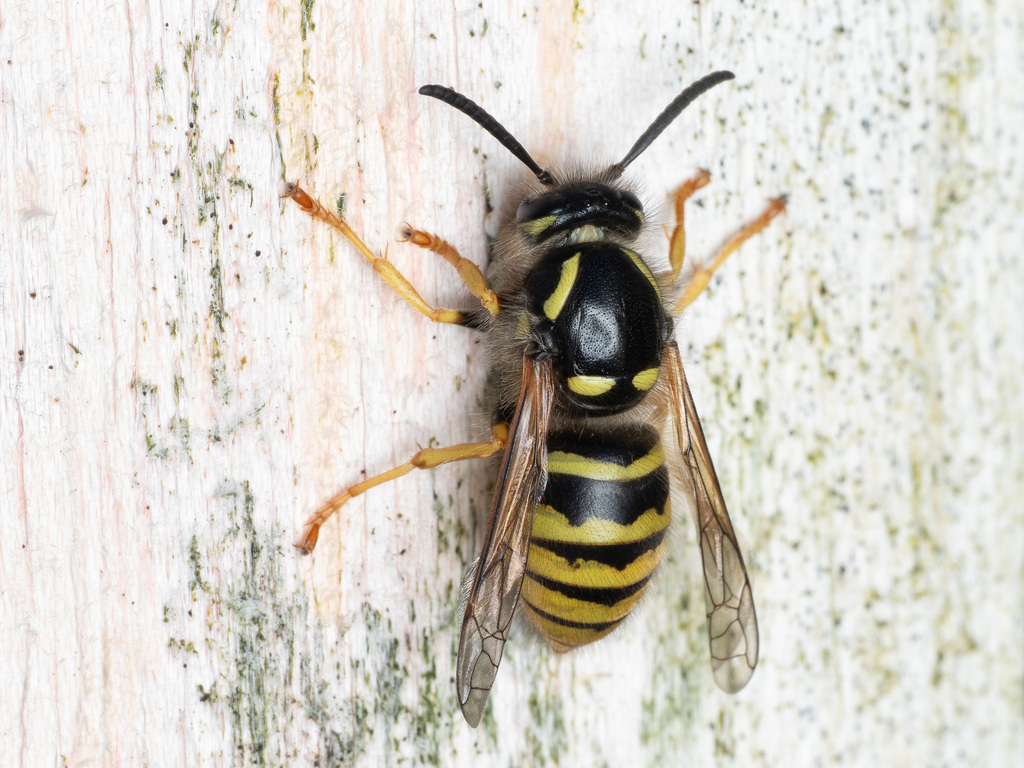
Tree Wasp
Dolichovespula sylvestris
The tree wasp (Dolichovespula sylvestris) is a species of eusocial wasp in the family Vespidae, found in the temperate regions of Eurasia, particularly in western Europe. Despite being called the tree wasp, it builds both aerial and underground paper nests, and can be found in rural and urban habitats. D. sylvestris is a medium-sized wasp that has yellow and black stripes and a black dot in the center of its clypeus. It is most common to see this wasp between May and September during its 3.5 month colony cycle.
Tree wasps carry out worker policing and have a haplodiploid sex-determination system; this results in a high level of relatedness within the colony. The workers will take over all of the foraging from the queen once the first workers reach adulthood. Worker wasps typically forage for other insects, the nectar of plants, and wood to digest for nest construction. The tree wasp is sometimes a victim of the nest parasite Dolichovespula omissa, who lays its eggs in the nest of D. sylvestris, as well as individual parasites including roundworms.
From the article Dolichovespula sylvestris on Wikipedia (CC BY-SA), quoted section by section
Description
Dolichovespula sylvestris can reach a length of 11–15 millimetres (0.43–0.59 in) in workers, of 15–19 millimetres (0.59–0.75 in) in queens and of 13–17 millimetres (0.51–0.67 in) in males. This medium-sized species has the typical drawing of black and yellow stripes of many social wasps. The head and the thorax are predominantly black with yellow drawings. The abdomen is black with transverse yellow bands. The wings are slightly brownish. The distance between mandible and lower edge of the compound eye (oculo-malar space) is the same or longer than width of antennal scape. The large eyes are C-shaped, as they have a strong cut in the edge. At the top of the head there are three small ocelli. This species can be identified by its solid yellow face with a single small, central, black dot on the clypeus, a thorax with long lateral hairs, and two posterior yellow spots. This species is less aggressive in comparison to many wasps, but will sting both animals and humans to protect its nest. Nests are made of paper that comes from the digestion of wood, generally dead bark, and measure 10–15 centimetres (3.9–5.9 in) in diameter with an average of 4 combs.
Wikipedia: “Description and identification”
Range & habitat
D. sylvestris can be found throughout Western Europe and across central Asia to China, and it has also been sighted in northern Africa. It is not known to live outside of this region of the world. This species of wasp prefers temperate climates. In these regions it can be found in most habitats, including trees and shrubs, hanging from houses, and in the ground. It is often found in both urban and rural areas. Despite being called the tree wasp, D. sylvestris builds both aerial nests in trees and hedges, as well as underground nests. These underground nests are typically built near the ground surface in preexisting holes. All nests appear to need an overhanging structure to suspend from, such as a rock, grass stem, or roof of a house, but the location and type of these structures can vary significantly.
Wikipedia: “Distribution and habitat”
What it does
In the colony, the queen is responsible for all of the foraging for the nest until workers mature. This includes foraging for wood to make into pulp for the nest as well as food for the larvae. Most workers begin to help with foraging the day after they emerge from the nest as adults. Almost immediately, they take over all foraging activity for the queen. The behaviour of the workers who forage differs depending on their activity. Those trying to catch flies move quickly from one flower head to the next and pounce on prey when it is found. In comparison, wasps that forage for nectar move slower and spend more time at each flower. Other workers collect pulp from dead wood to use for nest construction. It appears that if the wasp is unable to quickly catch a fly it goes on to collect nectar suggesting one worker does not always collect the same type of material. Different amounts of time are given to each activity with the most time spent gathering fluid, then pulp, and then flies. Foraging takes place from roughly sunrise to sunset of each day in order to keep up with the resources needed for the colony.
Wikipedia: “Foraging behaviour”
Listen
Looking for field recordings…
Where it lives
Recorded sightings
—
geo-referenced records in GBIF, from museums, herbaria and field observers.
Drag the globe to turn it. Dots are where records exist, not a range map; darker means more records.
In the stacks
Searching the stacks…
Every page naming Dolichovespula sylvestris in the Biodiversity Heritage Library →
This page is assembled live from iNaturalist, GBIF, Wikipedia, the Source Library and the Internet Archive. It is not yet part of the hand-edited codex. iNaturalist taxon 127743.