On eBird ↗
La Selle Thrush
Live sightings near you, the range map, bar charts of when it is seen, and Macaulay Library photos and recordings.
La Selle Thrush
Turdus swalesi
The La Selle thrush (Turdus swalesi) is a species of bird in the family Turdidae. A skulker of broadleaf and pine forests around 1300m, it is limited to a small and declining population in inland Dominican Republic. Despite a usually shy behavior, it often boldly approaches roads and other human artifacts. It only usually sings at dusk and dawn, also when it is most active.
From the article La Selle thrush on Wikipedia (CC BY-SA), quoted section by section
Description
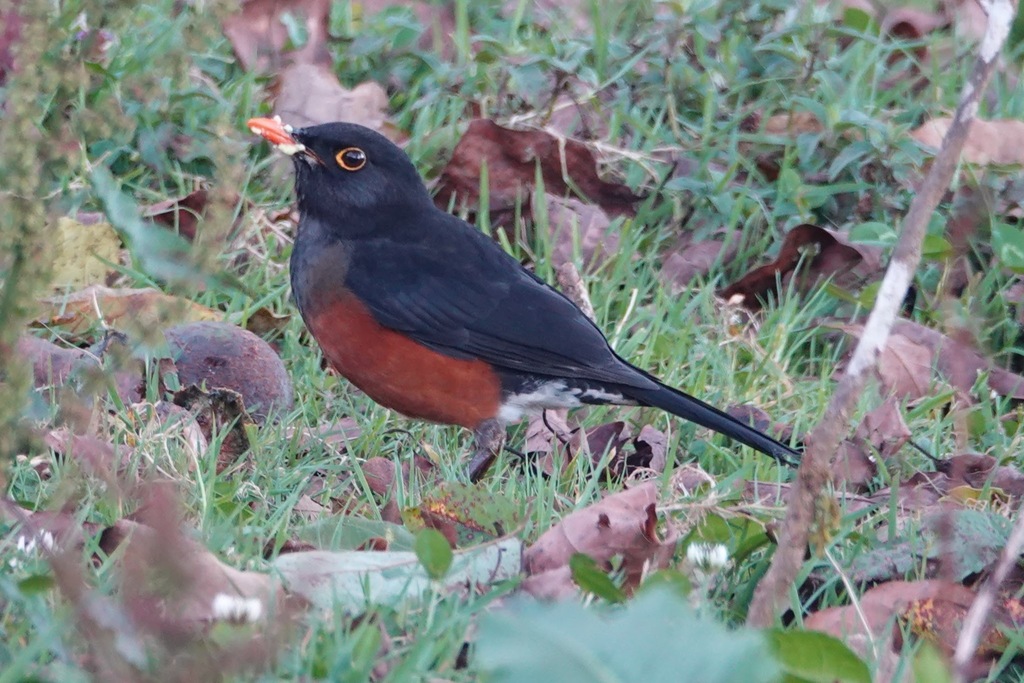
The La Selle thrush is 26 to 27 cm (10 to 11 in) long and weighs 88 to 110 g (3.1 to 3.9 oz). The sexes have the same plumage. Adults of the nominate subspecies have a mostly slate-black head with a bright yellow to orange eye-ring and a few white streaks on the ear coverts and throat. Their upperparts, wings, tail, and upper breast are slate-black. Their upper flanks are rusty red, their lower breast and sides rich rufous, and their belly and undertail coverts white. Adults of subspecies T. s. dodae have an olivaceous-brown back but are otherwise like the nominate. Both subspecies have a dark iris, a yellow to orange bill with a dark base, and dark gray to black legs and feet.
Range & habitat
The La Selle thrush has a disjunct distribution. The nominate subspecies is found in southeastern Haiti's Chaîne de la Selle and east into the Baoruco Mountain Range in southwestern Dominican Republic. Subspecies T. s. dodae is found only in the Dominican Republic. There it is in the Sierra de Neiba and Cordillera Central. The species inhabits the understory of wet montane broadleaf evergreen forest and, at higher elevations, pine forest. In elevation it mostly ranges between 1,300 and 2,100 m (4,300 and 6,900 ft).
Wikipedia: “Distribution and habitat”
What it does
The La Selle thrush feeds on fruit, insects, and other invertebrates like earthworms. It forages mostly on the ground and sometimes does so in cultivated gardens near the edge of forest.
Wikipedia: “Feeding”
Listen
Looking for field recordings…
Where it lives
Recorded sightings
—
geo-referenced records in GBIF, from museums, herbaria and field observers.
Drag the globe to turn it. Dots are where records exist, not a range map; darker means more records.
In the stacks
Searching the stacks…
Every page naming Turdus swalesi in the Biodiversity Heritage Library →
This page is assembled live from iNaturalist, GBIF, Wikipedia, the Source Library and the Internet Archive. It is not yet part of the hand-edited codex. iNaturalist taxon 12761.