On eBird ↗
Gray-sided Thrush
Live sightings near you, the range map, bar charts of when it is seen, and Macaulay Library photos and recordings.
Grey-sided Thrush
Turdus feae
The grey-sided thrush (Turdus feae) is a species of bird in the thrush family, Turdidae.
From the article Grey-sided thrush on Wikipedia (CC BY-SA), quoted section by section
Description
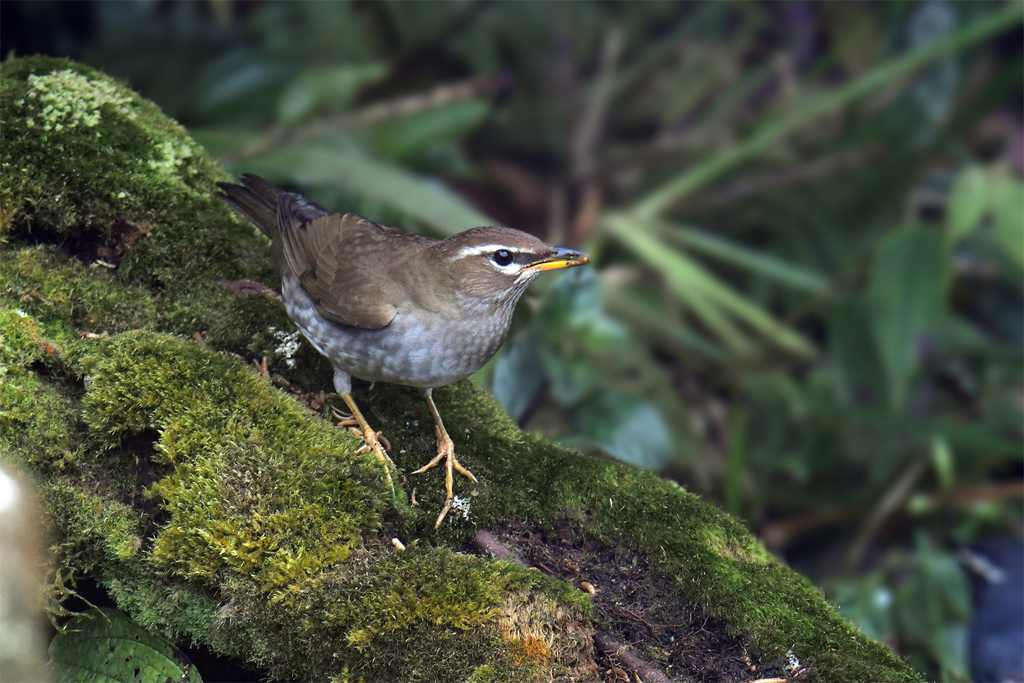
The grey-sided thrush is a medium-sized, warm-brown thrush with a white supercilium and crescent below the eye. The male has rufescent-olive upperparts, including the crown and ear-coverts, and grey underparts becoming paler on the belly and vent. The female has a white throat and whiter centre to the breast and belly, some dark spots or streaks on the sides of the throat and upper breast and warm brownish fringes to the breast feathers.
Range & habitat
The species is migratory, breeding in the mountains of north-east China and migrating to subtropical or tropical moist montane forest in India, and Indochina. Lately it has also been found in parts of Daman, Makwanpur; Nepal and as a vagrant in north-eastern Bangladesh.
Wikipedia: “Distribution and habitat”
What it does
The grey-sided thrush forages for insects and berries on the ground or less commonly in the trees, often in the company of the eyebrowed thrush (Turdus obscurus). It is also thought to feed on nectar from the flowers of the shingle tree (Acrocarpus fraxinifolius). It is threatened by habitat loss and habitat fragmentation.
== References ==
Wikipedia: “Behaviour and ecology”
Listen
Looking for field recordings…
Where it lives
Recorded sightings
—
geo-referenced records in GBIF, from museums, herbaria and field observers.
Drag the globe to turn it. Dots are where records exist, not a range map; darker means more records.
In the stacks
Searching the stacks…
Every page naming Turdus feae in the Biodiversity Heritage Library →
This page is assembled live from iNaturalist, GBIF, Wikipedia, the Source Library and the Internet Archive. It is not yet part of the hand-edited codex. iNaturalist taxon 12758.