On eBird ↗
Black Thrush
Live sightings near you, the range map, bar charts of when it is seen, and Macaulay Library photos and recordings.
Black Thrush
Turdus infuscatus
The black thrush (Turdus infuscatus) is a species of bird in the family Turdidae. It was formerly known as the black robin. It is found in El Salvador, Guatemala, Honduras, and Mexico. Its natural habitat is subtropical or tropical moist montane forest.
From the article Black thrush on Wikipedia (CC BY-SA), quoted section by section
Description
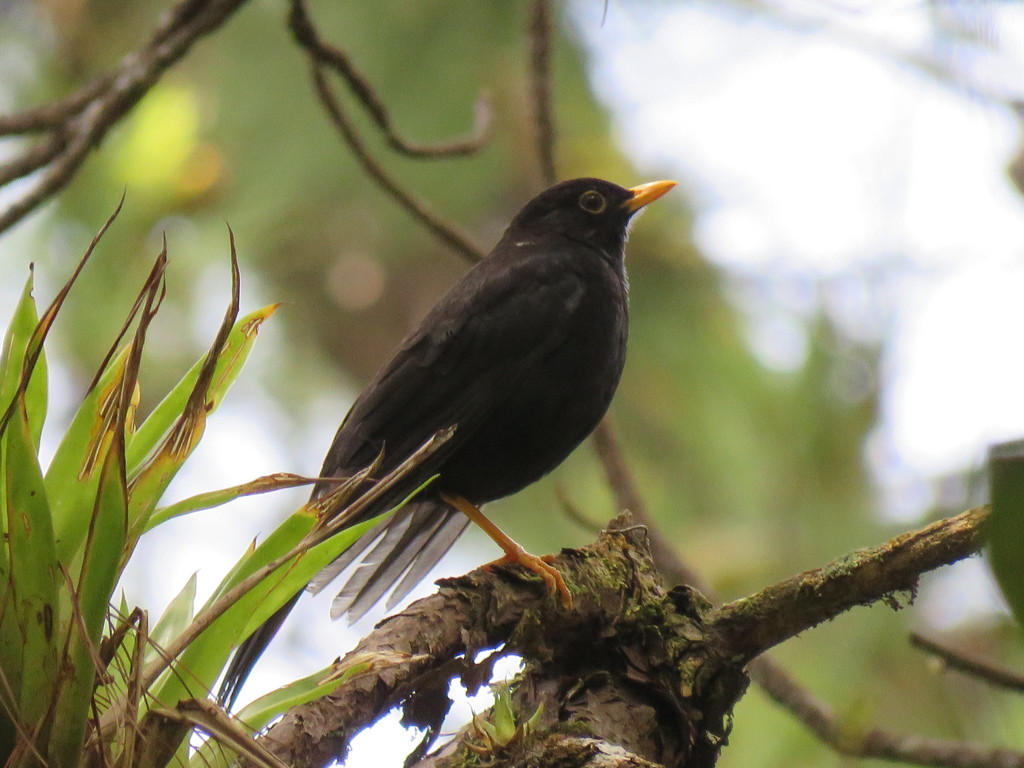
The black thrush is 22 to 23 cm (8.7 to 9.1 in) long and weighs about 60 to 90 g (2.1 to 3.2 oz). The species is sexually dimorphic. Adult males are almost entirely black with a slightly duller and more slaty belly and undertail coverts. They have a bright yellow ring of bare skin around the eye. Adult females have an olive brown head with dusky brown streaks on the cheeks and a dark brown eye ring. Their upperparts, tail, and upper surface of the wings are olive brown. Their chin and throat are whitish with dusky brown streaks on the latter. Their underparts are paler olive brown that is lightest on the belly and undertail coverts. Their underwing coverts are cinnamon. Juveniles have brown upperparts. Their underparts are brownish buff with black or dusky spots. All ages have a dark brown iris. Adult males have a bright yellow bill and adult females a blackish bill. Both sexes of adults have bright yellow legs and feet. Juveniles have a mostly dark bill dull yellow legs and feet.
Range & habitat
The black thrush has a disjunct distribution. It is found in eastern Mexico's Sierra Madre Oriental from Tamaulipas south to Veracruz and in western Mexico's Sierra Madre del Sur from central Guerrero to Chiapas. Vagrants have been recorded in Jalisco, Morelos, and Tabasco. Separate populations are in west-central Guatemala, El Salvador, and approximately the western half of Honduras. It has relatively recently been found in extreme northwestern Nicaragua, and "[i]t is unclear whether this represents a range extension or whether the species had simply been overlooked previously". The black thrush inhabits montane evergreen and pine-oak forest in the subtropical and temperate zones. It also occurs in semi-deciduous forest and cloudforest. Overall it ranges in elevation between 900 and 3,100 m (3,000 and 10,200 ft) but is most common between 1,600 and 2,600 m (5,200 and 8,500 ft). South of Mexico it ranges between 1,000 and 3,050 m (3,300 and 10,000 ft).
Wikipedia: “Distribution and habitat”
What it does
The black thrush feeds on insects and fruit. It is probably an important disperser of some plant seeds. It generally forages alone or with its mate but outside the breeding season may gather at fruiting trees in flocks of up to about 20 black thrushes and other frugivorous species. It feeds mostly in the forest's mid-to upper levels but at times at all levels from the ground to the forest canopy.
Wikipedia: “Feeding”
Listen
Looking for field recordings…
Where it lives
Recorded sightings
—
geo-referenced records in GBIF, from museums, herbaria and field observers.
Drag the globe to turn it. Dots are where records exist, not a range map; darker means more records.
In the stacks
Searching the stacks…
Every page naming Turdus infuscatus in the Biodiversity Heritage Library →
This page is assembled live from iNaturalist, GBIF, Wikipedia, the Source Library and the Internet Archive. It is not yet part of the hand-edited codex. iNaturalist taxon 12757.