On eBird ↗
Mistle Thrush
Live sightings near you, the range map, bar charts of when it is seen, and Macaulay Library photos and recordings.
Mistle Thrush
Turdus viscivorus
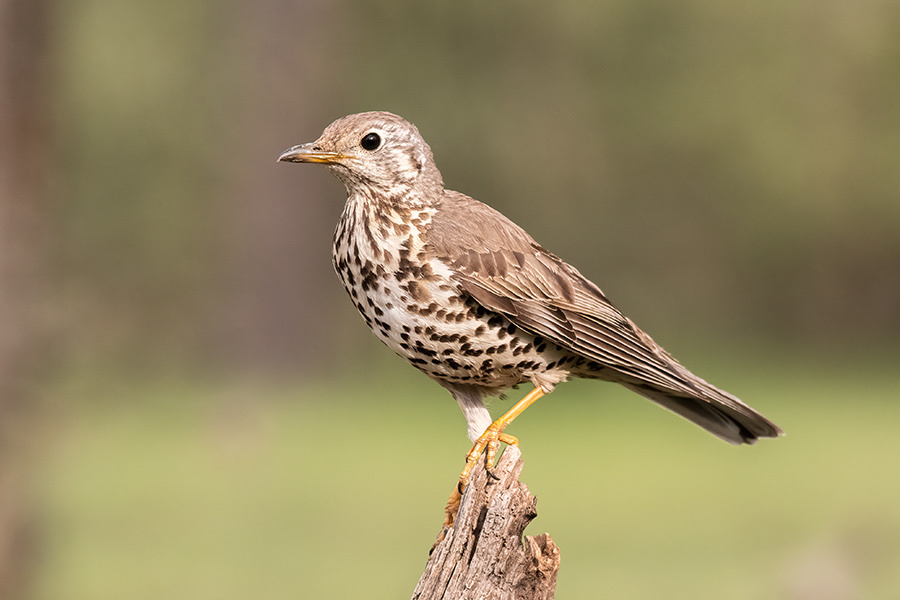
The mistle thrush (Turdus viscivorus) is a bird common to much of Europe, temperate Asia and North Africa. It is a year-round resident in a large part of its range, but northern and eastern populations migrate south for the winter, often in small flocks. It is a large thrush with pale grey-brown upper parts, a greyish-white chin and throat, and black spots on its pale yellow and off-white under parts. The sexes are similar in plumage, and its three subspecies show only minimal differences. The male has a loud, far-carrying song which is delivered even in wet and windy weather, earning the bird the old name of stormcock. Historically, the name was also sometimes spelled "missel thrush".
Found in open woods, parks, hedges and cultivated land, the mistle thrush feeds on a wide variety of invertebrates, seeds and berries. Its preferred fruit include those of mistletoe, holly, rowan, and yew. Mistletoe is favoured where it is available, and this is reflected in the thrush's English and scientific names; the plant, a parasitic species, benefits from its seeds being excreted by the thrush onto branches where they can germinate. In winter, a mistle thrush will vigorously defend mistletoe clumps or other fruit-bearing trees as a food reserve for when times are hard, chasing off other thrushes and other fruit-eating birds like waxwings.
From the article Mistle thrush on Wikipedia (CC BY-SA), quoted section by section
Description
The mistle thrush is the largest thrush native to Europe. The nominate subspecies measures 27–28 cm (11–11 in) in length, with a 45 cm (18 in) wingspan. It weighs 93 to 167 g (3.3 to 5.9 oz), with an average of around 130 g (4.6 oz). It has a stocky upright posture when on the ground. It has pale grey-brown upperparts, the chin and throat are greyish-white, and the yellowish-buff breast and off-white belly are marked with round black spots. The spotting becomes denser on the lower chest. The long tail has white tips on the outer feathers, and the underwing coverts are white. The eyes are dark brown and the bill is blackish with a yellowish base to the lower mandible. The legs and feet are yellowish-brown. There are no plumage differences between the sexes. Juveniles are similar to adults, but they have paler upperparts with creamy 'teardrop' centres to many of the feathers and smaller spots on the yellowish underparts. By their first winter they are very similar to adults, but the underparts are usually more buff-toned. There is clinal variation in nominate T. v. viscivorus across its range with the darkest birds in western Europe, and the palest in Siberia and Turkey. The southeastern subspecies T. v. bonapartei is 30 cm (12 in) in length, and therefore slightly larger than the nominate form. It is paler grey above and whiter below, with fewer black spots. …
Range & habitat
The mistle thrush breeds in much of Europe and temperate Asia, although it is absent from the treeless far north, and its range becomes discontinuous in southeast Europe, Turkey and the Middle East. In these warmer southern areas, it tends to be found in the milder uplands and coastal regions. The mistle thrush is a partial migrant: birds from the north and east of the range wintering in the milder areas of Europe and North Africa. Scandinavian and Russian birds start moving south from mid-September onwards, most birds wintering in Europe, western Turkey and the Middle East. Between mid-October and November, large numbers cross the Strait of Gibraltar and others pass through Cyprus, but there is hardly any migration across the North Sea. Breeding birds in the British Isles and north-west Europe are resident or move only short distances. In the Himalayas, the breeding population moves to nearby lower-altitude sites in winter. Return migration starts mainly from late March, although it can be a month earlier in the Middle East, and northern breeders may not arrive back on their territories until late April or early May. Migration may be by day or night, and typically involves individuals or small groups. Vagrant birds have occurred in the Azores, China, Crete, Faroe Islands, Iceland, Japan, Oman, Saudi Arabia, Sikkim and the United Arab Emirates. …
Wikipedia: “Distribution and habitat”
What it does
Mistle thrushes are found as individuals or pairs for much of the year, although families forage together in late summer, and groups may merge to form large flocks when food sources are plentiful. It is not uncommon for up to 50 thrushes to feed together at that time of year. They roost at night in trees or bushes, again typically as individuals or pairs, except in late summer or autumn when families may roost together. The mistle thrush is quite terrestrial, hopping with its head held up and body erect; when excited, it will flick its wings and tail. The flight consists of undulating bounds interspersed with glides.
Breeding. Mistle thrushes breed in the year subsequent to their hatching; they are monogamous and stay as a pair throughout the year in areas where they are not migratory. Their territories are much larger than those of blackbirds or song thrushes; although the nest territory is only about 0.6 hectares (1.5 acres), around 15–17 ha (37–42 acres) is used for feeding. Territories are normally reoccupied in subsequent years. Territories are larger in woods than in farmland. The male will attack intruders into its breeding area, including birds of prey and corvids, and sometimes cats or humans. …
Wikipedia: “Behaviour”
In human culture
Desiderius Erasmus's early sixteenth-century collection of Latin proverbs included Turdus malum sibi ipse cacat (the thrush himself excretes his own trouble), which refers to the use of the sticky mistletoe berries favoured by this species as an ingredient in birdlime, used to trap birds. The thrush was seen to be thus spreading the seeds of his own destruction. Mistle Thrush and Alpine Chough, by Giovanni da Udine, an artist who worked in Raphael's studio in the 16th century, was a sketch for his Bird with Garland and Fruit, and this in turn was the basis for a Raphael fresco in the Apostolic Palace. The early Renaissance poem "The Harmony of Birds" features a thrusshe (mistle thrush) singing the phrase "sanctus, sanctus", distinguishing the bird from the song thrush, the mauys or throstle. The song of the mistle thrush is also described in Thomas Hardy's "Darkling Thrush" and Edward Thomas's "The Thrush". The loud call of this common and conspicuous bird also led to many old or local names, including "screech", "shrite" and "gawthrush". Other names, including "stormcock" referred to its willingness to sing in wind and rain. …
Wikipedia: “In culture”
Listen
Looking for field recordings…
Where it lives
Recorded sightings
—
geo-referenced records in GBIF, from museums, herbaria and field observers.
Drag the globe to turn it. Dots are where records exist, not a range map; darker means more records.
In the old herbals & bestiaries


In the stacks
Searching the stacks…
Every page naming Turdus viscivorus in the Biodiversity Heritage Library →
This page is assembled live from iNaturalist, GBIF, Wikipedia, the Source Library and the Internet Archive. It is not yet part of the hand-edited codex. iNaturalist taxon 12735.