- Plants
- ›Vascular Plants
- ›flowering plants
- ›monocots
- ›grasses, sedges, cattails, and allies
- ›Sedges
- ›Cyperoideae
- ›Scirpeae
- ›Eriophorum
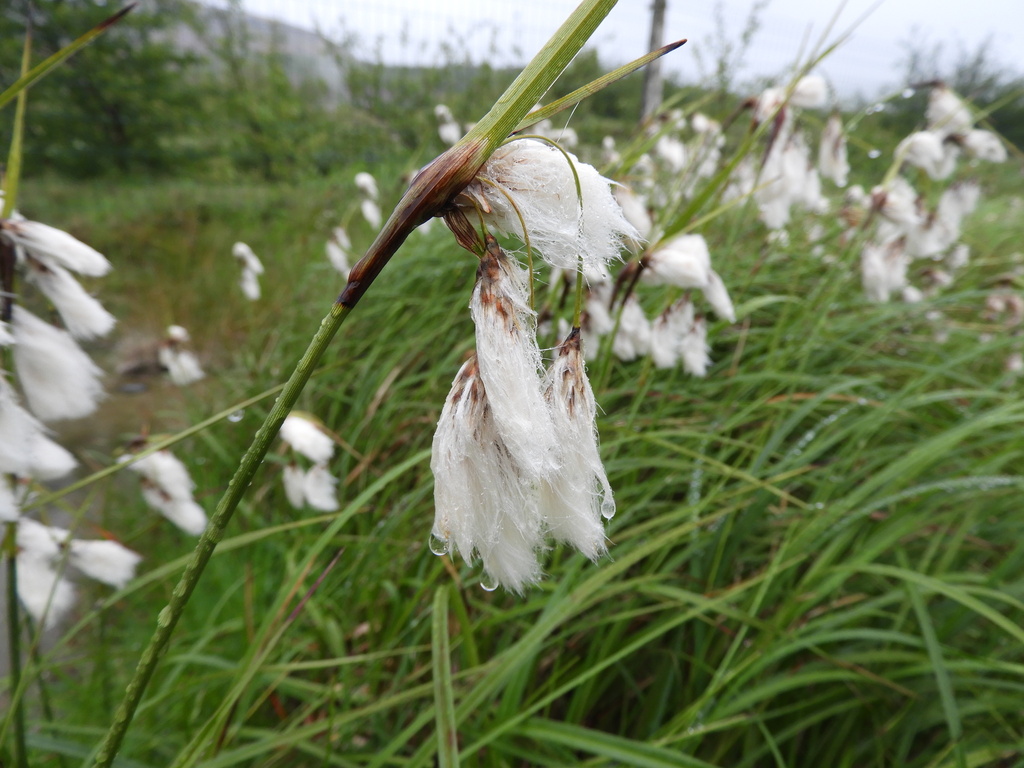
Common Cottongrass
Eriophorum angustifolium
Eriophorum angustifolium, commonly known as common cottongrass or common cottonsedge, is a species of flowering plant in the sedge family, Cyperaceae. Native to North America, North Asia, and Europe, it grows on peat or acidic soils, in open wetland, heath or moorland. It begins to flower in April or May and, after fertilisation in early summer, the small, unremarkable brown and green flowers develop distinctive white bristle-like seed-heads that resemble tufts of cotton; combined with its ecological suitability to bog, these characteristics give rise to the plant's alternative name, bog cotton.
Eriophorum angustifolium is a hardy, herbaceous, rhizomatous, perennial sedge, able to endure in a variety of environments in the temperate, subarctic and arctic regions of Earth. Unlike Gossypium, the genus from which cotton is derived, the bristles of E. angustifolium are unsuited to textile manufacturing. Nevertheless, in Northern Europe, they were used as a substitute in the production of paper, pillows, candle-wicks, and wound-dressings. The indigenous peoples of North America use the plant in cooking and in the treatment of digestive problems. Following a vote in 2002, Plantlife International designated E. angustifolium the County Flower of Greater Manchester, as part of its British County Flowers campaign.
From the article Eriophorum angustifolium on Wikipedia (CC BY-SA), quoted section by section
Description
In the wild, Eriophorum angustifolium is a creeping rhizomatous perennial sedge, with an abundance of unbranched, translucent pink roots. Fully grown, it has a tall, erect stem shaped like a narrow cylinder or triangular prism; it is smooth in texture and green in colour. Reports of the plant's height vary; estimates include up to 60 cm (24 in), 15–75 cm (5.9–29.5 in), and up to 100 cm (39 in). E. angustifolium has "stiff grass-like foliage" consisting of long, narrow solidly dark green leaves, which have a single central groove, and narrow from their 2–6-millimetre (0.08–0.24 in) wide base to a triangular tip. Up to seven green and brown aerial peduncles and chaffs, roughly 4–10 millimetres (0.16–0.39 in) in size, protrude from umbels at the top of the stem from which achenes are produced after fertilisation, each with a single pappus; these combine to form a distinctive white perianth around 5 centimetres (2.0 in) long. Eriophorum angustifolium is described as "a rather dull plant" in winter and spring, but "simply breathtaking" in summer and autumn, when 1–7 conspicuous inflorescences – composed of hundreds of white pappi comparable to cotton, hair, tassels, and/or bristles – stand out against naturally drab surroundings. Eriophorum angustifolium differs from other species within the genus Eriophorum in its habitat and morphology. …
Range & habitat
Eriophorum angustifolium is native to the Northern Hemisphere, and distributed across Eurasia, North America and the British Isles, where there is open bog, heath, wetland and moorland, with standing water and calcareous peat or acidic soil. It can survive in the Subarctic and Arctic, and is found in Alaska, Finland and Greenland as far north as 83° N. The British botanist William Turner Thiselton-Dyer recorded E. angustifolium in the South African Republic in 1898. In North America, Eriophorum angustifolium is found in the north from Alaska through Manitoba and the Canadian Prairies to Newfoundland and Labrador, down the Pacific Northwest and the state of Washington, across the Midwestern United States through Michigan and Iowa, down the Eastern Seaboard as far south-east as New York and New Jersey, and reaching as far south-west as New Mexico. In Eurasia, E. angustifolium is distributed throughout the Caucasus, European Russia and North Asia, including Siberia and the Kamchatka Peninsula, and south-east to Manchuria and Korea. …
Wikipedia: “Distribution and habitat”
What it does
Eriophorum angustifolium is a hardy, herbaceous, rhizomatous, perennial plant, meaning that it is resilient to cold and freezing climatic conditions, dies back at the end of its growing season, has creeping rootstalks, and lives for over two years. It grows vigorously from seed over a period of 2–5 years, and thrives particularly well in freshly disturbed, cut or eroded peat. E. angustifolium is protogynous. Sexual reproduction in Eriophorum angustifolium begins with flowering in spring or early summer (in or around May), when groups of 3–5 brown flowers are produced. Fertilisation usually takes place in May or June, via anemophily (wind-pollination), and the white bristle-like perianth, composed of achenes with pappi (seeds with hairs) then grows outwards to appear like short tufts of cotton thread. These pappi endure well into summer, lasting from around June to September. Like the pappus of Taraxacum (dandelions), this aids in wind-dispersal, and also serves as thermal insulation, conserving the temperature of the plant's reproductive organs by trapping solar radiation. It is a known host to the fungal species Myriosclerotinia ciborium, Hysteronaevia advena, Lachnum imbecille and Lophodermium caricinum.
Wikipedia: “Ecology”
At the table
Eriophorum angustifolium seeds and stems are edible and are used in traditional Native American cuisine by Alaska Natives, Inuit and Inupiat people. The leaves and roots of E. angustifolium are also edible and, because of their astringent properties, used by the Yupik peoples for medicinal purposes, through a process of decoction, infusion or poultice, to treat ailments of the human gastrointestinal tract, and in the Old World for the treatment of diarrhoea. In abundance, E. angustifolium can grow with enough density to disguise wetland and bog. Consequently, it may be used as a natural indicator of areas which are hazardous and to avoid travelling through. Attempts to make a cotton-like thread from the hairs of the plant's seed-heads have been thwarted by its brittleness, but it has been used in the production of paper and candle wicks in Germany, and was used as a feather substitute in pillow stuffing in Sweden and Sussex, England. In Scotland, during World War I, it was used to dress wounds.
Cultivation. Although "difficult to grow under cultivation", The Royal Horticultural Society states Eriophorum angustifolium can be cultivated as a low-maintenance wildflower, suitable for meadows, ponds margins or bog gardens. …
Wikipedia: “Uses”
In human culture
In 2002, the County Flowers campaign of Plantlife International, which asked members of the public to nominate and vote for a wildflower emblem for each of the counties and metropolitan areas of the United Kingdom, resulted in Eriophorum angustifolium being announced as the County Flower of Greater Manchester.
Wikipedia: “Cultural significance”
Where it lives
Recorded sightings
—
geo-referenced records in GBIF, from museums, herbaria and field observers.
Drag the globe to turn it. Dots are where records exist, not a range map; darker means more records.
In the stacks
Searching the stacks…
Every page naming Eriophorum angustifolium in the Biodiversity Heritage Library →
This page is assembled live from iNaturalist, GBIF, Wikipedia, the Source Library and the Internet Archive. It is not yet part of the hand-edited codex. iNaturalist taxon 127215.