On eBird ↗
Albert's Lyrebird
Live sightings near you, the range map, bar charts of when it is seen, and Macaulay Library photos and recordings.
Albert's Lyrebird
Menura alberti
Albert's lyrebird (Menura alberti), sometimes known as the northern lyrebird, is a timid, pheasant-sized songbird which is endemic to subtropical rainforests of Australia, in a small area on the state border between New South Wales and Queensland. The rarer of the two species of lyrebirds, Albert's lyrebird is named after Prince Albert, the prince consort of Queen Victoria, queen of the United Kingdom. It lacks the elegant lyre-shaped tail feathers of the superb lyrebird and is found in a much more restricted range.
The total population of Albert's lyrebirds was estimated at only 3,500 breeding birds in 2000, with one of the smallest distributional ranges of any bird on the continent.
From the article Albert's lyrebird on Wikipedia (CC BY-SA), quoted section by section
Description
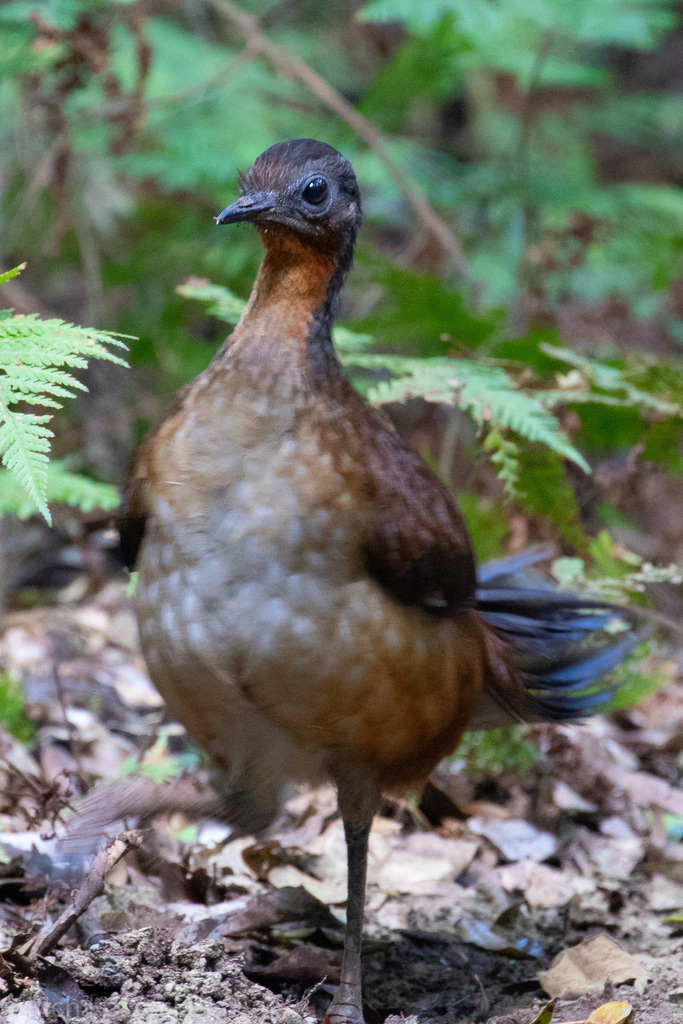
Albert's lyrebird is a ground-dwelling bird. Females reach approximately 75 cm (30 in) in length and males reach about 90 cm (35 in). They have a wingspan of 76–79 cm (30–31 in) and weigh about 930 g (33 oz). They are chestnut-brown in colour with a rufous undertail, rump, and throat. The bill is black; the iris dark brown or black, and it has a broad, blue-grey ring around the eye. The legs and feet are brownish grey to dark grey or black. The sexes are alike except for the shape of the tail. The male has a spectacular tail composed of: (1) a central pair of long ribbon-like dark-brown median plumes; (2) six pairs of long, filmy and luxuriant filamentary feathers, which are black-brown above and dark grey below; and (3) a long broad fully webbed outermost pair of lyrates, which are black-brown above and dark grey below. The tail of the female is shorter, simpler, slightly drooping and appears more pointed when closed; it is composed of a pair of long, narrow and tapered median plumes, and fully webbed, broad, brown feathers with rounded tips, but lacks filamentaries. When walking, the male carries its tail in an upward-curving train. Juveniles are separable from adults at close range. …
Range & habitat
The extent of the Albert lyrebird's distribution has apparently declined significantly following European settlement. Much of the lyrebird's habitat was cleared during the 19th century. Although the species was still widespread in lowland areas at the beginning of the 20th century, the continued clearing of habitat since then has driven most populations into higher altitude forests, usually at least 300 metres above sea level. In the past, Albert's lyrebirds were shot to be eaten in pies, to supply tail-feathers to "globe-trotting curio-hunters" or by vandals. The total population of Albert's lyrebirds was estimated at only 3,500 breeding birds in 2000, with one of the smallest distributional ranges of any bird on the continent. The bird's distribution is now restricted to several small areas of mountain ranges in the vicinity of far south-east Queensland and far north-east New South Wales; with much of the remaining habitat occurring in reserves. In Queensland, the Albert's lyrebird is found from Tamborine Mountain and Springbrook National Park in the east, to the McPherson Range in the west. Isolated populations exist in Mount Barney National Park and on the Main Range. The largest single population is found on the Lamington Plateau. …
Wikipedia: “Habitat and distribution”
What it does
The mating system of Albert's lyrebird is unknown; although the male courtship display has been well documented. The male birds use a flat piece of ground from which all debris has been raked for a stage, rather than a mound of debris as used by the superb lyrebird. In display, the male initially raises his tail to arch forwards above the head, then gradually lowers and shimmers it forwards until the bird is enveloped beneath the veil of fine bushy filaments, these are silvery with the shiny white underside of the plumes uppermost. There is no evidence of any lasting pair-bond between the male and female. Throughout the species' range, eggs have been recorded from late May to mid-August. They nest beneath the canopy, usually in the darkest areas of the forest. Nests are often located in rocky areas, usually on ledges, in clefts or between rocks, or occasionally in caves, on rock or cliff-faces, or in deep rocky ravines; nests in such places are sometimes located near waterfalls. Nests may also be placed in a variety of other sites, including on the ground on steep slopes, on creek banks, between buttress roots of fig (Ficus) trees, amongst tree stumps, at the base of palm trees, amongst ferns, in dense shrubs or occasionally in tree forks. Females sometimes nest close to sites used the previous year; occasionally, nest-sites may be re-used. …
Wikipedia: “Breeding and life cycle”
Listen
Looking for field recordings…
Where it lives
Recorded sightings
—
geo-referenced records in GBIF, from museums, herbaria and field observers.
Drag the globe to turn it. Dots are where records exist, not a range map; darker means more records.
In the stacks
Searching the stacks…
Every page naming Menura alberti in the Biodiversity Heritage Library →
This page is assembled live from iNaturalist, GBIF, Wikipedia, the Source Library and the Internet Archive. It is not yet part of the hand-edited codex. iNaturalist taxon 12699.