On eBird ↗
Afghan Snowfinch
Live sightings near you, the range map, bar charts of when it is seen, and Macaulay Library photos and recordings.
Afghan Snowfinch
Pyrgilauda theresae
The Afghan snowfinch (Pyrgilauda theresae) or the Afghan ground-sparrow, bar-tailed snowfinch, Meinertzhagen's snowfinch, or Theresa's snowfinch, is a passerine bird of the sparrow family Passeridae, endemic to the northern parts of the Hindu Kush mountains in Afghanistan. There are no major threats to the species despite its restricted range, so it is assessed as least concern on the IUCN Red List. This species is mostly a seed-eater, supplementing its diet with some insects. It builds its nest in the burrows or hollows of ground-dwelling rodents, lined with hair or feathers.
From the article Afghan snowfinch on Wikipedia (CC BY-SA), quoted section by section
Description
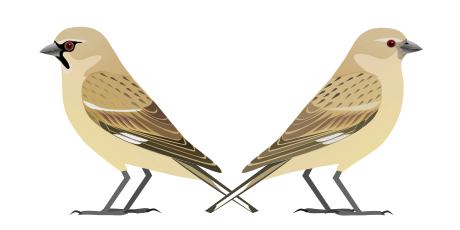
It is 13.5–15 centimetres (5.3–5.9 in) long, weighing 23–35 grams (0.81–1.23 oz). The wingspan ranges from 8.5 to 9.9 cm (3.3–3.9 in), and bills measure from 1.3 to 1.5 cm (0.51–0.59 in). Females are slightly smaller on average than males. The male is grey-brown with some white in the wings and a black face-mask and two-pronged patch on the throat. The female is a buff-tinged brown, with a weaker, greyer face mask and less white in the wings. There are short dark streaks on the mantle and a white subterminal band on the tail feathers other than the central pair. There is white on the upperwing coverts, secondaries, and inner primaries. The male has a brick red iris. The plumage of juvenile birds after fledging has not been described, but can be assumed to be similar to the female's plumage. The only similar species that occur in the Afghan snowfinch's range are the white-winged snowfinch and the desert finch. It can be distinguished from the former by the smaller white patches on the wings and an overall more brownish plumage. While it is similar in general appearance to the latter species, the Afghan snowfinch is more streaked, has stronger facial markings, and has a smaller bill, among other differences. The flight of the Afghan snowfinch is heavy and straight. The alarm call is a sharp tsi, and they make soft quaak calls in flight, and a stridulant zig-zig.
Range & habitat
The Afghan snowfinch is the only species of bird known to be endemic to Afghanistan. It is found only in some northern parts of the Hindu Kush mountains, where it occurs at elevations of 2,575–3,000 m (8,450–9,840 ft). Besides the Shibar Pass, it is known from Deh Sabz and Unai Pass, and a few other localities between 67° and 69° E in the northerly ranges of the Hindu Kush. This species disperses in the winter especially after heavy snowfalls, and moves slightly beyond its breeding range, into lower altitudes and northwards into Badghis Province. It has been recorded on occasion as a vagrant in southern Turkmenistan. Its habitats are stony mountain slopes, plateaux, and open hillsides in the passes. Despite having a relatively small range and population, it is not thought to have an unstable population or significant threats, so it is assessed as a species of least concern on the IUCN Red List. This species is among those protected by Band-e Amir National Park, Afghanistan's first national park, which encompasses a large area of the Hindu Kush near Bamyan.
Wikipedia: “Distribution and habitat”
What it does
In winter, the Afghan snowfinch forms large flocks of dozens or hundreds, sometimes mixed with snowfinches of other species, rock sparrows, and various larks. This species feeds mostly on small seeds, from plants such as Carex pachystylis, Convolvulus divaricatus, and Thuspeinantha persica, and it will also eat insects such as ants and weevils. The Afghan snowfinch builds nests in the burrows and hollows made by rodents, including ground squirrels, marmots, and in one recorded case Williams' jerboa (Allactaga williamsi). In particular, it is associated with the yellow ground squirrel (Spermophilus fulvus). Several of the other southern snowfinch species have similar nesting preferences, as does at least one species that occurs in the Afghan snowfinch's range, the isabelline wheatear. The materials used to line the burrows it nests in are the hairs of squirrels, sheep, and dromedaries; and feathers. Nests are built at the far end of the burrows, as protection from predators. The young hatch blind and helpless, with exposed pink skin and only a few, light-coloured tufts of down. Young give a soft call in response to adults calling at the entrance of a nest.
Wikipedia: “Behaviour and ecology”
Listen
Looking for field recordings…
Where it lives
Recorded sightings
—
geo-referenced records in GBIF, from museums, herbaria and field observers.
Drag the globe to turn it. Dots are where records exist, not a range map; darker means more records.
In the stacks
Searching the stacks…
Every page naming Pyrgilauda theresae in the Biodiversity Heritage Library →
This page is assembled live from iNaturalist, GBIF, Wikipedia, the Source Library and the Internet Archive. It is not yet part of the hand-edited codex. iNaturalist taxon 1269296.