- Plants
- ›Vascular Plants
- ›flowering plants
- ›Dicots
- ›nightshades, bindweeds, gooseweeds, and allies
- ›bindweed family
- ›Bindweeds, Morning-glories and Allies
- ›Ipomoeeae
- ›Ipomoea
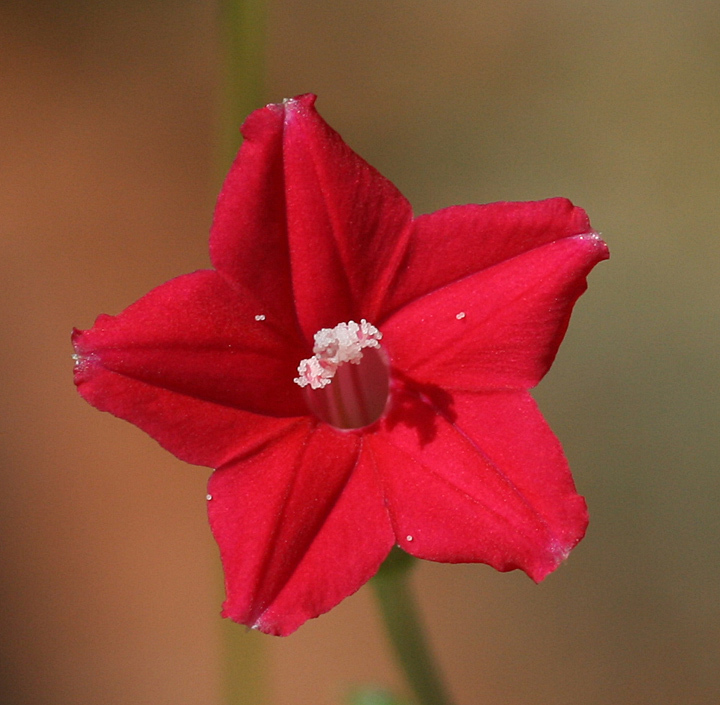
Cypress Vine
Ipomoea quamoclit
Ipomoea quamoclit, commonly known as cypress vine, cypress vine morning glory, cardinal creeper, cardinal vine, star glory, star of Bethlehem or hummingbird vine, is a species of vine in the family Convolvulaceae native to tropical regions of the Americas and naturalized elsewhere in the tropics.
From the article Ipomoea quamoclit on Wikipedia (CC BY-SA), quoted section by section
Description
I. quamoclit is a herbaceous, twining vine growing up to 3–10 feet (0.91–3.05 m) tall. The leaves are 1–4 inches (25–102 mm) long, deeply lobed (nearly pinnate), with 9-19 lobes on each side of the leaf. The flowers are 1–2 inches (25–51 mm) long and 1 inch (25 mm) in diameter, trumpet-shaped with five points, and can be red, pink or white.
Range & habitat
This plant is native to northern South America north to Mexico but has been widely distributed throughout the world since Europeans first began to explore the Americas, initially becoming popular as a medicinal plant and later as an ornamental. It has become naturalised in many tropical areas and is considered an invasive weed in some.
Wikipedia: “Distribution and habitat”
At the table
It is widely cultivated as an ornamental plant throughout the tropics, and also outside of tropical regions, where it is grown as an annual plant only, not surviving temperate zone winters. In some tropical areas, it has become naturalized. It flowers in summer and fall. Its seeds are sown in rainy season. It blooms continuously from August to December in temperate regions of the Northern Hemisphere and February to June in temperate regions of the Southern Hemisphere. Seedlings must always be kept moist. They require full sun for good growth. This vine is one of the best plants for attracting hummingbirds, and is a vigorous grower. In warmer climates, this plant can be extremely invasive. It doesn't require any fertilizer and gives blooms without any care. It can be grown anywhere. In containers along with other plants, it can be grown in small containers, or in big containers it thrives well in small spaces and big spaces alike. Ipomoea × multifida is a hybrid between I. quamoclit (the cypress vine) and I. coccinea. The allotetraploid of this hybrid is Ipomoea × sloteri. Both are known as cardinal climber.
== References ==
Wikipedia: “Cultivation and uses”
In human culture
There are two schools of thought as to the origin of the species epithet quamoclit. The first, originally put forward by the French writer and botanist Alexandre de Théis, is that it is derived from Greek. The second is that the name comes from the Nahuatl language of Mexico. Neither explanation can be verified, although the botanist Daniel F. Austin makes an argument that the latter is the most likely.
Wikipedia: “Etymology”
Where it lives
Recorded sightings
—
geo-referenced records in GBIF, from museums, herbaria and field observers.
Drag the globe to turn it. Dots are where records exist, not a range map; darker means more records.
In the old herbals & bestiaries

In the stacks
Searching the stacks…
Every page naming Ipomoea quamoclit in the Biodiversity Heritage Library →
This page is assembled live from iNaturalist, GBIF, Wikipedia, the Source Library and the Internet Archive. It is not yet part of the hand-edited codex. iNaturalist taxon 126869.