On eBird ↗
Gibberbird
Live sightings near you, the range map, bar charts of when it is seen, and Macaulay Library photos and recordings.
Gibberbird
Ashbyia lovensis
The gibberbird (Ashbyia lovensis) is a species of chat within the passerine birds. This species, also known at the desert chat or gibber chat is endemic to Australia and the only species within the genus Ashbyia. This genus was in fact named after the South Australian ornithologist Edwin Ashby. It, along with the four chats of the genus Epithianura, have sometimes been placed in a separate family, Epthianuridae (the Australian chats), but are now thought to...
From the article Gibberbird on Wikipedia (CC BY-SA), quoted section by section
Description
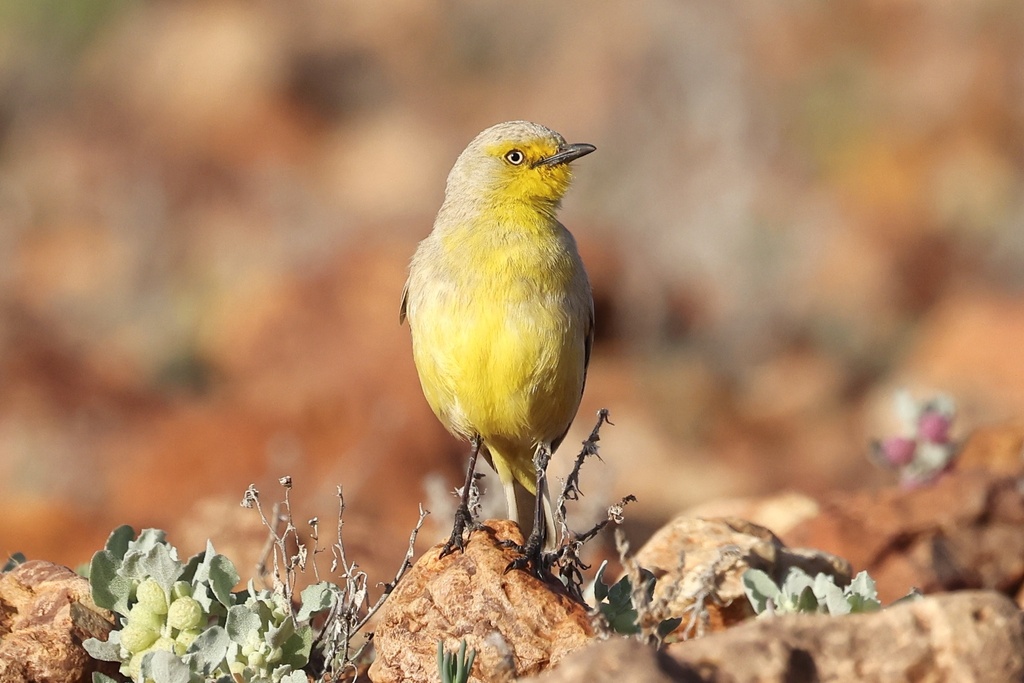
The gibberbird has a distinctive visage which is characterized by a grey crown, yellow forehead, face and underbelly with a black to grey-brown rump. The bill is a dark brown to black with grey-brown feet. The iris of the eye is a distinguishing shade of bright yellow. Unlike other chats, the gibberbird only has slight sexual dimorphisms between the male and female. Females differ very slightly and can sometimes be distinguished by more brown plumage, especially around the throat, face and neck. They can also have a heavier breast band and a generally duller appearance in comparison to the males. Juveniles appear similar to adults, with a brown back, crown and wings, and a pale yellow throat. The gibberbird is monomorphic in terms of length and weight. Generic measurements have been found to range from 12.5 to 13 cm (4.9 to 5.1 in) in length and 14 to 20 g (0.49 to 0.71 oz) in weight.
Range & habitat
The gibberbird is endemic to Australia and is known to inhabit the sparsely vegetated, stony regions of gibber desert. This habitat can include very open shrubland or grasslands. The extent of distribution for the gibberbird has been denoted as the southeastern Northern Territory, south-west Queensland to north-west New South Wales and across the northeastern region of South Australia. This species is more common on the sparsely vegetated, stony plains of the Lake Eyre basin and adjoining regions. It is primarily a sedentary species with no records of migration patterns; however, there have been some local movements outside of breeding season, presumably for resource attainment, especially in times of drought or flood. Gibberbirds are observed in sparsely vegetated stony deserts with a scattering of grasses such as Astrebla and Enneapogon. It is also found in low chenopod shrubland, which is mainly dominated by plant species such as Sclerolaena and Atriplex on higher ground. In the stony deserts of northern South Australia, gibberbirds can often be encountered in low, open shrubland or grassland of Atriplex vesicaria, Frankenia Serpyllifolia and Astrebla pectinata.
Wikipedia: “Distribution and habitat”
What it does
The gibberbird primarily feeds upon a range of invertebrates including spiders, caterpillars, moths, cicadas, grasshoppers, and other insects. Gibberbirds are indiscriminate, opportunistic foragers and have been known to feed on blowfly larvae dropped from fly-blown sheep. These are obtained by turning over clay clods with their bill to expose the sheltering maggots. Smaller larvae are consumed whole while larger larvae are bashed on the ground several times before swallowing. The majority of foraging occurs while walking on the ground but they will occasionally take to the air, up to 1 meter above ground level, while chasing flying insects. The gibberbird has also been observed running swiftly over short distances while chasing low-flying insects.
Wikipedia: “Diet”
Listen
Looking for field recordings…
Where it lives
Recorded sightings
—
geo-referenced records in GBIF, from museums, herbaria and field observers.
Drag the globe to turn it. Dots are where records exist, not a range map; darker means more records.
In the stacks
Searching the stacks…
Every page naming Ashbyia lovensis in the Biodiversity Heritage Library →
This page is assembled live from iNaturalist, GBIF, Wikipedia, the Source Library and the Internet Archive. It is not yet part of the hand-edited codex. iNaturalist taxon 12686.