On eBird ↗
Bishop's Oo
Live sightings near you, the range map, bar charts of when it is seen, and Macaulay Library photos and recordings.
Bishop's 'O'o
Moho bishopi
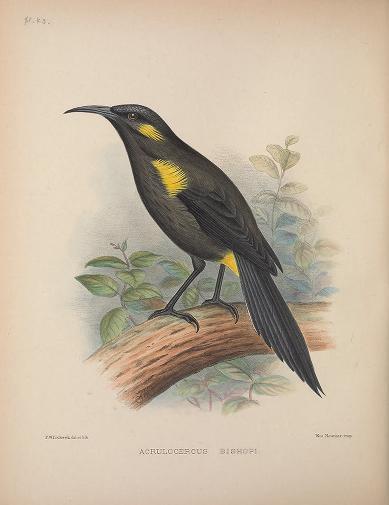
Bishop's ʻōʻō or the Molokai ʻōʻō (Moho bishopi) is an extinct species of Hawaiian honeyeater. The penultimate member of the family, it went extinct six years before the Kauaʻi ʻōʻō. It was previously regarded as member of the Australo-Pacific honeyeaters (Meliphagidae). Lionel Walter Rothschild named it after Charles Reed Bishop, the founder of the Bishop Museum.
From the article Bishop's ʻōʻō on Wikipedia (CC BY-SA), quoted section by section
Description
It was discovered in 1892 by Henry C. Palmer, a bird collector for Lord Rothschild. Its length was about 29 centimeters. The tail had reached a length of 10 centimeters. The plumage was general glossy black with yellow feather tufts on the maxillaries, beneath the wings and the undertail coverts. Their songs were simple two notes, took-took, which could be heard for miles.
Range & habitat
It was endemic to the montane forests of the Hawaiian islands of Molokai, Maui, and Lanai. Subfossil bone finds from Maui (on Mount Olinda at about 4,500 ft above sea level) are sometimes referred to in literature as the Maui ʻōʻō.
Wikipedia: “Distribution”
What it does
Little is known about its ecology. It fed on nectar from the flowers of Hawaiian lobelioids, much like other members of its family.
Wikipedia: “Ecology”
Listen
Looking for field recordings…
Where it lives
Recorded sightings
—
geo-referenced records in GBIF, from museums, herbaria and field observers.
Drag the globe to turn it. Dots are where records exist, not a range map; darker means more records.
In the stacks
Searching the stacks…
Every page naming Moho bishopi in the Biodiversity Heritage Library →
This page is assembled live from iNaturalist, GBIF, Wikipedia, the Source Library and the Internet Archive. It is not yet part of the hand-edited codex. iNaturalist taxon 12675.