On eBird ↗
White-fronted Chat
Live sightings near you, the range map, bar charts of when it is seen, and Macaulay Library photos and recordings.
White-fronted Chat
Epthianura albifrons
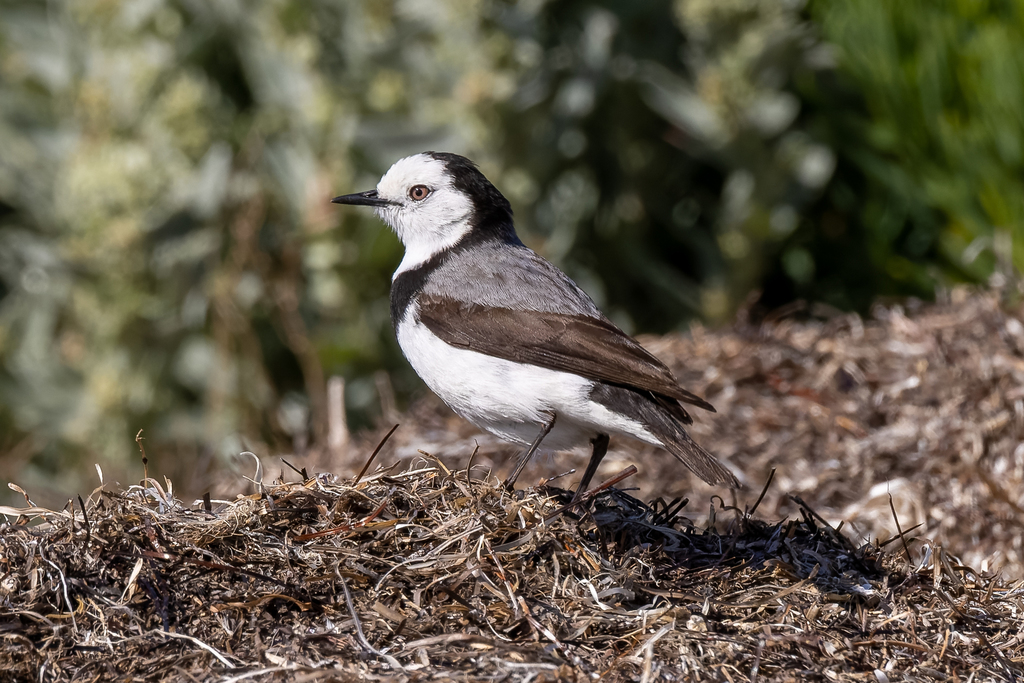
The white-fronted chat (Epthianura albifrons) is a species of bird in the honeyeater family Meliphagidae native to southern Australia. The male has a white face bordered by a black breast band. It is insectivorous.
From the article White-fronted chat on Wikipedia (CC BY-SA), quoted section by section
Description
Adult white-fronted chats are 11–13 cm (4.3–5.1 in) in length and weigh 11–17 g (0.4–0.6 oz). The male has a white face and breast bordered by a black band across the breast and nape to the hind crown. The upperparts are silver-grey, wings and upper tail coverts are dark brown, and the abdomen is white. The eyes of the male are pinkish-white, whereas the eyes of the female are brown. The female has grey-brown upperparts and white or pale grey underparts with a fainter blackish-brown breast band. The contact call, a metallic tang sound given in flight at irregular intervals, has been likened to the twanging of a rubber band.
Range & habitat
The white-fronted chat is endemic to Australia, being found across southern Australia (including Tasmania) from Shark Bay in Western Australia around to the Darling Downs in Queensland. Its preferred habitat is open country with low vegetation, including samphire (Tecticornia), tea-tree (Melaleuca) and heath, in saltmarshes and coastal dunes, in swamp or mangrove margins and around inland salt lakes. It is generally sedentary in the wetter southern part of its range, though it may be nomadic in more arid areas.
Wikipedia: “Distribution and habitat”
What it does
The white-fronted chat is usually conspicuous, perching prominently on bushes, tussocks or fences. However, it is quite secretive in approaching the nest, engaging in distraction displays. They are a gregarious species, often nesting in small colonies.
Breeding. In the breeding season from June to January, the female builds a cup-shaped nest of grasses and twigs, lined with fine grass, feathers, wool and hair, which is well concealed in a tussock or a low shrub. A clutch of 2 to 4 eggs is incubated by both parents for 13–14 days. The eggs measure 17 mm × 14 mm (0.67 in × 0.55 in) and are white, spotted with reddish-brown at the large end. The chicks are fed by both parents and fledge after 10–15 days. The nests are occasionally parasitised by Horsfield's bronze-cuckoo (Chrysococcyx basalis).
Feeding. The white-fronted chat usually forages singly or in small parties, seeking insects in low bushes or on the ground. Their diet consists of a wide variety of insects, including beetles, ants, bees, grasshoppers, moths and caterpillars, as well as spiders, acacia seeds, and nectar.
Wikipedia: “Behaviour”
Listen
Looking for field recordings…
Where it lives
Recorded sightings
—
geo-referenced records in GBIF, from museums, herbaria and field observers.
Drag the globe to turn it. Dots are where records exist, not a range map; darker means more records.
In the stacks
Searching the stacks…
Every page naming Epthianura albifrons in the Biodiversity Heritage Library →
This page is assembled live from iNaturalist, GBIF, Wikipedia, the Source Library and the Internet Archive. It is not yet part of the hand-edited codex. iNaturalist taxon 12651.