On eBird ↗
New Zealand Bellbird
Live sightings near you, the range map, bar charts of when it is seen, and Macaulay Library photos and recordings.
New Zealand Bellbird
Anthornis melanura
The New Zealand bellbird (Anthornis melanura), also known by its Māori language names korimako, makomako and kōmako, is a medium-sized species of honeyeater endemic to New Zealand. It has been the only living member of the genus Anthornis since the Chatham Islands bellbird went extinct in the early 20th century. The bellbird's closest living relative is the only other New Zealand honeyeater, the tūī (Prosthemadera novaeseelandiae). The bellbird forms a significant component of the famed New Zealand dawn chorus of birdsong, which was much noted by early European settlers. Exceptional singing abilities were already observed by Captain James Cook, who described its song as "like small bells most exquisitely tuned".
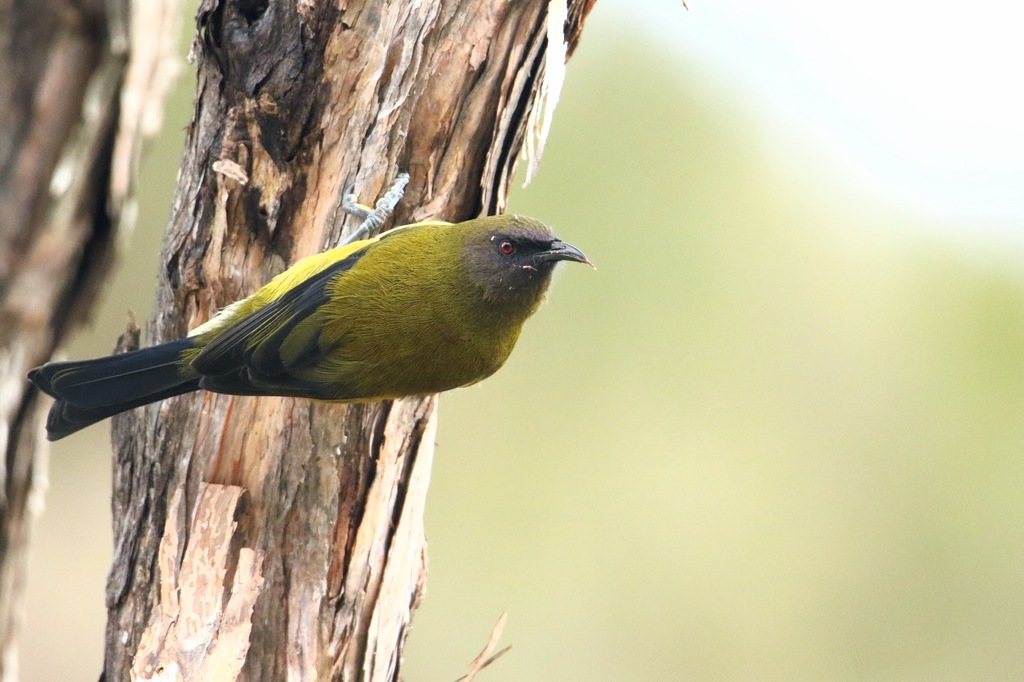
Bellbirds measure about 17–20 cm (6.7–7.9 in) in length, with females weighing approximately 25 g (0.88 oz) and males 33 g (1.2 oz). Males are mostly olive-green with paler underparts, and bluish-black wings and tail. Females are paler and browner. Like other honeyeaters, the bellbird has a brush-like tongue that enables effective feeding on nectar from deep flowers. The species is common across much of New Zealand, its offshore islands, and the Auckland Islands, but it is scarce north of Waikato and across the Canterbury Plains and Central Otago. Its habitat includes both native and exotic forests and scrublands, and it is commonly found in parks and gardens.
From the article New Zealand bellbird on Wikipedia (CC BY-SA), quoted section by section
Description
Bellbirds are medium-sized honeyeaters, about 17–20 cm in length from the tip of their beak to the end of their tail. Females weigh about 25 g and males 33 g. Males have an olive-green body with a dark purplish sheen on their head. Their belly and flanks are lighter. The uppertail is black-brown with a narrow iridescent blue-black edge on most feathers. The upperwing coverts are mostly dark olive-green, with blackish inner webs. The vent and undertail-coverts are pale yellow to off-white, and the thighs are grey. The underwing is mainly grey with a dark olive leading edge, pale-yellow secondary coverts, and a brown tint to the remiges. There is a yellow patch at the bend of a folded wing. The iris of the male is red. Females are slightly smaller than males. Their plumage is duller and much browner than adult males. The gloss on the head is bluish, and there is a narrow white stripe starting at the gape and continuing below the eye. Upperparts are dark olive-brown with dark brown uppertail and olive-edged outer webs. The upperwing is mostly dark olive-brown with dark brown inner webs and olive outer edges. Underparts are mostly olive-brown with a patch of pale yellow feathers on the flanks, less prominent than in adult males, and pale olive to off-white vent and undertail-coverts. The undertail is brownish grey, and the underwing resembles that of an adult male. …
Range & habitat
The most widespread subspecies by far is melanura, which can be found throughout North, South and Stewart Island and the Auckland Islands. It is also present on many satellites, like Tiritiri Matangi, Little Barrier, Cuvier and Mayor Island, and the Mokohinau, Mercury, Hen and Chickens and Aldermen Islands. Vagrants have appeared as far south as Campbell Island and there is a historical record from the Snares Islands dating back to 1888. Subspecies oneho only occurs on the Three Kings Islands, and subspecies obscura only nests on the Poor Knights Islands, but occasionally visits the nearby mainland of eastern Northland. Bellbirds are almost absent north of Waikato. Northland can get occasional winter female visitors from nearby offshore islands, and small pocket populations exist in some places north of Auckland, like Tāwharanui Peninsula and Shakespear Regional Park. It is also scarce in the Canterbury Plains and Central Otago. In their native forest habitat, bellbirds can be abundant and are more widely distributed than tūī.
The bellbird's habitat encompasses both native and exotic forests and scrublands, and it is frequently found in urban areas such as parks and gardens, especially if there is a nearby patch of native bush. It is found from lowland areas at sea level up to about 1200 metres, including subalpine regions above the tree line. …
Wikipedia: “Distribution and habitat”
What it does
During the breeding season, bellbirds mostly remain within their territories but may leave to feed at nearby food sources. Outside of this period, they are solitary and nomadic. The bellbird's flight is noisy and direct. While some populations are residential, some may migrate locally. Seasonal migrations were recorded between bush in the winter and summer coastal forest, or between river beds and urban areas. They are also capable of moving between offshore islands and the mainland. Bellbirds from Tawharanui are believed to have flown from Little Barrier Island, which is 23 km away across the open sea. Main natural predators of bellbirds are the swamp harrier (Circus approximans) and the New Zealand falcon (Falco novaeseelandiae). In the Auckland Islands, bellbirds were the most commonly eaten prey of falcons. Bellbirds can also be attacked by Australian magpie (Gymnorhina tibicen).
Breeding. Bellbirds are monogamous and establish long-term bonds. They keep the same territory each year. On Poor Knight Islands, adult males were defending their territories year-round. During the breeding season, a female shared a male's territory and helped defend it by chasing away other bellbirds. After breeding, she became non-territorial and, especially in autumn, joined flocks of juveniles and immature birds. …
Wikipedia: “Behaviour and ecology”
In human culture
The first Europeans to encounter New Zealand bellbirds were members of the first voyage of James Cook (1768–1771). When anchored at Queen Charlotte Sound, the voyage botanist Joseph Banks wrote in his diary on 17 January 1770 about a local dawn chorus: "Their voices were certainly the most melodious wild musick I have ever heard, almost imitating small bells but with the most tuneable silver sound imaginable". It is assumed that the chorus was created by bellbirds. Johann Reinhold Forster and Anders Sparrman collected the first specimens in April 1773 during Cook's second voyage. Forster illustrated the bellbird in Dusky Sound, however his illustration remained unpublished for many years. John Latham published a description of the bellbird in his 1782 work A General Synopsis of Birds. He mentioned that the bellbird "has an agreeable note" and that because of its ability to imitate the notes of other birds, "it was called by the English the Mocking-bird". Latham, who at that time created English names for species, and did not start applying Latin binomial names until a 1790 publication, assigned it to the Creeper genus and named the species the Mocking Creeper. …
Wikipedia: “History and names”
Listen
Looking for field recordings…
Where it lives
Recorded sightings
—
geo-referenced records in GBIF, from museums, herbaria and field observers.
Drag the globe to turn it. Dots are where records exist, not a range map; darker means more records.
In the stacks
Searching the stacks…
Every page naming Anthornis melanura in the Biodiversity Heritage Library →
This page is assembled live from iNaturalist, GBIF, Wikipedia, the Source Library and the Internet Archive. It is not yet part of the hand-edited codex. iNaturalist taxon 12612.