- Plants
- ›Vascular Plants
- ›flowering plants
- ›monocots
- ›lilies, supplejacks, and allies
- ›greenbrier family
- ›Smilax
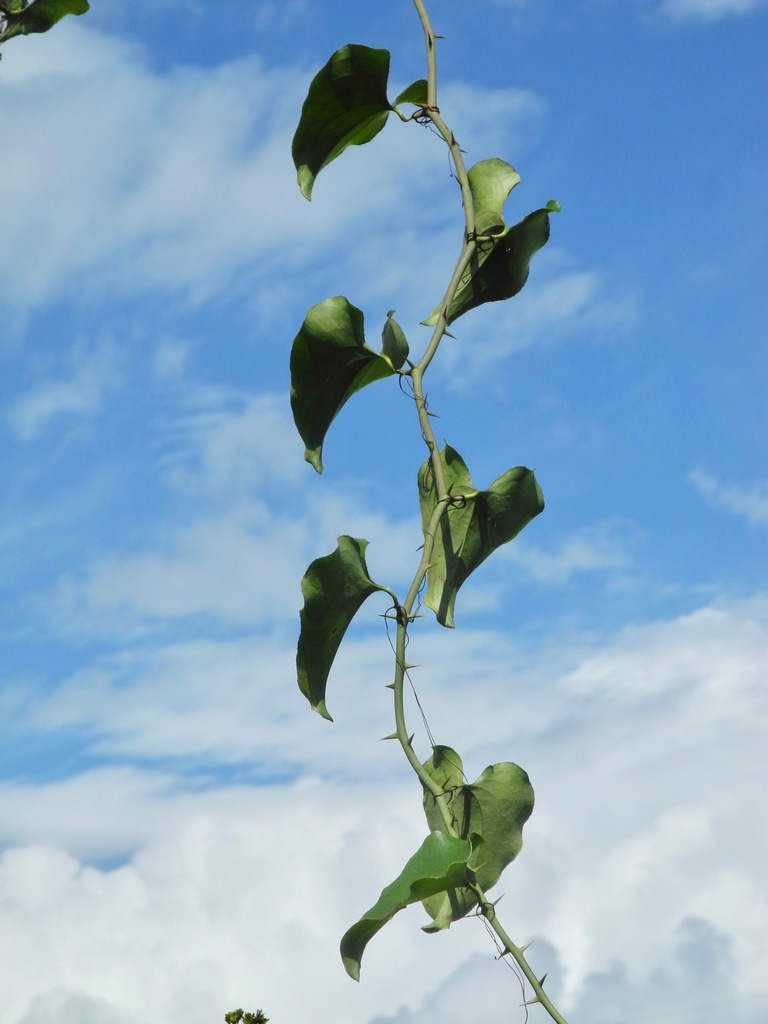
saw greenbrier
Smilax bona-nox
Smilax bona-nox, known by the common names saw greenbrier, zarzaparrilla, catbrier, bullbrier, chinabrier, and tramp's trouble, is a species of flowering plant in the Smilacaceae, or greenbrier family. The species is native to the southeastern United States from Delaware to Florida and as far west as Kansas and Texas, as well as Bermuda and much of Mexico.
From the article Smilax bona-nox on Wikipedia (CC BY-SA), quoted section by section
Description
Smilax bona-nox, also known as saw greenbrier, is a flowering vine that is prickly with a one-seeded fruit. This plant prefers full sun but can also survive in partial shade. It prefers moist soil but is tolerant of numerous soil types. They are commonly found in wooded disturbed areas. Smilax bona-nox is dioecious, meaning it is either male or female.
Smilax bona-nox produces fruits, one seeded drupes, that are dispersed by animals. Fruits are black and blue in color. The fruits are edible to humans and wildlife. Fruit harvest is during the fall and summer months. Bullbriar, Catbriar, Dunes Saw Greenbrier, Greenbriar, Streychberry Vine, and Tramp's Trouble are common names for Smilax bona-nox.
Range & habitat
Smilax bona-nox ranges across much of the eastern part of the U.S. It is distributed as far south as southern Florida, west to the edge of Texas and eastern Mexico, north to Maryland, Kentucky and southern parts of Indiana and Illinois, Missouri and Southeastern Kansas. Smilax bona-nox also occurs in Bermuda and Mexico. S. bona-nox has been observed in habitats such as dunes, maritime forests, wetlands, and uplands environments. This species may occur in fine, medium, or coarse soils. It has a high shade tolerance and a medium drought tolerance. Smilax bona-nox is dispersed by its berries being eaten and defecated by wildlife. Mainly small animals and songbirds partake of the fruits but they are also eaten by deer and black bears.
Wikipedia: “Distribution and habitat”
What it does
The Smilax bona-nox is tolerant to the occasional control burns and natural fires. Because they have rhizomes under ground, they can still sprout even when they have lost the tops of their plants. Corm-like forms can grow along with their rhizomes.
== References ==
Wikipedia: “Fire ecology”
At the table
Smilax bona-nox is edible whether cooked or not. If cooked, the roots can be made into a gelatin replacement if ground into a powder. Younger shoots are edible raw or cooked. The fruits are also edible; they are black and blue.
Wikipedia: “Edibility”
How it is grown
Smilax bona-nox is easy to grow by seed, and should be grown near lattice work or near something it can climb. This is a climbing plant that needs something to hold on to. It should also be given plenty of room as it will grow quickly and will shade other plants.
Wikipedia: “Cultivation”
Where it lives
Recorded sightings
—
geo-referenced records in GBIF, from museums, herbaria and field observers.
Drag the globe to turn it. Dots are where records exist, not a range map; darker means more records.
In the stacks
Searching the stacks…
Every page naming Smilax bona-nox in the Biodiversity Heritage Library →
This page is assembled live from iNaturalist, GBIF, Wikipedia, the Source Library and the Internet Archive. It is not yet part of the hand-edited codex. iNaturalist taxon 125677.