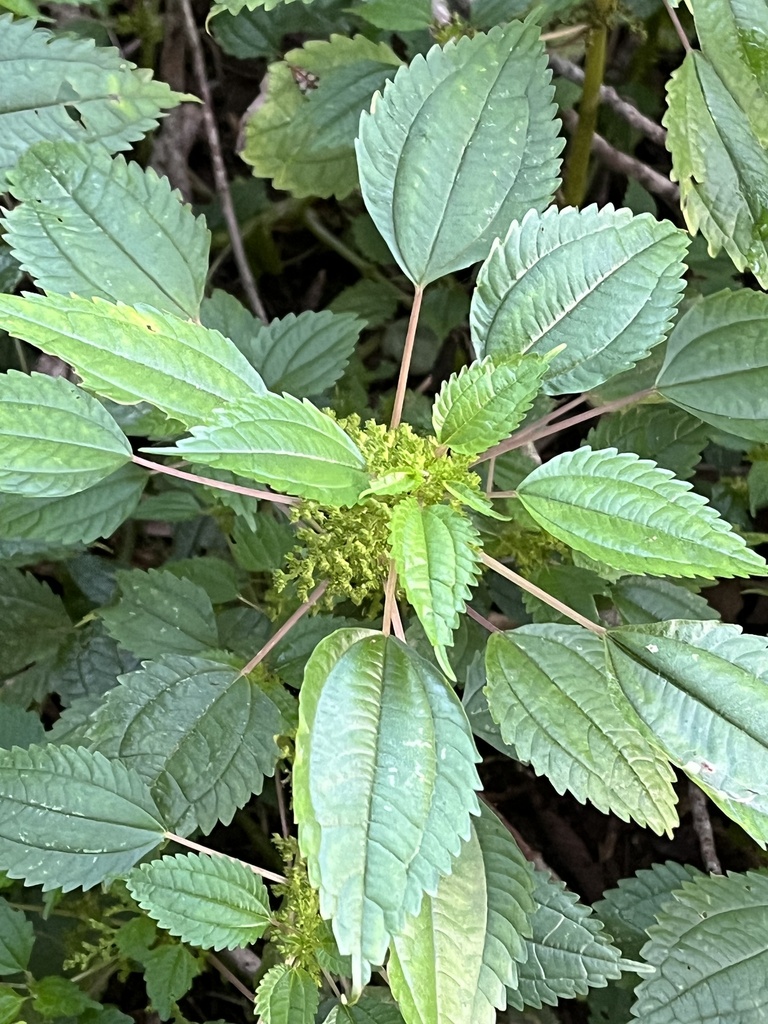
Canada clearweed
Pilea pumila
Pilea pumila, commonly known as clearweed, Canadian clearweed, coolwort or richweed, is an herbaceous plant in the nettle family (Urticaceae). It is native to Asia and eastern North America, where it is broadly distributed.
This plant is most often found in rich loamy soil, usually in moist to wet areas. Its natural habitat is in forests or other lightly shaded conditions. It is a common plant throughout its range, and forms large colonies where it is found. It grows in both high-quality habitats and in ecologically degraded areas. Due to its high tolerance for disturbance, it is often seen near buildings and as a garden weed.
From the article Pilea pumila on Wikipedia (CC BY-SA), quoted section by section
Description
Pilea pumila is an erect annual, growing 0.7 to 70 cm tall. The foliage is opposite, simple with dentate margins, wrinkly (with depressed veins), ovate, and with long petioles. Both the leaves and stems are translucent and bright green, turning bright yellow in autumn. The flowers are small, borne in axillary cymes, unisexual with both genders occurring on the same plant, greenish yellow, and pollinated by wind. Flowers bloom from midsummer through early autumn. Fruits (achenes) are green with purple markings. Roots are fibrous, shallow, and adventitious off the stem in moist areas or when in contact with the soil. The plant is often mistaken for stinging nettle (Urtica dioica), but can be distinguished by the lack of trichomes, or stinging hairs, and the lower amount of branching of the inflorescences.
What it does
The plant is host to various caterpillars, including the leaf-mining larvae of Cosmopterix pulchrimella, as well as the aphid Pseudasiphonaphis corni and leafhopper Empoasca recurvata.
== References ==
Wikipedia: “Ecology”
At the table
Canadian clearweed is edible, but unpalatable. The plant can be used in classroom demonstrations of transpiration using food coloring due to its translucent stem. It was reportedly used medicinally by certain Native Americans for sinus issues, itch relief and to reduce hunger, and it is sometimes used as a diuretic in Asia.
Wikipedia: “Uses”
Where it lives
Recorded sightings
—
geo-referenced records in GBIF, from museums, herbaria and field observers.
Drag the globe to turn it. Dots are where records exist, not a range map; darker means more records.
In the stacks
Searching the stacks…
Every page naming Pilea pumila in the Biodiversity Heritage Library →
This page is assembled live from iNaturalist, GBIF, Wikipedia, the Source Library and the Internet Archive. It is not yet part of the hand-edited codex. iNaturalist taxon 125482.