On eBird ↗
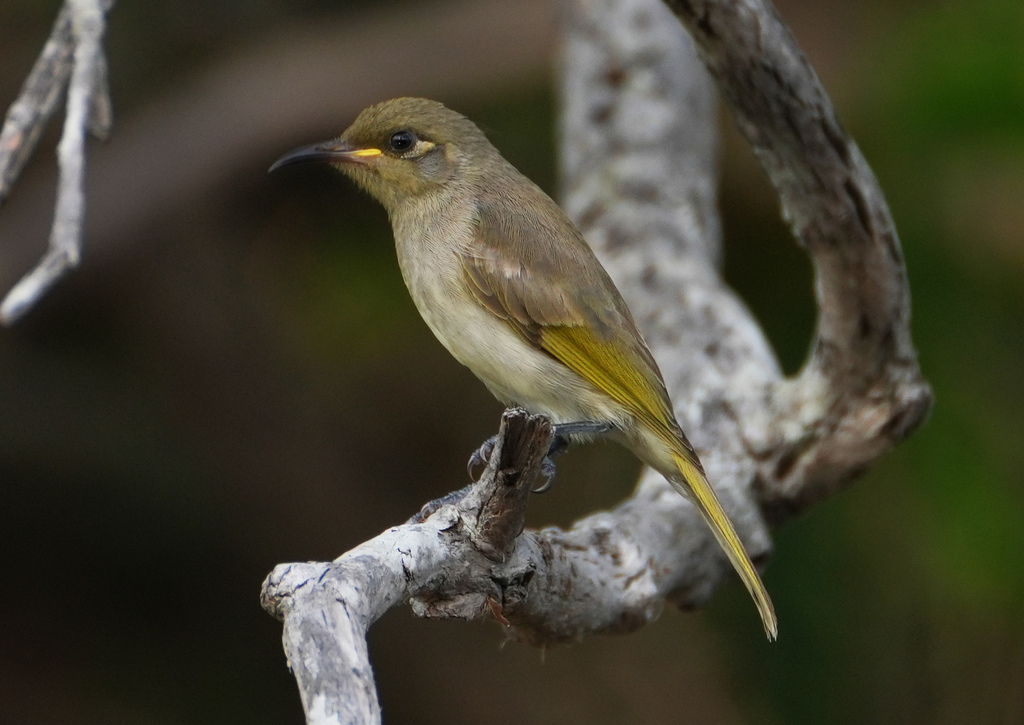
Brown Honeyeater
Live sightings near you, the range map, bar charts of when it is seen, and Macaulay Library photos and recordings.
Brown Honeyeater
Lichmera indistincta
The brown honeyeater (Lichmera indistincta) is a species of bird in the family Meliphagidae. It belongs to the honeyeaters, a group of birds which have highly developed brush-tipped tongues adapted for nectar feeding. Honeyeaters are found mainly in Australia, New Guinea, and parts of Indonesia, but the brown honeyeater is unique in that it also occurs on the island of Bali, making it the only honeyeater to be found west of the Wallace Line, the biogeographical boundary between the Australian-Papuan and Oriental zoogeographical regions.
It is a medium-small brownish bird, with yellow-olive panels in the tail and wing, and a yellow tuft behind the eye. It is widespread across western, northern and eastern Australia, New Guinea and surrounding islands, and the Lesser Sundas of Indonesia. Throughout this range, the brown honeyeater occupies a range of habitats from mangroves to eucalypt woodlands. It is seasonally nomadic within its local area, following flowering food plants. While it usually forages alone, it also feeds in small groups, or flocks of mixed honeyeater species. Nectar and insects form its diet. It occupies the same breeding territory each year, and lays two or three eggs in a cup-shaped nest woven from grass and soft bark. Both sexes contribute to nest building and feeding the young. It has a loud, clear, musical song, described as the best of all the honeyeaters.
From the article Brown honeyeater on Wikipedia (CC BY-SA), quoted section by section
Description
The brown honeyeater is a medium-small, plain grey-brown honeyeater with a body length of 12–16 centimetres (4.7–6.3 in), a wingspan of 18–23 centimetres (7.1–9.1 in), and an average weight of 9–11 grams (0.32–0.39 oz). The female is slightly smaller than the male, but the sexes differ only slightly in appearance. The head, back, rump, and upper tail-coverts are brown, and the wings a darker brown. The only distinguishing features are a small yellow patch behind the eye, which is indistinct in some birds, and dull yellow-olive panels in the folded wings and tail. The brown honeyeater's sexual dimorphism is slight. The adult male has a dark brownish-grey forehead and crown, contrasting with a brownish nape. The forehead and crown of the adult female is a similar olive-brown to the rest of the upper body. A juvenile bird is similar to the female, but may lack or show only a trace of the yellow tuft behind the eye. The bill is black, and is long, slender, and curved slightly downwards, well adapted for probing deep tubular flowers. The gape in the male is black when breeding, and pale yellow at other times. The gape of the female is always pale yellow, and in the juvenile it is bright yellow and swollen. …
Wikipedia: “Appearance”
Range & habitat
The brown honeyeater is found in a wide range of wooded habitats, and is widespread across Australia. The nominate race ranges across a broad band from Newcastle on the New South Wales coast north and west to Queensland and the Top End to southwestern Western Australia. It is rarely seen in Sydney, where populations have declined since the late 1950s, though it is being recorded in suitable habitats, such as Homebush Bay and Kurnell in small numbers, and is a vagrant to the Illawarra region. It is rare in South Australia, and not present in Victoria and Tasmania. Population densities range from 2.3 birds per 1 hectare (2.5 acres) in the Kakadu National Park, to 0.26 birds per hectare in Wellard in Western Australia. L. i. ocularis is found in New Guinea, the Torres Strait Islands, and Cape York intergrading with the nominate race along the Gulf of Carpentaria river system. L. i. melvillensis inhabits the Tiwi Islands, while L. i. limbata is found in Bali and the Lesser Sundas, and L. i. nupta on the Aru Islands. The brown honeyeater is seasonally nomadic across its local area in response to flowering food plants. For example, there are marked increases in numbers in Toowoomba in southeast Queensland during winter, and in the Northern Territory the range contracts during the dry season. …
Wikipedia: “Distribution and habitat”
What it does
A busy, acrobatic bird, the brown honeyeater is frequently on the wing, hovering over flowers and pursuing insects in flight.
Feeding. The brown honeyeater feeds mainly in the foliage and flowers in the canopy of trees and shrubs, though it does use all levels of the habitat including the ground. It feeds singly and in pairs, but will gather in small groups or in mixed-species feeding flocks with other honeyeaters, such as banded, yellow-tinted, black-chinned and rufous-throated. Observations of foraging birds record the brown honeyeater feeding primarily on nectar, and taking some insects. Main sources of nectar include flowering mistletoe and mangroves, bloodwood, woollybutt, cajeput, and Banksia and Grevillea species. Nectar is primarily taken from flowers with cups of stamens, brush-shaped inflorescences, or tubular flowers. The brown honeyeater will hover above small flowers while extracting nectar, perch on a stem for large single flowers, and, in the case of Banksia flowers, perch on unopened florets at the top of the inflorescence. Insects were most often gleaned from leaves or bark, and sometimes caught by sallying or taken from the ground. Insects eaten include beetles, flies, ants, wasps, and bees. The brown honeyeater is more active in the early morning than at other times of the day; flying more when visiting flowers at the time when nectar is most abundant. …
Wikipedia: “Behaviour”
Listen
Looking for field recordings…
Where it lives
Recorded sightings
—
geo-referenced records in GBIF, from museums, herbaria and field observers.
Drag the globe to turn it. Dots are where records exist, not a range map; darker means more records.
In the stacks
Searching the stacks…
Every page naming Lichmera indistincta in the Biodiversity Heritage Library →
This page is assembled live from iNaturalist, GBIF, Wikipedia, the Source Library and the Internet Archive. It is not yet part of the hand-edited codex. iNaturalist taxon 12526.