On eBird ↗
Red-headed Myzomela
Live sightings near you, the range map, bar charts of when it is seen, and Macaulay Library photos and recordings.
Red-headed Myzomela
Myzomela erythrocephala
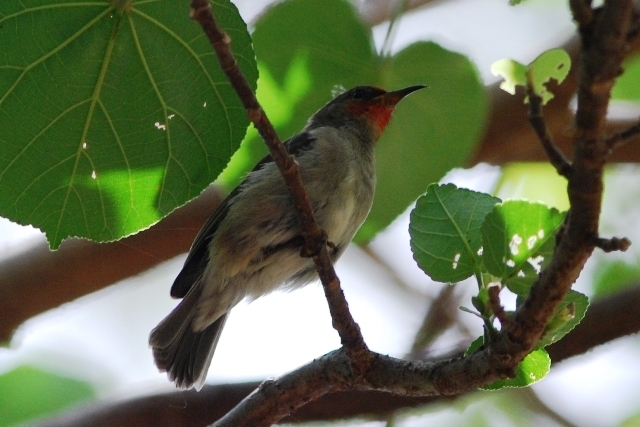
The red-headed myzomela or red-headed honeyeater (Myzomela erythrocephala) is a passerine bird of the honeyeater family Meliphagidae found in Australia, Indonesia, and Papua New Guinea. It was described by John Gould in 1840. Two subspecies are recognised, with the nominate race M. e. erythrocephala distributed around the tropical coastline of Australia, and M. e. infuscata in New Guinea. Though widely distributed, the species is not abundant within this range. While the IUCN lists the Australian population of M. e. infuscata as being near threatened, as a whole the widespread range means that its conservation is of least concern.
At 12 cm (4.7 in), it is a small honeyeater with a short tail and relatively long down-curved bill. It is sexually dimorphic; the male has a glossy red head and brown upperparts and paler grey-brown underparts while the female has predominantly grey-brown plumage. Its natural habitat is subtropical or tropical mangrove forests. It is very active when feeding in the tree canopy, darting from flower to flower and gleaning insects off foliage. It calls constantly as it feeds. While little has been documented on the red-headed myzomela's breeding behaviour, it is recorded as building a small cup-shaped nest in the mangroves and laying two or three oval, white eggs with small red blotches.
From the article Red-headed myzomela on Wikipedia (CC BY-SA), quoted section by section
Description
The red-headed myzomela is a distinctive small honeyeater with a compact body, short tail and relatively long down-curved bill. It averages 12 centimetres (4.7 in), with a wingspan of 17–19 cm (6.7–7.5 in) and a weight of 8 grams (0.28 oz). The birds exhibit sexual dimorphism, with males being slightly larger and much more brightly coloured than females. The adult male of the nominate subspecies has a dark red head, neck, and rump; the red is glossy, reflecting bright light. The rest of the upper body is a blackish-brown, and the upper breast and under-body a light brownish-grey. The red of the head is sharply demarcated against the brown plumage, giving the bird the appearance of having a red hood. The bill is black or blackish-brown, and the gape is black or yellowish. There is a distinct black loral stripe that extends to become a narrow eye ring. The iris is dark brown. The adult female's head and neck are grey-brown with a pink-red tint to the forehead and chin. The rest of the female's upper body is grey-brown with darker shades on the wings and lighter shades on the breast and underparts. The gape is yellow. One study suggested a connection between the female's bill colour and breeding status, with birds that had a horn-coloured (grey) bill also having well-developed brood patches. …
Range & habitat
The nominate subspecies of the red-headed myzomela is distributed across the tropical coastlines of Western Australia, the Northern Territory and Queensland. It inhabits coastal areas of the Kimberley and various offshore islands in Western Australia, and is similarly distributed in the Northern Territory, including Melville Island and the Sir Edward Pellew Group of Islands. It is widespread around the coast of the Gulf of Carpentaria and the Cape York Peninsula. M. e. infuscata occurs at scattered sites in West Papua and in south Papua New Guinea, from the Mimika Regency in the west to the Fly River in the east, and the Aru Islands. Some birds of Cape York have features intermediate between the two subspecies. Although the red-headed myzomela is widely distributed, it is not abundant within its range. The largest recorded population was 5.5 birds per hectare or 2.2 per acre at Palmerston in the Northern Territory. The peak abundance of the species in the mangroves around Darwin Harbour during the mid-dry and early wet season coincided with the production of young and the flowering of the yellow mangrove (Ceriops australis). The species' movements are poorly understood, variously described as resident, nomadic or migratory. …
Wikipedia: “Distribution and habitat”
What it does
While the social organisation of the red-headed myzomela is relatively unknown, it is reported as being usually solitary or found in pairs, though it has been described as forming loose associations with brown honeyeaters, and other mangrove-feeding birds such as the northern fantail and yellow white-eye. It is an inquisitive bird and readily responds to pishing, coming close to the caller to investigate the source of the sound and to warn off the intruder. It calls throughout the day when feeding, and males sing from exposed branches in the upper canopy of the food trees. The red-headed myzomela actively defends food trees, engaging in aggressive bill-wiping both in response to a threat and after chasing intruders from a tree. It is very antagonistic even towards its own species; the males fight by grappling in mid-air and falling close to the ground before disengaging. It constantly chases brown honeyeaters through the canopy, though it has not been observed in grappling fights with other species.
Wikipedia: “Social behaviour”
Listen
Looking for field recordings…
Where it lives
Recorded sightings
—
geo-referenced records in GBIF, from museums, herbaria and field observers.
Drag the globe to turn it. Dots are where records exist, not a range map; darker means more records.
In the stacks
Searching the stacks…
Every page naming Myzomela erythrocephala in the Biodiversity Heritage Library →
This page is assembled live from iNaturalist, GBIF, Wikipedia, the Source Library and the Internet Archive. It is not yet part of the hand-edited codex. iNaturalist taxon 12435.