- Plants
- ›Vascular Plants
- ›flowering plants
- ›monocots
- ›Agaves, Orchids, Irises, and Allies
- ›agave and allies
- ›cabbage tree subfamily
- ›Cordyline
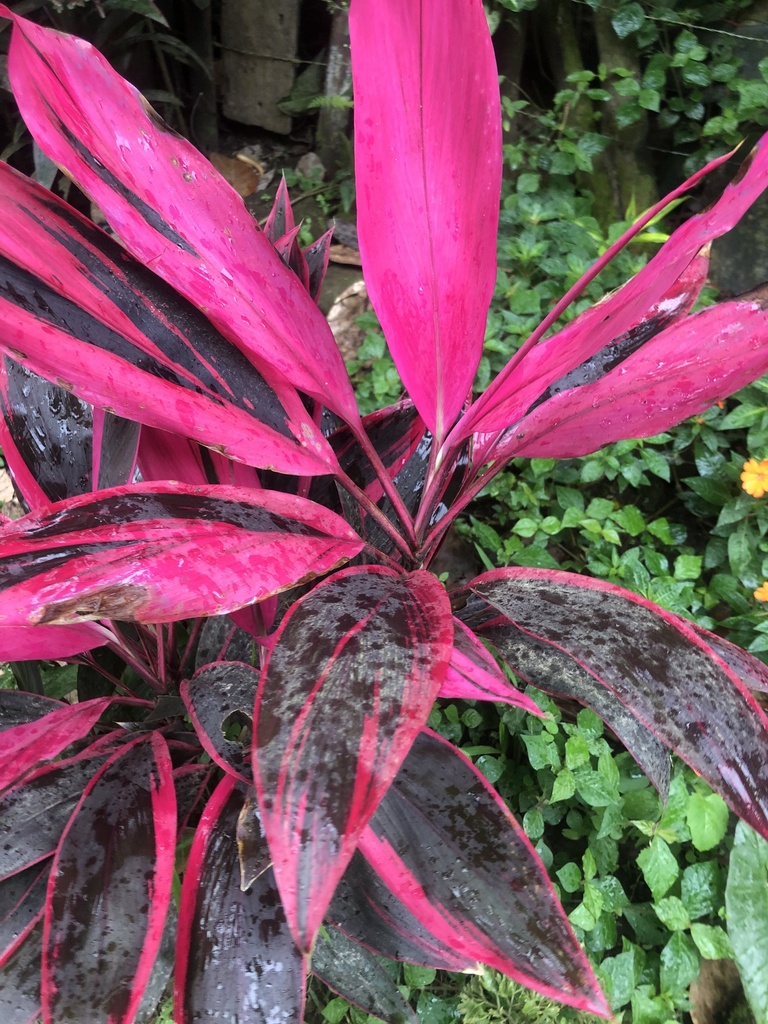
Ti
Cordyline fruticosa
Cordyline fruticosa is an evergreen flowering plant in the family Asparagaceae. It is known by a wide variety of common names, including ti plant, palm lily, and cabbage palm.
The plant has been cultivated in Asia and Oceania, with a number of uses including food and traditional medicine. It is of great cultural importance to the traditional inhabitants of the Pacific Islands and Maritime Southeast Asia.
From the article Cordyline fruticosa on Wikipedia (CC BY-SA), quoted section by section
Description
It is a palm-like plant growing up to 4.5 metres (15 feet) tall with an attractive fan-like and spirally arranged cluster of broadly elongated leaves at the tip of the slender trunk. The leaves range from red to green and variegated forms. It is a woody plant with leaves 30–60 centimetres (12–24 inches) (rarely 75 cm or 30 in) long and 5–10 cm (2–4 in) wide at the top of a woody stem. It produces 40–60 cm (16–24 in) long panicles of small scented yellowish to red flowers that mature into red berries.
At the table
The roots and young leaves can be cooked and eaten as survival food. The leaves can make a rain cloak. In the Philippines, the roots were used to flavor the traditional intus sugarcane wines of the Lumad people of Mindanao. In Polynesia, the leaves of the green-leafed form are used to wrap food, line earth ovens and fermentation pits of breadfruit, and their rhizomes harvested and processed into a sweet molasses-like pulp eaten like candy or used to produce a honey-like liquid used in various sweet treats. In Hawaii, the roots mixed with water and fermented are also distilled into an alcoholic beverage known as okolehao. The plants are widely used for traditional medicine, and ornamentation throughout Austronesia and New Guinea. The flowers are a traditional treatment for asthma, and their anthocyanin content has been assessed to see if they might be commercial herbal remedy. Ti is a popular ornamental plant, with numerous cultivars available, many of them selected for green or reddish or purple foliage.
Wikipedia: “Uses”
How it is grown
Its original native distribution is unknown, but it is believed to be native to the region from Bangladesh, to Mainland Southeast Asia, South China, Taiwan, Maritime Southeast Asia, New Guinea, and Northern Australia. It has the highest morphological diversity in New Guinea and is believed to have been extensively cultivated there. It was carried throughout Oceania by Austronesians, reaching as far as Hawaii, New Zealand, and Easter Island at their furthest extent. In New Zealand, it grew only in the far north and is now extinct there, except on the Kermadec Islands. A particularly important type of ti in eastern Polynesia is a large green-leafed cultivar grown for their enlarged edible rhizomes. Unlike the ti populations in Southeast Asia and Near Oceania, this cultivar is almost entirely sterile in the further islands of eastern Polynesia. It can be propagated only by cuttings from the stalks or the rhizomes. It is speculated that this was the result of deliberate artificial selection, probably because they produce larger and less fibrous rhizomes more suitable for use as food. It was introduced to Europe as a houseplant in 1771.
Wikipedia: “Cultivation”
In human culture
The species is regarded as one of the most important plants related to the indigenous socio-cultural practices of the Pacific and Island Southeast-Asia. In particular, it was propagated throughout the Austronesian linguistic area by humans, not so much for its food value but mainly for socio-cultural reasons. It is widely regarded as having mystical and spiritual importance in various cultures. It is common planted on grave sites, used in magical and ritual practices, including for healing. It is also used as a decorative attire and ornamentation, and as a boundary markers. It is common for the red and green cultivars to be used differently in rituals. Red ti plants commonly symbolize blood, war, and the ties between the living and the dead; while green ti plants commonly symbolize peace and healing. Their ritual uses in Island Southeast Asia have largely been obscured by the introduction of Hinduism, Buddhism, Islam, and Christianity, but they still persist in certain areas or are co-opted for the rituals of the new religions. In Philippine anitism, ti were commonly used by babaylan (female shamans) when conducting mediumship or healing rituals. A common belief in Filipino cultures is that the plant has the innate ability to host spirits. …
Wikipedia: “Cultural significance”
Where it lives
Recorded sightings
—
geo-referenced records in GBIF, from museums, herbaria and field observers.
Drag the globe to turn it. Dots are where records exist, not a range map; darker means more records.
In the stacks
Searching the stacks…
Every page naming Cordyline fruticosa in the Biodiversity Heritage Library →
This page is assembled live from iNaturalist, GBIF, Wikipedia, the Source Library and the Internet Archive. It is not yet part of the hand-edited codex. iNaturalist taxon 123572.