- Plants
- ›Vascular Plants
- ›flowering plants
- ›monocots
- ›grasses, sedges, cattails, and allies
- ›Sedges
- ›Cyperoideae
- ›Eleocharideae
- ›Eleocharis
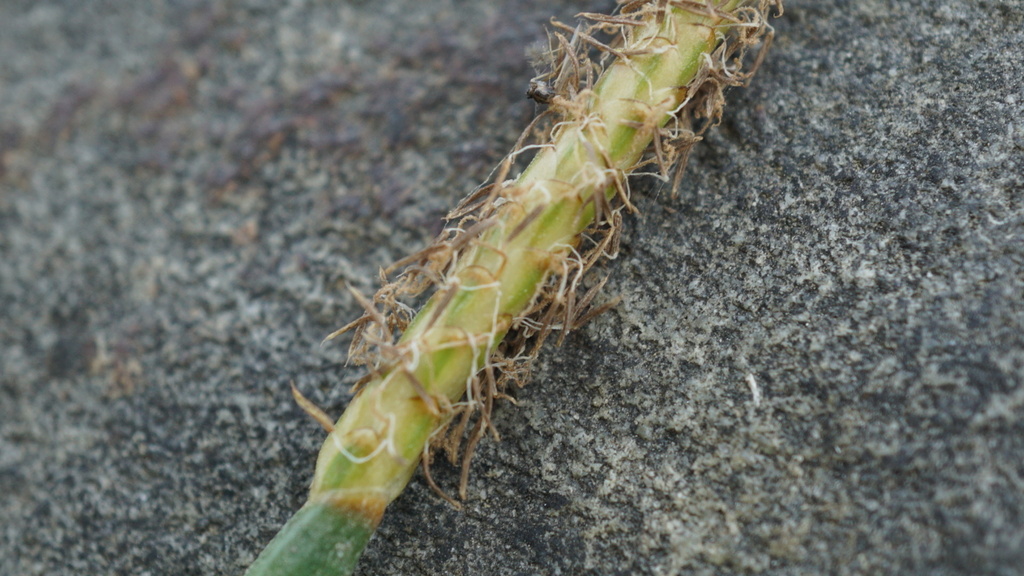
Water Chestnut
Eleocharis dulcis
Eleocharis dulcis, the Chinese water chestnut or water chestnut, is a grass-like sedge native to Asia, tropical Africa, and Oceania. It is grown in many countries for its edible corms, but if eaten uncooked, the surface of the plants may transmit fasciolopsiasis.
The water caltrop, which also is referred to by the same name, is unrelated and often confused with the water chestnut.
From the article Eleocharis dulcis on Wikipedia (CC BY-SA), quoted section by section
Description
The water chestnut is not a nut but rather an aquatic vegetable that grows in marshes, under water, or in mud. It has stem-like, tubular green leaves that grow to about 1.5 m (5 ft).
What it does
In the dry season of the Northern Territory in Australia, magpie geese eat the bulbs of water chestnuts, allowing them to put on fat for the wet season and ensuring they are ready for breeding. In the wet season, water chestnut leaves are used to build their floating nests.
Wikipedia: “Ecology”
At the table
Nitrogen addition is beneficial for corm production, applying a dose before planting and another dose when corms begin to enlarge. To further improve nutrient levels, potassium and phosphorus mineral fertilizers can be used before planting, where the N:P:K uptake ratio is 1:0.5:1.75. Also organic mulch, especially mushroom compost, shows good results.
Wikipedia: “Plant nutrition”
How it is grown
The crop can be cultivated in paddies, 2–7.5 m (7–25 ft) wide by up to 100 m (330 ft) long to allow for mechanization, or in a hydroponic culture. As it is an aquatic plant, it should always be submerged in approximately 10 cm (4 in) of water. The crop needs continuously high soil temperatures, ideally 14–15.5 °C (57–60 °F). At 13.6 °C (56.5 °F), the corms begin to sprout. Soil is ideally a sandy loam with pH 6.5 to 7.2. The plant produces two types of subterranean rhizomes. Under long-daylength conditions, rhizomes grow horizontally and then turn upwards forming daughter plants. Under short-daylength conditions, the rhizomes grow downward and produce a corm at the tip. The photoperiod also significantly influences how fast the corms grow. Corms begin to develop much more slowly if the photoperiod exceeds 12 hours. The corms are also the propagating material. Alternatively, transplants can be used. Machinery, such as tractor-mounted vegetable planters, can be used for plantation.
Plant nutrition. Nitrogen addition is beneficial for corm production, applying a dose before planting and another dose when corms begin to enlarge. To further improve nutrient levels, potassium and phosphorus mineral fertilizers can be used before planting, where the N:P:K uptake ratio is 1:0.5:1.75. Also organic mulch, especially mushroom compost, shows good results.
Harvest. …
Wikipedia: “Cultivation”
Where it lives
Recorded sightings
—
geo-referenced records in GBIF, from museums, herbaria and field observers.
Drag the globe to turn it. Dots are where records exist, not a range map; darker means more records.
In the old herbals & bestiaries


In the stacks
Searching the stacks…
Every page naming Eleocharis dulcis in the Biodiversity Heritage Library →
This page is assembled live from iNaturalist, GBIF, Wikipedia, the Source Library and the Internet Archive. It is not yet part of the hand-edited codex. iNaturalist taxon 122977.