- Plants
- ›Vascular Plants
- ›flowering plants
- ›Dicots
- ›Legumes, Milkworts, and Allies
- ›Legumes
- ›Faboideae
- ›Phaseoleae
- ›Phaseolinae
- ›Vigna
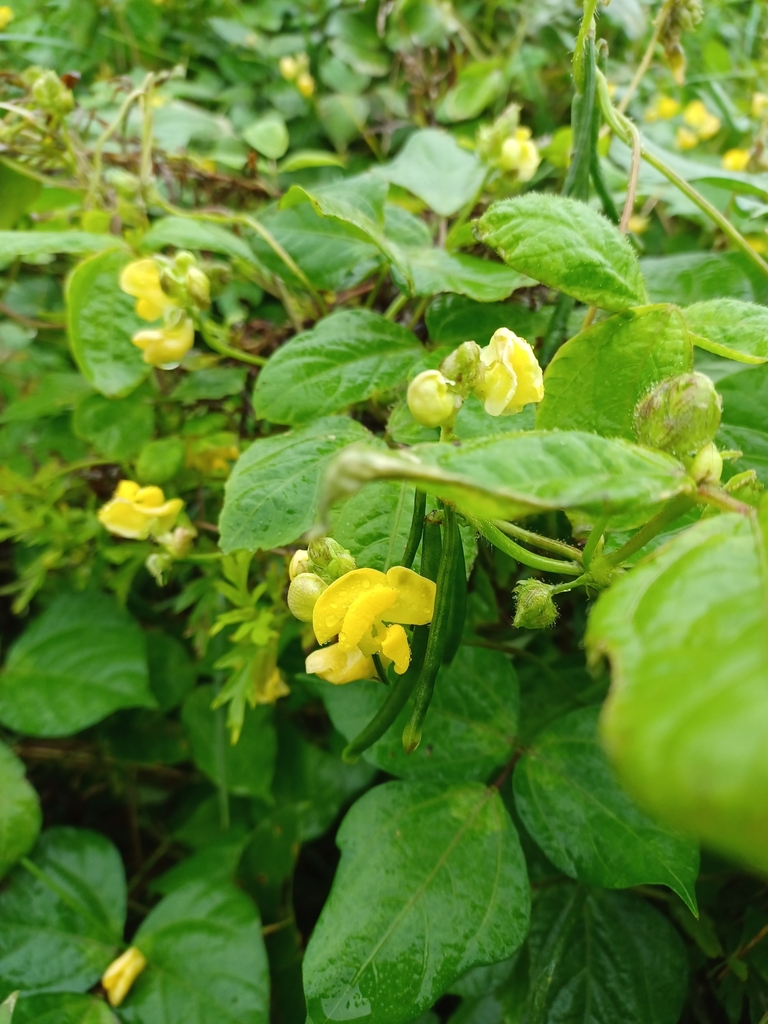
Adzuki Bean
Vigna angularis
The adzuki bean (Vigna angularis; from azuki (Japanese: アズキ(小豆)), sometimes transliterated as azuki or aduki, or English red mung bean) is an annual vine widely grown throughout East Asia and the Himalayas for its small (approximately 5 mm) bean. The cultivars most familiar in Northeast Asia have a uniform red colour, however, white, black, gray, and variously mottled varieties also are known. Scientists presume Vigna angularis var. nipponensis is the progenitor.
From the article Adzuki bean on Wikipedia (CC BY-SA), quoted section by section
Description
The description of the adzuki bean can vary between authors because there are both wild and cultivated forms of the plant. The adzuki bean is an annual, rarely biennial bushy erect or twining herb usually between 30 and 90 centimetres (12 and 35 in) high. There exist climbing or prostrate forms of the plant. The stem is normally green and sparsely pilose.
Roots. The adzuki bean has a taproot type of root system that can reach a depth of 40–50 centimetres (16–20 in) from the point of seed germination.
Leaves. The leaves of the adzuki bean are trifoliate, pinnate and arranged alternately along the stem on a long petiole. Leaflets are ovate and about 5–10 centimetres (2.0–3.9 in) long and 5–8 centimetres (2.0–3.1 in) wide.
Flowers. Adzuki flowers are papilionaceous and bright yellow. The inflorescence is an axillary false raceme consisting of six to ten (two to twenty) flowers.
Fruits. Adzuki pods are smooth, cylindrical, and thin walled. The colour of the pods is green turning white to grey as they mature. The size is 5–13 by 0.5 centimetres (1.97 in–5.12 in × 0.20 in), with 2 to 14 seeds per pod. Pod shatter during seed ripening, and harvesting can be difficult under certain conditions.
Seeds. The seeds are smooth and subcylindric with a length of 5.0–9.1 millimetres (0.20–0.36 in), width of 4.0–6.3 millimetres (0.16–0.25 in), thickness of 4.1–6.0 millimetres (0.16–0.24 in). …
At the table
In East Asian cuisine, adzuki beans are most commonly sweetened before eating. They are often boiled with sugar to produce red bean paste, a widely used ingredient throughout the region. The paste is sometimes flavored with ingredients such as chestnut and serves as a filling or topping in numerous traditional dishes. In Chinese cuisine, red bean paste appears in foods such as tangyuan, zongzi, mooncakes, baozi, and red bean ice. A more liquid preparation, made by boiling adzuki beans with sugar and a pinch of salt, is known as hong dou tang, a sweet soup-like dessert. In Japanese cuisine, red bean paste is used in confections including anpan, dorayaki, imagawayaki, manjū, monaka, anmitsu, taiyaki, and daifuku. It is also used in amanattō and in ice cream, either as whole beans or as a paste. Rice with adzuki beans (赤飯; sekihan) is traditionally prepared in Japan for auspicious occasions.
Across East Asia, red bean paste and adzuki beans are also enjoyed in waffles, pastries, baked buns, spring rolls, and biscuits. In addition, adzuki beans may be eaten sprouted or boiled in a hot, tea-like drink.
Wikipedia: “Culinary uses”
Where it lives
Recorded sightings
—
geo-referenced records in GBIF, from museums, herbaria and field observers.
Drag the globe to turn it. Dots are where records exist, not a range map; darker means more records.
In the old herbals & bestiaries


In the stacks
Searching the stacks…
Every page naming Vigna angularis in the Biodiversity Heritage Library →
This page is assembled live from iNaturalist, GBIF, Wikipedia, the Source Library and the Internet Archive. It is not yet part of the hand-edited codex. iNaturalist taxon 122889.