- Plants
- ›Vascular Plants
- ›flowering plants
- ›monocots
- ›Aroids, Water Plantains, Seagrass, and allies
- ›Arum Family
- ›Aroideae
- ›Colocasieae
- ›Colocasia
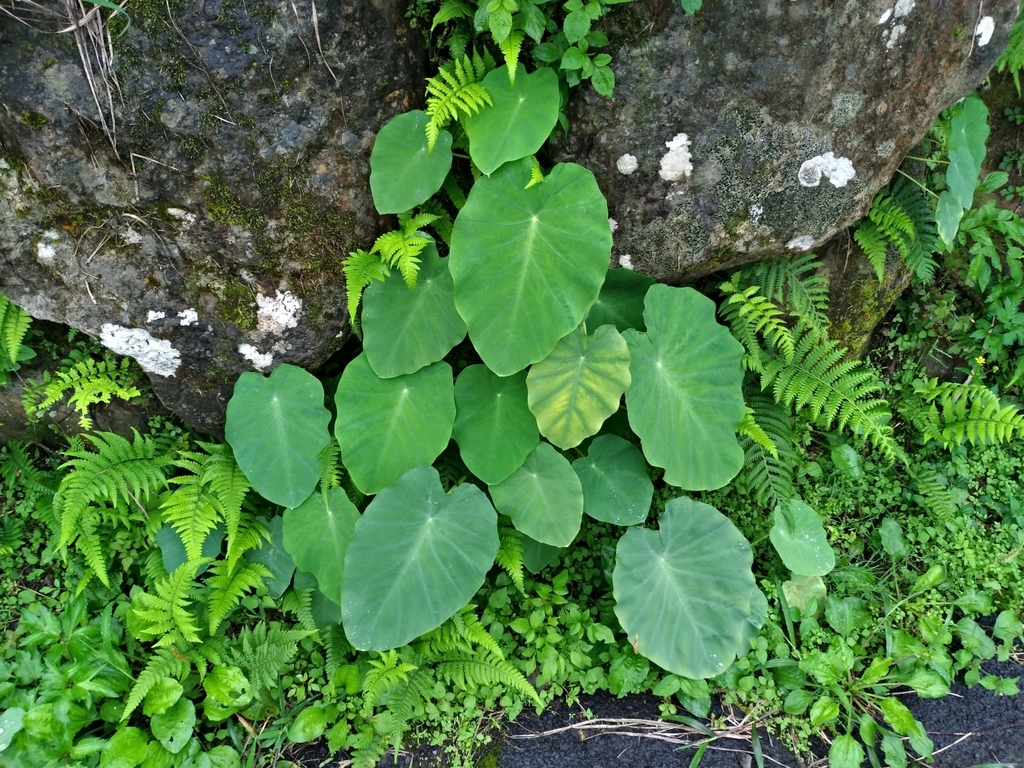
Taro
Colocasia esculenta
Colocasia esculenta is a tropical plant grown primarily for it's edible corms, the root vegetables most commonly known as taro. It is believed to be one of the earliest cultivated plants. Linnaeus originally described two species which are now known as Colocasia esculenta and Colocasia antiquorum of the cultivated plants that are known by many names including eddoes, dasheen, taro and madumbi, but many later botanists consider them all to be members of a single, very...
From the article Taro on Wikipedia (CC BY-SA), quoted section by section
Description
Colocasia esculenta is a perennial, tropical plant primarily grown as a root vegetable for its edible, starchy corm. The plant has rhizomes of different shapes and sizes. Leaves are up to 40 by 25 centimetres (15+1⁄2 by 10 inches) and sprout from the rhizome. They are dark green above and light green beneath. They are triangular-ovate, sub-rounded and mucronate at the apex, with the tip of the basal lobes rounded or sub-rounded. The petiole is .8–1.2 metres (2+1⁄2–4 feet) high. The path can be up to 25 cm (10 in) long. The spadix is about three fifths as long as the spathe, with flowering parts up to 8 millimetres (3⁄8 in) in diameter. The female portion is at the fertile ovaries intermixed with sterile white ones. Neuters grow above the females, and are rhomboid or irregular orium lobed, with six or eight cells. The appendage is shorter than the male portion.
Similar species. Taro is among the most widely grown species in the group of tropical perennial plants that are colloquially referred to as "elephant ears", when grown as ornamental plants. …
Range & habitat
Colocasia esculenta is thought to be native to Southern India and Southeast Asia, but is widely naturalised. Colocasia is thought to have originated in the Indomalayan realm, perhaps in East India, Nepal, and Bangladesh. It spread by cultivation eastward into Southeast Asia, East Asia and the Pacific Islands; westward to Egypt and the eastern Mediterranean Basin; and then southward and westward from there into East Africa and West Africa, where it spread to the Caribbean and Americas. Taro was probably first native to the lowland wetlands of Malaysia, where it is called talas. In modern times it is also called keladi Cina (literally Chinese yam). In Australia, C. esculenta var. aquatilis is thought to be native to the Kimberley region of Western Australia; the common variety esculenta is now naturalised and considered an invasive weed in Western Australia, the Northern Territory, Queensland and New South Wales. In Europe, C. esculenta is cultivated in Cyprus and it's called Colocasi, (Κολοκάσι in Greek) and it is certified as a PDO product. It is also found in the Greek island of Ikaria and cited as a vital source of food for the island during World War II. In Turkey, C. …
Wikipedia: “Distribution and habitat”
At the table
Cooked taro is 64% water, 35% carbohydrates, and contains negligible protein and fat (table). In a reference amount of 100 grams (3.5 oz), taro supplies 142 calories of food energy, and is a rich source (20% or more of the Daily Value, DV) of vitamin B6 (25% DV), vitamin E (20% DV), and manganese (21% DV), while phosphorus and potassium are in moderate amounts (10–11% DV). Raw taro leaves are 86% water, 7% carbohydrates, 5% protein, and 1% fat. The leaves are nutrient-rich, containing substantial amounts of vitamins and minerals, especially vitamin K at 103% of the DV.
Wikipedia: “Nutrition”
How it is grown
In the early 1970s, one of the earliest taro breeding programs was initiated in the Solomon Islands to create cultivars that were resistant to taro leaf blight. After taro leaf blight was introduced to Samoa in 1993, another breeding program was initiated. In this program Asian varieties that were resistant to TLB were used. The breeding program helped restore the taro export industry in Samoa. Corm yield and corm quality appear to be negatively correlated. In order to produce the uniform fresh healthy corms that the market desires, early maturing cultivars with a growth period of 5 to 7 months can be used.
Selection methods and programs. Cultivars grown in the Pacific regions produce good quality corms, as a result of selecting for corm quality and yield. However, the genetic bases of these cultivars is very narrow. Asian cultivars have agriculturally undesirable traits (such as suckers and stolon), but appear to be more genetically diverse. There needs to be an international exchange of taro germplasm with reliable quarantine procedures. There are thought to be 15,000 varieties of C. esculenta. Currently there are 6,000 accession from various institutes from across the world. The INEA (International Network for Edible Aroids) already has a core sample of 170 cultivars that have been distributed. …
Wikipedia: “Propagation”
In human culture
The Ancient Greek word κολοκάσιον (kolokasion, lit. 'lotus root') is the origin of the Modern Greek word kolokasi (κολοκάσι); the word for the plant is kolokas in Greek, gölevez in Turkish, and qulqas (قلقاس) in Arabic. These were borrowed by Latin as colocasia, thus becoming the genus name Colocasia. The specific epithet, esculenta, means "edible" in Latin. The English name taro was borrowed from the Māori language when Captain Cook first observed Colocasia plantations in New Zealand in 1769. The form taro or talo is widespread among Polynesian languages: taro in Tahitian; talo in Samoan and Tongan; kalo in Hawaiian; taʻo in Marquesan. All these forms originate from Proto-Polynesian *talo, which itself descended from Proto-Oceanic *talos (cf. dalo in Fijian) and Proto-Austronesian *tales (cf. taleus in Sundanese & tales in Javanese). However, irregularity in sound correspondences among the cognate forms in Austronesian suggests that the term may have been borrowed and spread from an Austroasiatic language perhaps in Borneo (cf. proto-Mon-Khmer *t2rawʔ, Khasi shriew, Khmu sroʔ, Mlabri kwaaj,...).
Wikipedia: “Etymology”
Where it lives
Recorded sightings
—
geo-referenced records in GBIF, from museums, herbaria and field observers.
Drag the globe to turn it. Dots are where records exist, not a range map; darker means more records.
In the old herbals & bestiaries

Rariorum Plantarum Historia (with Fungorum Historia)
Carolus Clusius · 1601 · p.457

The Plants of Egypt
Prospero Alpini · 1592 · p.98

Compendium of Materia Medica: Illustrated Volume Middle of Middle
李時珍 · 1596 · p.107

History of Rare Plants
Carolus Clusius · 1601 · p.451

Collected Illustrations of the Three Realms (Volume 104)
王圻, 王思義 · 1609 · p.110

Hokusai Manga (北斎漫画), Vol. 1
Katsushika Hokusai · 1814 · p.20

Hokusai Manga (北斎漫画), Vol. 3
Katsushika Hokusai · 1815 · p.34

Illustrated Investigation of the Names and Realities of Plants, Volume 4
吳其濬 · 1848 · p.8

Complete Treatise on Agricultural Administration
Xu Guangqi · 1909 · p.824
In the stacks
Searching the stacks…
Every page naming Colocasia esculenta in the Biodiversity Heritage Library →
This page is assembled live from iNaturalist, GBIF, Wikipedia, the Source Library and the Internet Archive. It is not yet part of the hand-edited codex. iNaturalist taxon 122835.