- Plants
- ›Vascular Plants
- ›flowering plants
- ›monocots
- ›grasses, sedges, cattails, and allies
- ›grasses
- ›bamboos, canes, and allies
- ›Bambuseae
- ›Bambusinae
- ›Bambusa
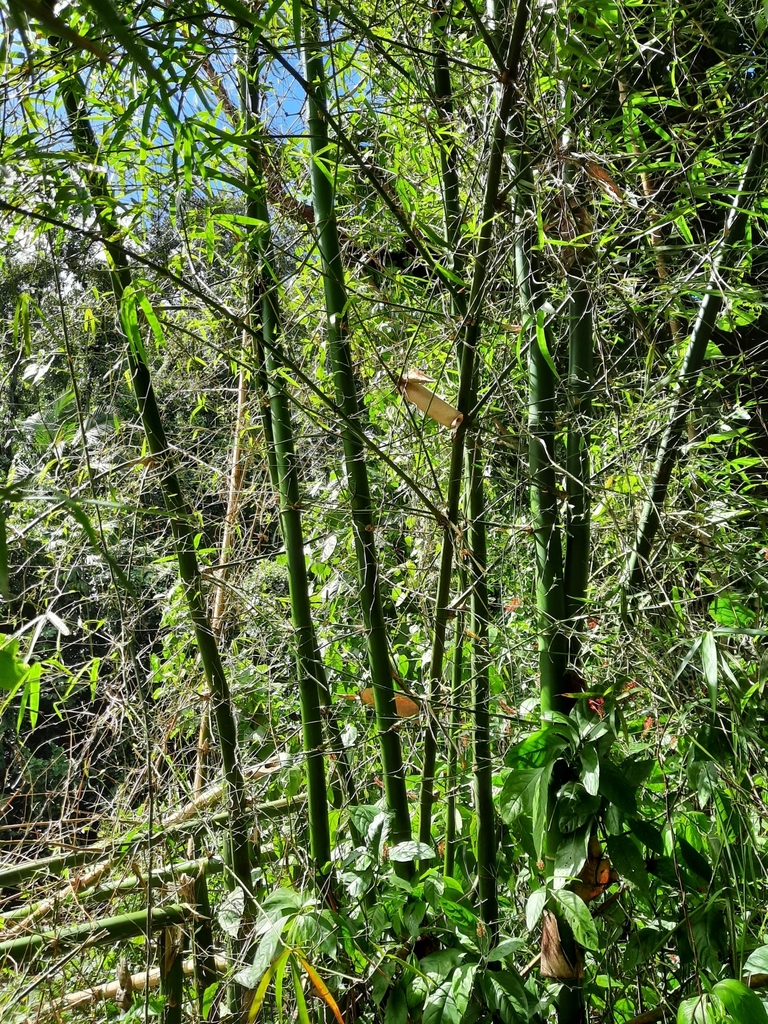
common bamboo
Bambusa vulgaris
Bambusa vulgaris, common bamboo, is an open-clump type bamboo species. It is native to Bangladesh, India, Sri Lanka, Southeast Asia, and to the province of Yunnan in southern China, but it has been widely cultivated in many other places and has become naturalized in several regions. Among bamboo species, it is one of the largest and most easily recognized.
From the article Bambusa vulgaris on Wikipedia (CC BY-SA), quoted section by section
Description
Bambusa vulgaris forms moderately loose clumps and has no thorns. It has lemon-yellow culms (stems) with green stripes and dark green leaves. Stems are not straight, not easy to split, inflexible, thick-walled, and initially strong. The densely tufted culms grow 10–20 m (30–70 ft) high and 4–10 cm (2–4 in) thick. Culms are basally straight or flexuose (bent alternately in different directions), drooping at the tips. Culm walls are slightly thick. Nodes are slightly inflated. Internodes are 20–45 cm (7.9–17.7 in). Several branches develop from mid-culm nodes and above. Culm leaves are deciduous with dense pubescence. Leaf blades are narrowly lanceolate. Flowering is not common, and there are no seeds. Fruits are rare due to low pollen viability caused by irregular meiosis. At the interval of several decades, the whole population of an area blooms at once, and individual stems bear a large number of flowers. Vegetation propagates through clump division, by rhizome, stem and branch cutting, layering, and marcotting. The easiest and most practised cultivation method is culm or branch cutting. In the Philippines, the best results were obtained from one-node cuttings from the lower parts of six-month-old culms. When a stem dies, the clump usually survives. A clump can grow out of stem used for poles, fences, props, stakes, or posts. …
Range & habitat
Common bamboo is the most widely grown bamboo throughout the tropics and subtropics. Although mostly known only from cultivation, spontaneous (nondomesticated), escaped, and naturalized populations exist throughout the tropics and subtropics in and outside Asia. B. vulgaris is widely cultivated in East, Southeast, and South Asia, as well as tropical Africa including Madagascar. It is highly concentrated in the Indomalayan rainforests. The species is one of the most successful bamboos in Pakistan, Tanzania, and Brazil. Popular as a hothouse plant by the 1700s, it was one of the earliest bamboo species introduced into Europe. It is believed to have been introduced to Hawaii in the time of Captain James Cook (the late 18th century), and is the most popular ornamental plant there. B. vulgaris is widely cultivated in the USA and Puerto Rico, apparently since introduction by Spaniards in 1840. It may have been the first foreign species introduced into the United States by Europeans.
Wikipedia: “Distribution and habitat”
What it does
B. vulgaris grows mostly on river banks, road sides, wastelands, and open ground, generally in the low altitudes. It is a preferred species for erosion control. It grows best under humid conditions, but can tolerate unfavorable conditions like low temperatures and drought. Though adoptable to a wide range of soils, common bamboo grows more vigorously on moist soils. It can tolerate frost down to −3 °C (27 °F), and can grow on ground up to 1,500 m (4,900 ft) above sea level, though in higher altitudes stems grow shorter and thinner. In extreme droughts, it may defoliate completely.
Pests. The two major threats to the species are small bamboo borers (Dinoderus minutus), which as adults bore stems in India, China, Philippines, Australia, and Japan, and bamboo weevils (Cyrtotrachelus longimanus), which destroy shoots during their larval stage in South China. Other pests include leaf blight (Cercospora), basal culm rot (Fusarium), culm sheath rot (Glomerella cingulata), leaf rust (Kweilingia divina), and leaf spots (Dactylaria). In Bangladesh, bamboo blight caused by Sarocladium oryzae is a serious disease.
Wikipedia: “Ecology”
At the table
Common bamboo has a wide variety of uses, including the stems used as fuel and the leaves used as fodder, though a large amount of ingestion of leaves is known to cause neurological disorder among horses. The worldwide production and trade of B. vulgaris is considerable, though no statistics are available. It also has some disadvantages. Working and machining properties of the stems are poor, as they are not straight, not easy to split, and not flexible, but they are thick-walled and initially strong. Because of high carbohydrate content, stems are susceptible to attacks from fungi and insects such as powderpost beetles. Protection from biological threats is essential for long-term use. B. v. var. striata is used as ornamental solitary or as border hedge. Its shoots boiled in water are sometimes used for medicinal qualities. Cultivated around the world, it is generally found in East, Southeast, and South Asia. B. v. f. waminii is cultivated in the US and Europe in addition to Asia. B. v. f. vittata is the most popular variety as an ornamental plant, and is considered to be very beautiful. The 'Kimmei' cultivar is mostly cultivated in Japan.
Ornamental. It is widely used as an ornamental plant. It often is planted as fences and border hedges. It is also planted as a measure for erosion control.
Construction. The stems or culms of B. …
Wikipedia: “Uses”
Toxicity
Among all bamboos, only shoots of B. vulgaris contains taxiphyllin (a cyanogenic glycoside) that functions as an enzyme inhibitor in the human body when released, but degrades readily in boiling water. It is highly toxic, and the lethal dose for humans is about 50–60 mg. A dose of 25 mg cyanogenic glycoside fed to rats (100–120 g body weight) caused clinical signs of toxicity, including apnoea, ataxia, and paresis. Horses in Pará, Brazil, were diagnosed with clinical signs of somnolence and severe ataxia after ingesting B. vulgaris. Farmers in Africa sometimes prefer to buy it rather than plant it, as they believe it harms the soil.
How it is grown
Though not suited for small yards, as it grows in large clumps, young plants of golden bamboo can be grown in large containers. Golden bamboo grows well in full sunlight or partial shade. Protection is important, as animals often graze on young shoots. In Tanzania, management of B. vulgaris cultivation entails clearing of the ground around clumps.
Wikipedia: “Cultivation”
Where it lives
Recorded sightings
—
geo-referenced records in GBIF, from museums, herbaria and field observers.
Drag the globe to turn it. Dots are where records exist, not a range map; darker means more records.
In the stacks
Searching the stacks…
Every page naming Bambusa vulgaris in the Biodiversity Heritage Library →
This page is assembled live from iNaturalist, GBIF, Wikipedia, the Source Library and the Internet Archive. It is not yet part of the hand-edited codex. iNaturalist taxon 122530.