On eBird ↗
Bell Miner
Live sightings near you, the range map, bar charts of when it is seen, and Macaulay Library photos and recordings.
Bell Miner
Manorina melanophrys
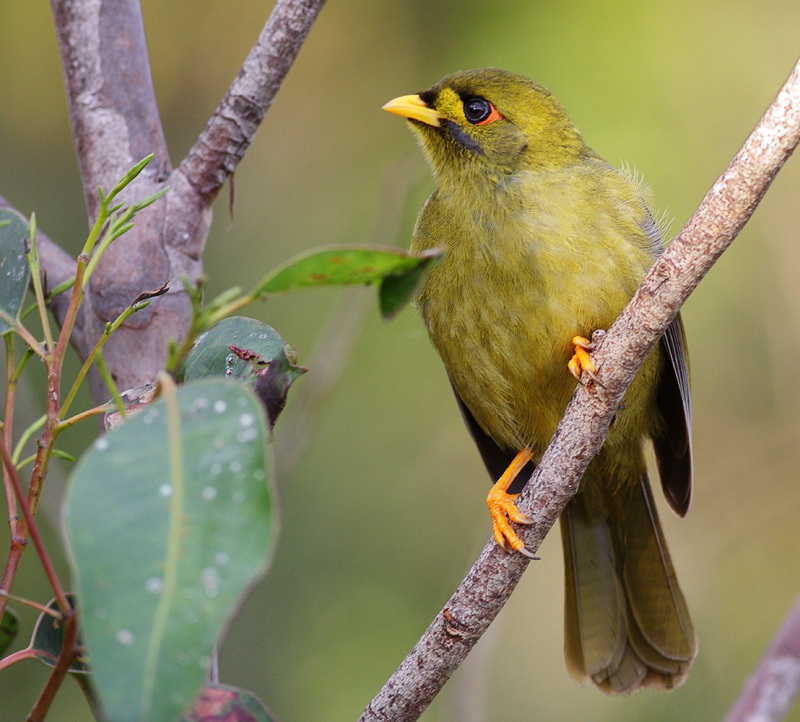
The bell miner or bellbird (Manorina melanophrys) is a colonial honeyeater, endemic to southeastern Australia. The common name refers to their bell-like call. "Miner" is an old alternative spelling of "myna", and is shared with other members of the genus Manorina. The birds feed almost exclusively on the dome-like coverings, referred to as lerps, of certain psyllid bugs.
Bell miners live in large, complex, social groups. Within each group, there are subgroups consisting of several breeding pairs, but also including a number of birds that are not currently breeding. The nonbreeders help in providing food for the young in all the nests within the subgroup, even though they are not necessarily closely related to them. The birds defend their colony area communally and aggressively, excluding most other passerine species. They do this in order to protect their territory from other insect-eating birds that would eat the bell lerps on which they feed. Whenever the local forests die back, due to increased lerp psyllid infestations, bell miners undergo a population boom.
From the article Bell miner on Wikipedia (CC BY-SA), quoted section by section
Description
Bell miners are the smallest of their genus, and differ from the other three predominantly grey miner species in having olive-green plumage, darker on the wings and yellower on the belly. They are a medium bodied honeyeater, slightly smaller and stockier than a Lewin's honeyeater (Meliphaga lewinii), weighing between 25 g and 35 g (average 29 g). Bell miners are 17.5–20 cm in length (average 18.5 cm) with a 22–30 cm wingspan (average 26.5 cm). They have the characteristic yellow bill of the miners, which is slightly downturned. The legs are bright orange, and the bare patch behind the eye is red-orange. The crown and lores are black, while the feathers in front of the eye are yellow. A dark streak runs from the corner of the bill downward giving a slight frowning appearance. Eyes are brown and mouth is yellow. Both sexes look alike, though the males tend to be slightly larger. It is possible to determine the sex of the birds by analyzing wing length, tail length, and culmen depth, or by observing calls that are unique to females, but there is no easy way to reliably determine the sex in the field without careful observation of behaviour and calls. Juveniles are more brown-colored than the adults and overall less bright in color. Young birds do not have the bare skin patch behind the eye. …
Range & habitat
Bell miners are distributed from around Gympie in Queensland, south along the coastal plain and ranges, to Victoria, around Melbourne. They prefer the margins of wet or dry sclerophyll forest and thick woodlands, often with a stream or other permanent water source nearby. This limits their range to higher rainfall areas near the coast, often bordering, but not inside, rainforest. Compared to the closely related noisy miner, bell miners prefer a denser habitat with a thick understory (<5 m), but a sparse midstory (5–15 m) and canopy (>15m). In an undisturbed setting, bell miners choose habitat with an understory of shrubs, ferns, sedges, and rainforest vines. They have been observed to expand their range in disturbed habitats that have a thick undergrowth of the invasive weed lantana. Bell miner population densities have been measured at 14 to 38 birds per hectare. They are particular about their preferred habitat and reasonably small disturbances to undergrowth, such as fire or lantana removal, can cause a colony to move to a new territory.
Wikipedia: “Distribution and habitat”
What it does
Bell miners specialize in consuming insects known as psyllids and their associated young nymphs, sweet lerps, and other psyllid secretions. Psyllid products may consist of up to 90% of the bell miner's diet. Bell miners forage primarily among leaves, branches, and loose bark in the canopy, generally at least 8 m in height, but they do descend to the dense understory. There is a theory that bell miners 'farm' psyllids by excluding other psyllid-eating bird species from a large enough territory, that the miners themselves do not require all the psyllids from in order to sustain the colony. One hypothesis under the farming theory is that the bell miners may selectively eat only older nymphs, or may often eat the lerps and leave the nymph unharmed. Evidence for this theory has been mixed. An early study of stomach contents did not find supporting evidence for this theory, as bell miner stomachs did not contain the higher lerp/nymph ratio that would have been expected. However, a later behavioral comparison between bell miners and noisy miners did observe that bell miners carefully used their tongue to remove lerps, which left the nymph intact. In contrast, noisy miners pried the lerp and nymph off with their beak and consumed both. …
Wikipedia: “Feeding”
Listen
Looking for field recordings…
Where it lives
Recorded sightings
—
geo-referenced records in GBIF, from museums, herbaria and field observers.
Drag the globe to turn it. Dots are where records exist, not a range map; darker means more records.
In the stacks
Searching the stacks…
Every page naming Manorina melanophrys in the Biodiversity Heritage Library →
This page is assembled live from iNaturalist, GBIF, Wikipedia, the Source Library and the Internet Archive. It is not yet part of the hand-edited codex. iNaturalist taxon 12230.