- Plants
- ›Vascular Plants
- ›flowering plants
- ›Dicots
- ›dogwoods, hydrangeas, and allies
- ›hydrangea family
- ›Hydrangea
- ›Macrophyllae
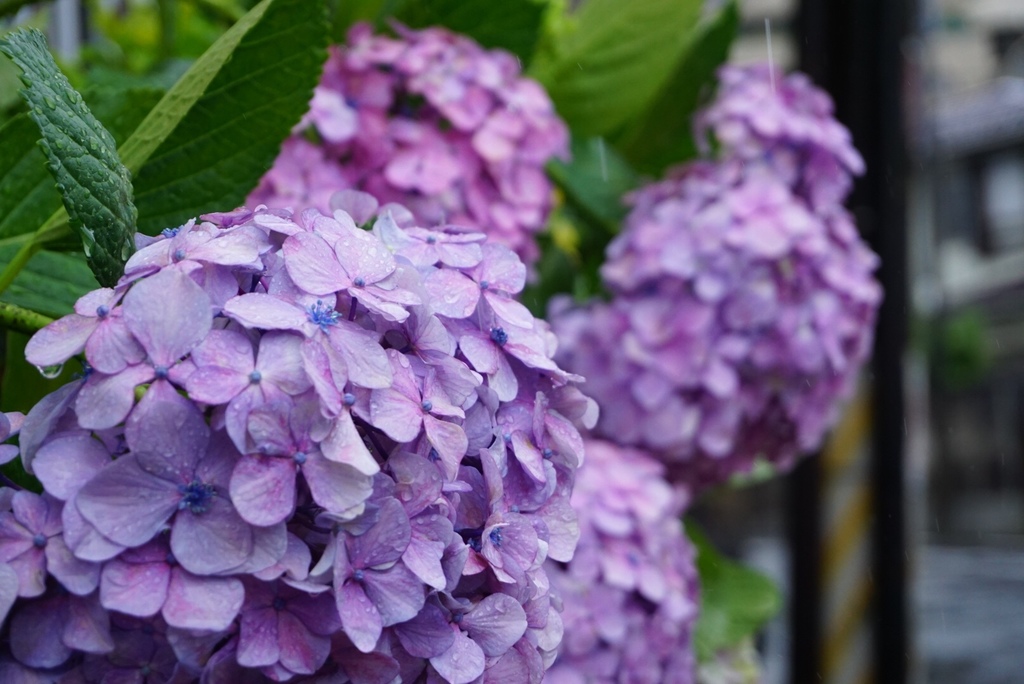
mophead hydrangea
Hydrangea macrophylla
Hydrangea macrophylla is a species of flowering plant in the family Hydrangeaceae, native and endemic to Japan. It is a deciduous shrub growing to 3 m (10 ft) tall by 2.5 m (8 ft) or more broad with large heads of pink or blue flowers in summer and autumn. It is currently treated as monotypic, with no subspecies or varieties. Common names include bigleaf hydrangea, and, for particular cultivar groups, the names lacecap hydrangea, mophead hydrangea, and hortensia. It is widely cultivated in many parts of the world in many climates. It is not to be confused with H. aspera 'Macrophylla'.
From the article Hydrangea macrophylla on Wikipedia (CC BY-SA), quoted section by section
Description
The term macrophylla means 'large- or long-leaved'. The opposite leaves can grow to 15 cm (6 in) in length. They are simple, membranous, orbicular to elliptic and acuminate. They are generally serrated. The natural inflorescence of wild Hydrangea macrophylla is a corymb, with all flowers placed in a plane. Two distinct types of flowers are found; numerous central, small, fertile pentamerous ones, and a few peripheral, large, tetramerous ones; the latter are usually sterile, and whitish to pale blue or pinkish. The small flowers have five small greenish sepals and five small petals. Flowering begins in early summer and lasts until early winter. The fruit is a subglobose capsule. In cultivation as an ornamental plant, numerous variants have been developed as cultivars; in most of these (over 500 cultivars), the small central flowers replaced by large, sterile or mostly sterile tetramerous flowers, the inflorescence forming a hemisphere or a whole sphere rather than in a flat plane. These cultivar groups are known as "mophead" or "hortensia" hydrangeas. These large flowers have colours ranging from pale pink to red, fuchsia, purple, to blue. …
Range & habitat
Hydrangea macrophylla is endemic to Japan, where it occurs in coastal habitats from Honshu southwards. Natural wild plants, formerly sometimes distinguished as H. macrophylla var. normalis E.H.Wilson, have "lacecap" structure flowerheads, with a few large sterile showy bract-like flowers that act as targets for pollinators, surrounding a central cluster of small fertile flowers. A closely related hydrangea from the mountains of the interior of Japan, Hydrangea serrata, was treated as a variety of H. macrophylla by some authors in the past, but is currently treated as a separate species. The species is naturalised in China, Korea, Siberia, New Zealand and the Americas, and has become an invasive species in the Azores and Madeira archipelagos.
Wikipedia: “Distribution and habitat”
At the table
Amacha is a Japanese beverage made from fermented leaves of Hydrangea macrophylla var. thunbergii. Hydrangeae Dulcis Folium is a drug made from the fermented and dried leaves of H. macrophylla var. thunbergii with possible antiallergic and antimicrobial properties. It also has a hepatoprotective activity by suppression of D-galactosamine-induced liver injury in vitro and in vivo. Hydrangea macrophylla is included in the Tasmanian Fire Service's list of low flammability plants, indicating that it is suitable for growing within a building protection zone. Leaf extracts of Hydrangea macrophylla are being investigated as a possible source of new chemical compounds with antimalarial activity. Hydrangeic acid from the leaves is being investigated as a possible anti-diabetic drug as it significantly lowered blood glucose, triglyceride, and free fatty acid levels in laboratory animals.
Wikipedia: “Uses”
Where it lives
Recorded sightings
—
geo-referenced records in GBIF, from museums, herbaria and field observers.
Drag the globe to turn it. Dots are where records exist, not a range map; darker means more records.
In the stacks
Searching the stacks…
Every page naming Hydrangea macrophylla in the Biodiversity Heritage Library →
This page is assembled live from iNaturalist, GBIF, Wikipedia, the Source Library and the Internet Archive. It is not yet part of the hand-edited codex. iNaturalist taxon 122034.