- Plants
- ›Vascular Plants
- ›flowering plants
- ›Dicots
- ›Mints, Plantains, Olives, and Allies
- ›Mint Family
- ›Nepetoideae
- ›Mentheae
- ›balms, mints, and thymes
- ›Blephilia
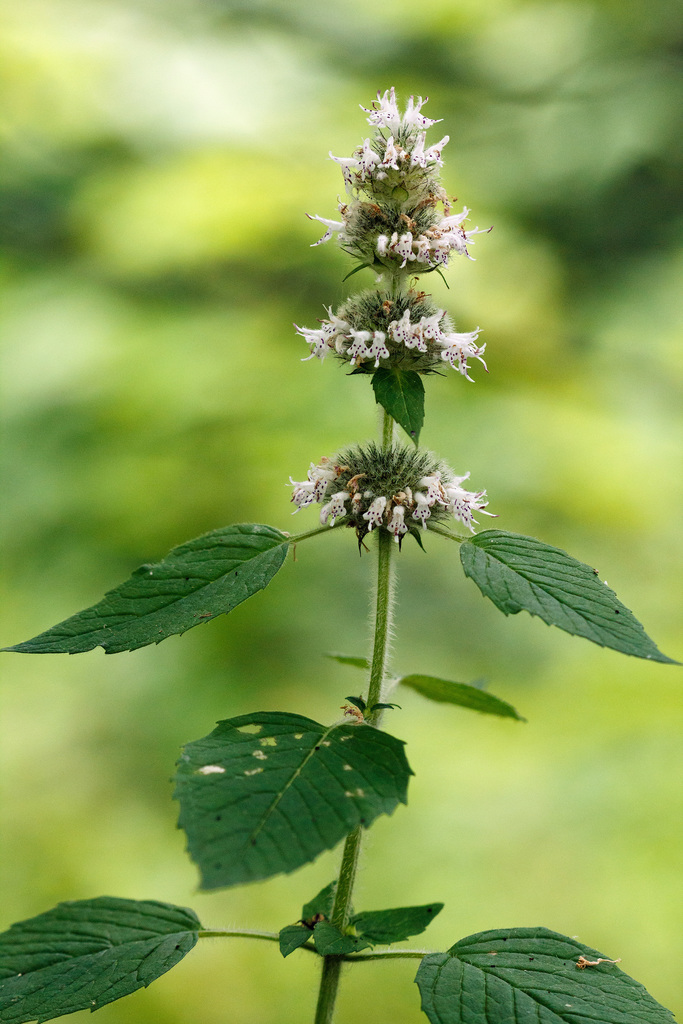
Hairy Wood Mint
Blephilia hirsuta
Blephilia hirsuta, commonly known as hairy wood-mint or hairy pagoda plant, is a species of herbaceous perennial in the mint family Lamiaceae. It is native to eastern North America.
From the article Blephilia hirsuta on Wikipedia (CC BY-SA), quoted section by section
Description
Hairy wood mint is a perennial plant that is normally 30 to 120 cm (12 to 47 inches) tall. The central stem is covered with long white hairs and ends in several whorls of flowers. The flowers can be either light blue, pale purple or white with purple spots. Each flower is about 1 cm (1⁄2 inch) long with light green sepals, two main 'lips', two visible stamens, and a style that is divided at its tip. The flowers appear in the summer for roughly a month and a half. Arranged oppositely along the stem, the leaves of hairy wood mint are long but thin, becoming wider near the base of the leaf. They are pleasantly fragrant. The petioles are 1 to 3 cm (1⁄2 to 1+1⁄4 inches) and are covered with little hairs. Out of all the plants in this genus, Blephilia hirsuta has the largest leaves. The stems grow from a system of rhizomes with fibrous roots.
Range & habitat
In Canada, hairy wood mint can be found in southern Quebec and Ontario. It is common throughout the eastern United States, including Connecticut, Florida, Indiana, Kentucky, Minnesota, Nebraska, North Carolina, Tennessee, West Virginia, and Wisconsin. Hairy wood mint prefers rich moist soil in hardwood forests, along streams and rivers, in forest openings and thickets underlain by limestone, and is occasionally found near wetlands. Hairy wood mint likes partial sun or light shade. Forests with infrequent, low-intensity disturbances (i.e., gap dynamics) are ideal.
Wikipedia: “Distribution and habitat”
What it does
Many different types of bees (e.g., honeybees, mason bees, and miner bees), flies (e.g., bee-flies and syrphids), and butterflies (e.g., skippers) pollinate the flowers of hairy wood mint. Many of these pollinators pollinate the hairy wood mint because they get a nectar reward, although some are after the pollen itself. The foliage "probably isn't attractive to mammalian herbivores as a food source."
Wikipedia: “Ecology”
Where it lives
Recorded sightings
—
geo-referenced records in GBIF, from museums, herbaria and field observers.
Drag the globe to turn it. Dots are where records exist, not a range map; darker means more records.
In the stacks
Searching the stacks…
Every page naming Blephilia hirsuta in the Biodiversity Heritage Library →
This page is assembled live from iNaturalist, GBIF, Wikipedia, the Source Library and the Internet Archive. It is not yet part of the hand-edited codex. iNaturalist taxon 120895.