- Animals
- ›Arthropods
- ›Hexapods
- ›Insects
- ›Winged and Once-winged Insects
- ›True Bugs, Hoppers, Aphids, and allies
- ›True Hoppers
- ›Spittlebugs, Cicadas, Leafhoppers and Treehoppers
- ›Leafhoppers and Treehoppers
- ›Typical Treehoppers
- ›Smiliinae
- ›Buffalo Treehoppers and allies
- ›Spissistilus
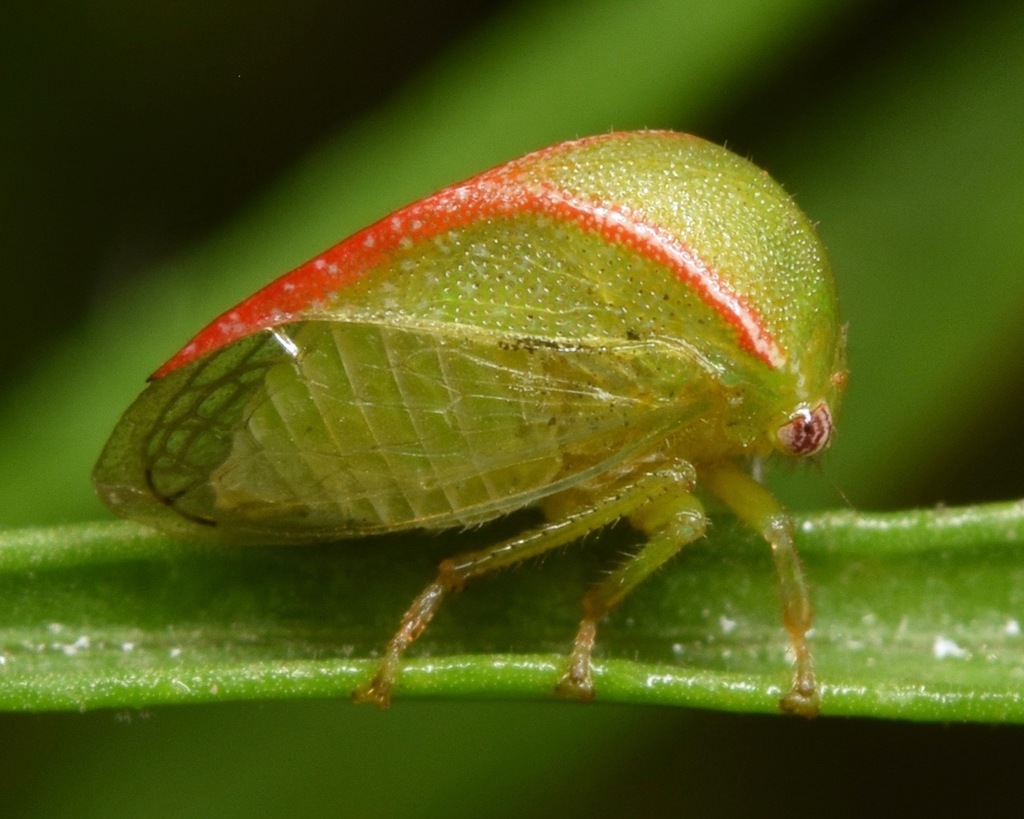
Three-cornered Alfalfa Hopper
Spissistilus festinus
Spissistilus festinus, the threecornered alfalfa hopper, is a species of treehopper in the family Membracidae. The common name is in reference to the species' notoriety as an alfalfa pest. S. festinus is a transcontinental species, spanning across Canada to the West Indies, and is most commonly found in the southern United States.
From the article Spissistilus festinus on Wikipedia (CC BY-SA), quoted section by section
Description
S. festinus is about 6-7mm long in adulthood, with a pronotum that spans to the tip of the abdomen. The species common name references the shape of the pronotum; the presence of three corners, one at the apex, and one at each shoulder, produces a "threecornered" appearance when viewed from the front. Live adult species are a light green colour; when dried and pinned, species appear deep orange to straw coloured. Adult males are distinguishable from females based on a starkly smaller body size, as well as a red tint on the dorsal side of the pronotum.
Wikipedia: “Morphology”
What it does
S. festinus has a hemimetabolous life cycle that includes three stages: egg, nymph and adult. Female eggs are white in colour, oblong in shape, and range in size from 0.9 to 1.3mm long. Eggs have a small and large end, with the larger end being covered in papillae; this is thought to secure the egg within the plant tissue of the host species. Female S. festinus uses ovipositor to create a slit under the epidermis of the host plant. The oviposition behaviour is dependent on the host plant species; in alfalfa plants, eggs are typically deposited near the base of the plant, just below the surface of the soil. The number of eggs laid per slit is also dependent on the host plant species. Following oviposition, embryonic development lasts from 6 to 27 days before the nymph emerges from the egg. Nymphal development typically lasts between 18 and 33 days, though may require longer as temperatures deviate from 30 degrees. There are typically 5 instars, though it can vary between 4–6; the number and length of instars is dependent on temperature and nutritional conditions. The first and second instars of S. festinus is 1.6mm and 2.1mm in length respectively, and develop a series of spurs along the length of the spine. The third instar is 2.9mm in length, and transitions from pale green or straw-like in colour to a darker yellow-brown with green markings. …
Wikipedia: “Life cycle”
Listen
Looking for field recordings…
Where it lives
Recorded sightings
—
geo-referenced records in GBIF, from museums, herbaria and field observers.
Drag the globe to turn it. Dots are where records exist, not a range map; darker means more records.
In the stacks
Searching the stacks…
Every page naming Spissistilus festinus in the Biodiversity Heritage Library →
This page is assembled live from iNaturalist, GBIF, Wikipedia, the Source Library and the Internet Archive. It is not yet part of the hand-edited codex. iNaturalist taxon 120884.