On eBird ↗
Yellow-billed Shrike
Live sightings near you, the range map, bar charts of when it is seen, and Macaulay Library photos and recordings.
Yellow-billed Shrike
Corvinella corvina
The yellow-billed shrike (Corvinella corvina) is a large passerine bird in the shrike family. It is sometimes known as the long-tailed shrike, but this invites confusion with the long-tailed shrike, Lanius schach, of tropical southern Asia. It is the only species placed in the genus Corvinella. The yellow-billed shrike is a common resident breeding bird in tropical Africa from Senegal eastwards to Uganda and locally in westernmost Kenya. It frequents forest and other habitats with trees.
From the article Yellow-billed shrike on Wikipedia (CC BY-SA), quoted section by section
Description
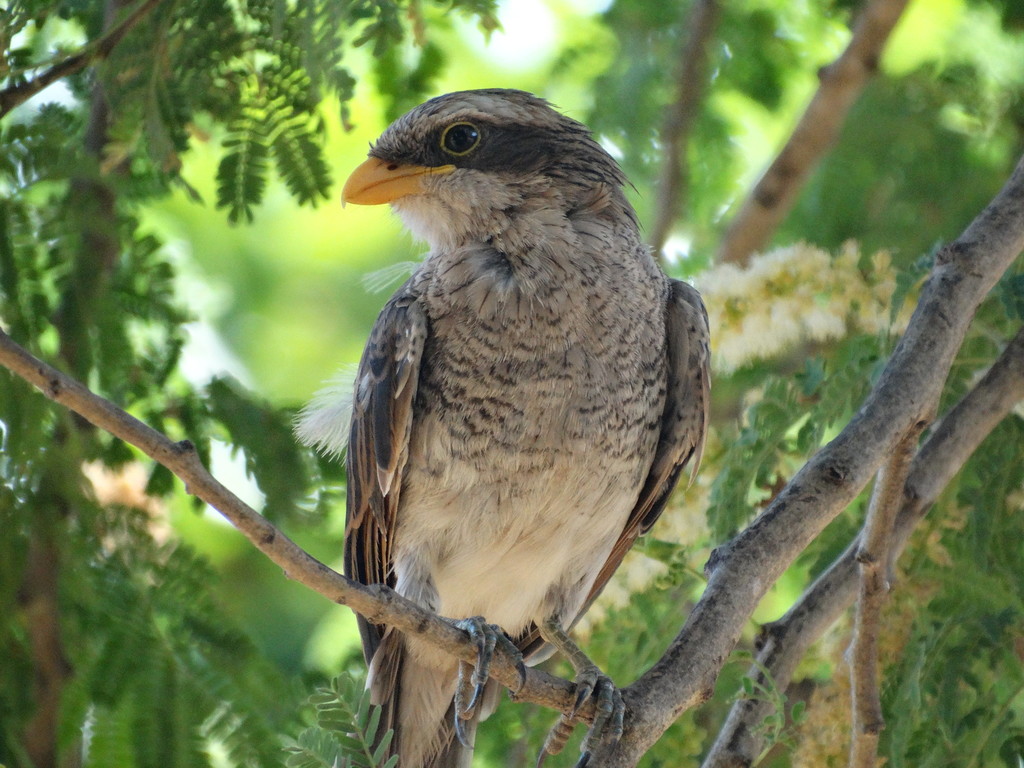
The yellow-billed shrike is 32 cm (13 in) with a long, graduating tail and short wings. The adult has mottled brown upperparts and streaked buff underparts. It has a brown eye mask and a rufous wing patch, and the bill is yellow. Sexes are largely similar, but females have maroon patches on the flanks, while males have rufous parches; these patches are only visible when the bird is in flight, displaying, engaging in territorial disputes, or preening. Immature birds show buff fringes to the wing feathers. The legs and feet are black, and the beak is yellow, even in juveniles. It is a noisy bird, with harsh swee-swee and dreee-too calls.
Range & habitat
The species is resident in tropical Africa, south of the Sahara and north of the equator, but is not present in the Horn of Africa. It is present in Benin, Burkina Faso, Cameroon, Central African Republic, Chad, Congo, the Democratic Republic of Congo, Côte d'Ivoire, Gambia, Ghana, Guinea, Guinea-Bissau, Kenya, Mali, Mauritania, Niger, Nigeria, Senegal, Sierra Leone, South Sudan, Sudan, Togo, and Uganda. It makes localised movements, but these have been little studied.
Wikipedia: “Distribution”
What it does
This is a conspicuous and gregarious bird and a cooperative breeder, always seen in groups, often lined up on telephone wires. The nest is a cup structure in a bush or tree into which four or five eggs are laid. Only one female in a group breeds at a given time, with other members providing protection and food. The yellow-billed shrike feeds on insects, which it locates from prominent look-out perches in trees, wires, or posts. They also sometimes eat small frogs, reptiles, and mice, but are not known to eat other birds or to form larders.
Wikipedia: “Behaviour and ecology”
Listen
Looking for field recordings…
Where it lives
Recorded sightings
—
geo-referenced records in GBIF, from museums, herbaria and field observers.
Drag the globe to turn it. Dots are where records exist, not a range map; darker means more records.
In the stacks
Searching the stacks…
Every page naming Corvinella corvina in the Biodiversity Heritage Library →
This page is assembled live from iNaturalist, GBIF, Wikipedia, the Source Library and the Internet Archive. It is not yet part of the hand-edited codex. iNaturalist taxon 12057.