- Plants
- ›Vascular Plants
- ›flowering plants
- ›Dicots
- ›beeches, oaks, walnuts, and allies
- ›beech family
- ›Quercus
- ›Quercus
- ›Lobatae
- ›Phellos
- ›Quercus phellos
willow oak
Quercus phellos
Quercus phellos, the willow oak, is a North American species of a deciduous tree in the red oak group of oaks. It is native to the eastern and central United States from Long Island Sound south to northern Florida, and west to southernmost Illinois, Missouri, Oklahoma, and eastern Texas. It is most commonly found growing on lowland floodplains, often along streams, but rarely also in uplands with poor drainage, up to 400 meters (1,300 ft) altitude.
From the article Quercus phellos on Wikipedia (CC BY-SA), quoted section by section
Description
It is a medium-sized tree growing to 20–30 meters (65–100 feet) tall (exceptionally to 39 m, 128 ft), with a trunk up to 1–1.5 m (3+1⁄2–5 ft) in diameter (exceptionally 2 m or 6+1⁄2 ft).
Bark. Willow oak bark on young stems is smooth, gray, and tight, becoming dark and furrowed as it ages.
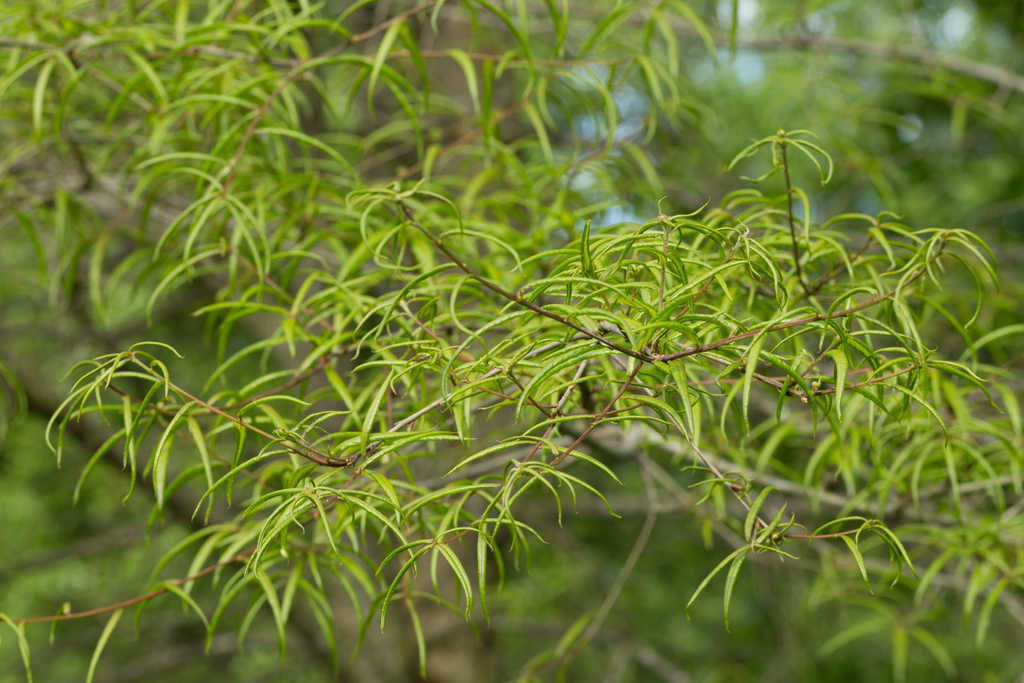
Leaves. It is distinguished from most other oaks by its leaves, which are shaped like willow leaves, with an entire (untoothed and unlobed) margin; they are bright green above, paler beneath, usually hairless but sometimes downy beneath. The leaves of the willow oak are 2-5 inches long, alternate, simple, linear in shape (resembling those of a Willow, from which it bears its name), with a bristle tip. In the fall, the color will be yellow, orange-brown, to red-brown.
Fruit. The willow oak is monoecious. Male and female flowers on the willow oak are unisex, and pollination occurs through wind. The female flowers develop into acorns, while the male flowers appear as catkins. Flowering typically takes place between February and May, and acorns mature between August and October of their second year. The fruit is an acorn, 8–12 millimeters (5⁄16–15⁄32 in) long, and almost as wide as long, with a shallow cup; it is one of the most prolific producers of acorns. The tree starts acorn production around 15 years of age, earlier than many oak species.
Form. …
Range & habitat
The species is most common in the American south and eastern states. It can be found from Long Island Sound south to northern Florida, and west to southernmost Illinois, Missouri, Oklahoma, and eastern Texas. Its natural range extends into southeastern Pennsylvania and southern New Jersey. It has also historically been recorded as occurring in Lancaster, Bucks, Chester, Delaware, and Philadelphia counties, chiefly on wet sites, occasionally in drier, upland ones. Much of that area has been built over and developed since World War II, and the tree is now classified as endangered in the state. It is most commonly found growing on lowland floodplains, often along streams, but rarely also in uplands with poor drainage, up to 400 m (1,300 ft) in altitude.
Climate. Willow oaks can be found in humid and temperate climates. The areas in which willow oaks mainly grow are characterized by daily temperatures above 0 °C, and where the temperature in the summer averages 21° to 27 °C. Winter temperatures range from -4° to 13° with annual temperatures ranging from 10° to 21°. Humidity averages 60 to 70 percent in January and 50 to 70 percent in July. Precipitation is fairly evenly distributed throughout the year, with more in the summer.
Soil. Willow oaks are typically found on ridges and high flats, as well as ridges, flats, and sloughs. …
Wikipedia: “Distribution and habitat”
At the table
Economic uses are primarily as an ornamental tree and the wood for pulp and paper production, but also for lumber. Willow oak is a source of lumber and pulp; it has a light to medium reddish-brown color and has fairly coarse grain. Some of the common uses for willow oak lumber are cabinetry, furniture, interior trim, and flooring. Willow oak lumber is considered cheaper because of its comparison to White oak lumber, which is less susceptible to decay. Historically, willow oaks have been used for pulpits, pews, bar tops, wagon axles, stairs, railings, and flour barrels. Native Americans also used the wood and bark in baths for aches and cuts. Acorns, in colonial times, were also used as a substitute for flour, and when roasted, could be used as a coffee substitute. Willow oaks are also used to stabilize soil and filter runoff. Because of their hardy roots and ability to thrive along rivers, they control erosion along river banks. They can also be used for restoration of bottomland hardwood forests and for the rehabilitation of disturbed area.
Chemistry and chemical uses. Willow oaks have been used in medicine as antiseptics and in gastrointestinal disorders due to the phenolic compounds, terpenoids, fatty acids, vitamins, sterols, and aliphatic alcohol present in the leaves, acorns, and bark. Within the willow oak, phenolic compounds protect the plant against herbivores. …
Wikipedia: “Uses”
How it is grown
The willow oak is also known for its ability to handle urban landscapes. Because of their shallow root structure, the willow oak is ideal for lawns and parks, as long as their roots have room to spread. The willow oak is fairly drought-tolerant, valued for storm resistance, withstands flooding, and is tolerant to urban pollution. Willow oaks transplant easily because of their shallow roots. They are primarily propagated through their acorns. They can be planted in their desired growing location, but if transplanted, they can be moved in late winter when dormant. When planting, the willow oak grows best in full sun and, when maturing, needs to be watered deeply; along with this, applying fertilizer in the early spring and providing ample space for the canopy will give it the best chance to thrive. The willow oak is one of the most popular trees for horticultural planting, due to its rapid growth, hardiness, balance between axial and radial dominance, ability to withstand both sun and shade, light green leaf color, and full crown. Despite being heavily used in landscaping in the Southern US (in cities such as Washington, D.C., Raleigh, Charlotte, and Atlanta) around malls, along roads, etc., the trees tend to grow larger than planners expect, which often leads to cracked sidewalks.
Wikipedia: “Horticulture”
In human culture
One of the first recorded willow oaks was found at the site of Jamestown and was found to be around 157 years old; this was determined using acorns, photographs, and tree dating. When measuring the tree, it was found to be 36.4 inches in diameter, growing between 0.26 and 0.40 inches in diameter a year. Within this study, it was found that willow oaks were present on Jamestown Island when Jamestown was established in the early 1600s. Another prominent willow oak is the War of 1812 Willow Oak in Prince George's County, Maryland. This willow oak was likely planted in the nineteenth century, and has witnessed the War of 1812 and its growing site, Oxon Hill, become a living history site through the National Park Service.
Wikipedia: “History”
Where it lives
Recorded sightings
—
geo-referenced records in GBIF, from museums, herbaria and field observers.
Drag the globe to turn it. Dots are where records exist, not a range map; darker means more records.
In the old herbals & bestiaries


In the stacks
Searching the stacks…
Every page naming Quercus phellos in the Biodiversity Heritage Library →
This page is assembled live from iNaturalist, GBIF, Wikipedia, the Source Library and the Internet Archive. It is not yet part of the hand-edited codex. iNaturalist taxon 119983.