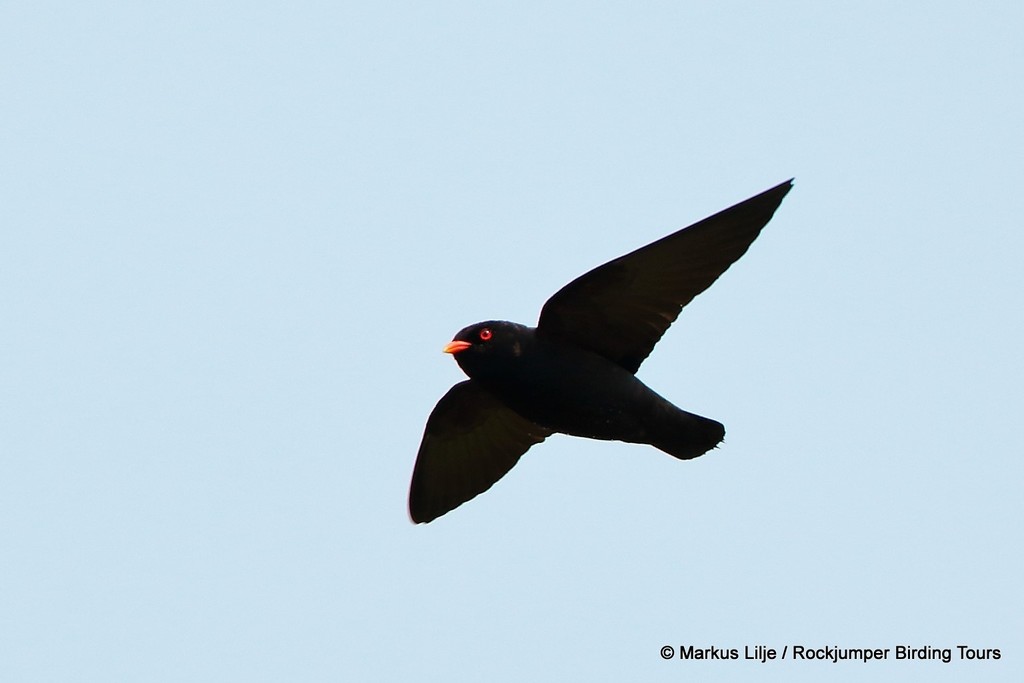
River Martins
Pseudochelidon
The river martins form a distinctive subfamily Pseudochelidoninae within the swallow and martin bird family Hirundinidae. The two species are the African river martin Pseudochelidon eurystomina, found in the Congo and Gabon, and the white-eyed river martin Pseudochelidon sirintarae, known only from one site in Thailand. These are medium-sized, largely black swallows that have a light buoyant flight and feed on insects caught in the air. They appear to be more terrestrial than other swallows, frequently walking rather than perching, and the white-eyed may be crepuscular. The African species excavates nest holes in sandy ridges in rivers, while the breeding locations and habits of the Asian bird are unknown.
When the African river martin was first discovered in the 19th century, Gustav Hartlaub thought it was a roller, and later authors either placed it in its own family, or with the woodswallows. Study of the anatomy revealed that the species was closest to the swallows and martins, but that it possessed a number of distinctive features, such as its robust legs and feet and stout bill. These indicated that it should be placed in a separate subfamily. The two river martin species are usually considered to belong to a single genus, Pseudochelidon, due to their having a number of structural similarities. However, Brooke proposed that the white-eyed river martin be placed in a separate monotypic genus Eurochelidon.
2 branches of this genus, most-observed first · about 2 known species

African River Martin
speciesPseudochelidon eurystomina

White-eyed River Martin
speciesPseudochelidon sirintarae
Where it lives
Recorded sightings
—
geo-referenced records in GBIF, from museums, herbaria and field observers.
Drag the globe to turn it. Dots are where records exist, not a range map; darker means more records.
In the stacks
Searching the stacks…
Every page naming Pseudochelidon in the Biodiversity Heritage Library →
This page is assembled live from iNaturalist, GBIF, Wikipedia, the Source Library and the Internet Archive. It is not yet part of the hand-edited codex. iNaturalist taxon 11980.