- Plants
- ›Vascular Plants
- ›flowering plants
- ›Dicots
- ›geraniums, bridal wreaths, and allies
- ›Geranium family
- ›Pelargonium
- ›Pelargonium
- ›Polyactium
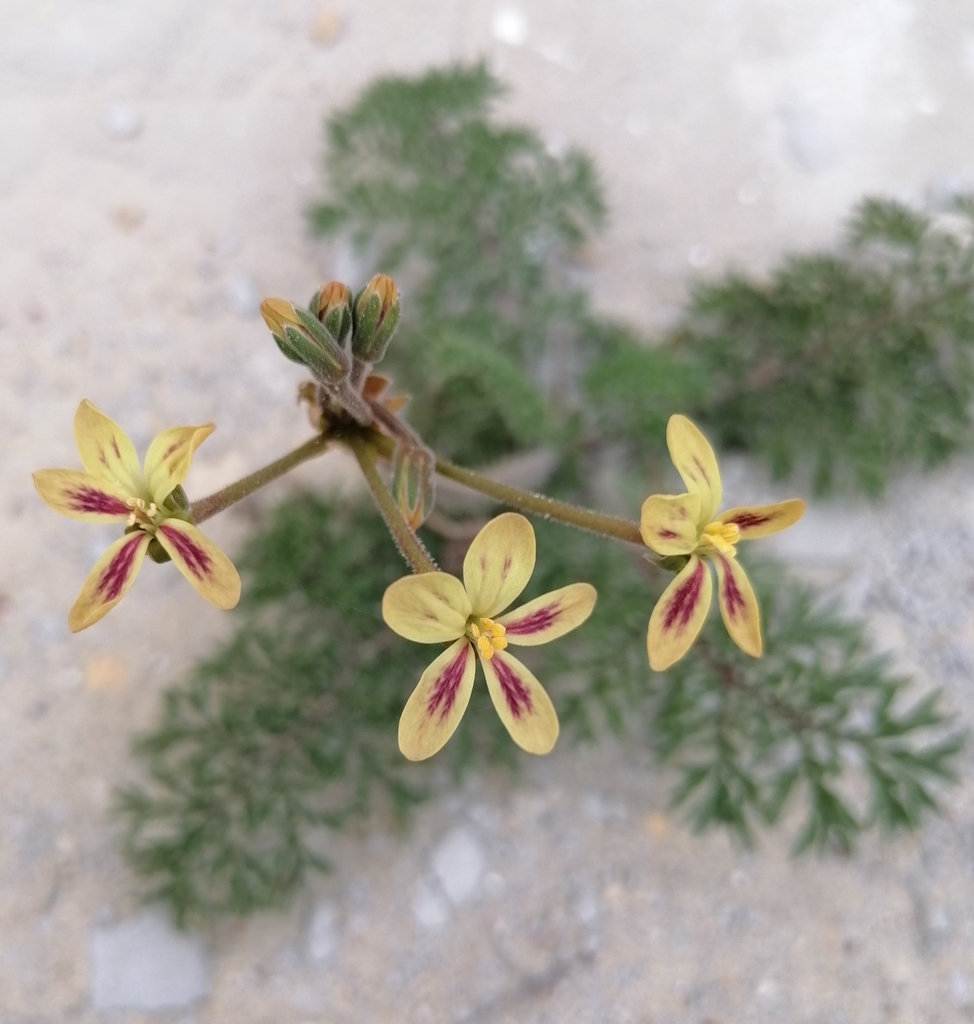
Night-scented Pelargonium
Pelargonium triste
Pelargonium triste, is a geophyte with flowering stems of about 25 cm (9.8 in) high on average, that is assigned to the Stork's bill family. It has hairy, divided and softly feathered leaves that are about twice as long as wide, resemble carrot leaves, and emerge from the tuberous rootstock directly at ground level. The bracts on the flowering stems are usually much smaller than the leaves at ground level. It carries inconspicuous, star-shaped flowers, each with a "spur" that is merged with the flower stalk, with five free green sepals, 5 pale yellow petals, 10 filaments, only 7 of them initially carrying an anther and a style with 5 curved branches. The flowers are crowded in umbels, and mostly there are slight to intense maroon to black markings that may be small or cover the entire petal except for a narrow line along the margins. In the evening, the flowers start to smell like cloves. Flowers may be found practically year round, but most proficiently from September to December. As typical for many species in the Stork's bill family, its fruits resemble the neck, head and bill of a stork. It is known as the night-scented pelargonium in English, kaneeltjie, pypkaneel or rooiwortel in Afrikaans and wit n/eitjie in the Khoi language.
From the article Pelargonium triste on Wikipedia (CC BY-SA), quoted section by section
Description
The night-scented pelargonium is a geophyte, usually about 25 cm (9.8 in), exceptionally up to 50 cm (20 in) high, that loses all above ground parts when it enters dormancy during the dry, hot summer. It lacks spines. From the subterranean rootstock emerge tuberous roots. The stems are hard and woody at their base and succulent towards their tip, initially green but eventually brown, and rough due to the scars left by discarded stipules and petioles. It is up to 15 cm (5.9 in) long and 0.5–1 cm (0.20–0.39 in) thick. The leaves in the basal rosette look somewhat like those of a carot and are at least twice as long as wide, 10–45 cm (3.9–17.7 in) long and 4–15 cm (1.6–5.9 in) wide, on a petiole of up to 12 cm (4.7 in) long. These leaves may be upright or lay down. They are herbaceous, variably covered in short glandular hairs between short, whitish hairs. The rosette leaves are pinnately divided, the segments itself mostly further pinnately divided or incised in linear leaflets or lobes, up to four times in total. The highest order leaflets are usually about 1 mm wide, but up to 8 mm wide in less divided leaves. The base of the segments is wedge-shaped or narrow into a stalk while the tips are rounded or squared-off, the margins entire and rolled upwards. …
Range & habitat
The night-scented pelargonium is common in parts of the Northern and Western Cape Provinces of South Africa, from the Cape Peninsula in the southwest to the Orange River in the north and Mossel Bay in the east. It can be found on coastal sands, but is also present on slopes up to an elevation of 1,800 m (5,900 ft). Across this entire region, most precipitation falls during the winter half year, but the annual rainfall varies over its distribution area from about 100 mm (3.9 in) to over 600 mm (24 in). It is most apparent in open areas, but as the fynbos develops, the plants get shaded by the surrounding shrubs and stop flowering. The large underground tuber however enables the plants to survive for many years and reappear after a fire has destroyed the above ground vegetation. The deep hypantium and night scents are suggestive that the flowers are pollinated by night-active, long-tongued insects such as moths. In Pelargonium, the seed capsule splits open along its length when dry, so releasing the seeds. The seed is dispersed on the wind carried by its feathery plumes. Each seed has a section in its tail that is spiraled when dry and uncoils when moist. Once the seed settles on the soil, it drills into the soil as it coils and uncoils with varying moisture. The continued survival of the night-scented pelargonium is considered to be of least concern.
Wikipedia: “Distribution, habitat and ecology”
Where it lives
Recorded sightings
—
geo-referenced records in GBIF, from museums, herbaria and field observers.
Drag the globe to turn it. Dots are where records exist, not a range map; darker means more records.
In the stacks
Searching the stacks…
Every page naming Pelargonium triste in the Biodiversity Heritage Library →
This page is assembled live from iNaturalist, GBIF, Wikipedia, the Source Library and the Internet Archive. It is not yet part of the hand-edited codex. iNaturalist taxon 119327.