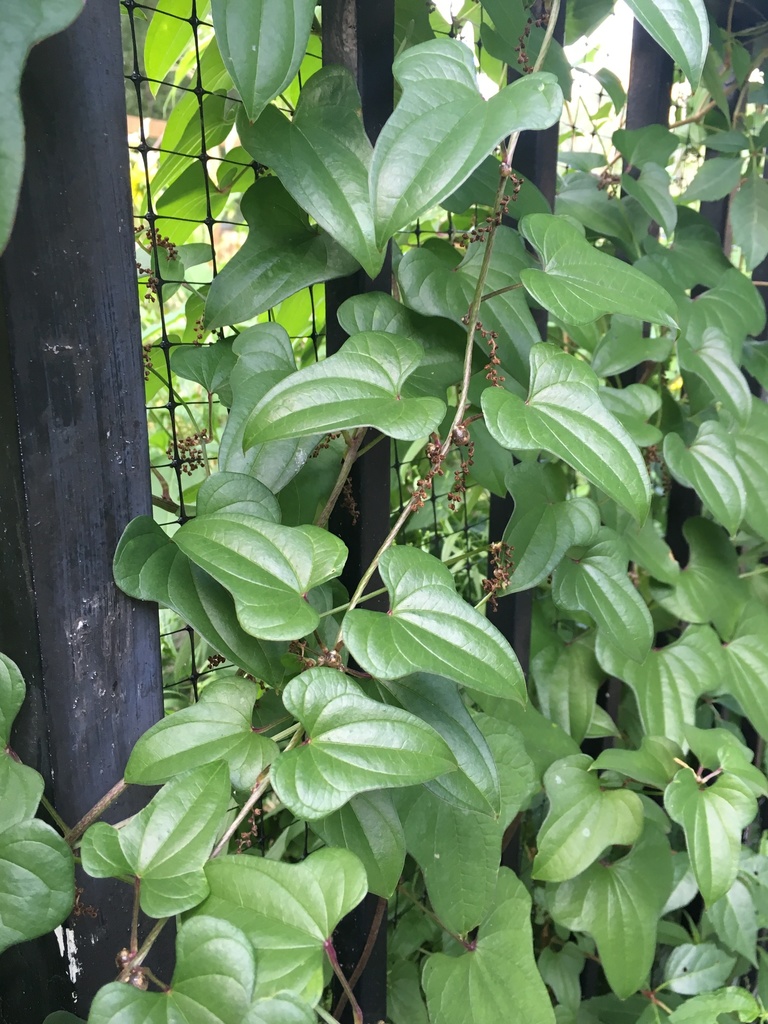
Chinese yam
Dioscorea polystachya
Dioscorea polystachya or Chinese yam (shānyào, simplified Chinese: 山药; traditional Chinese: 山藥), also called cinnamon-vine, is a species of flowering plant in the yam family. It is sometimes called Chinese potato or by its Korean name ma. It is also called huaishan in Mandarin and wàaih sāan in Cantonese.
It is a perennial climbing vine, native to East Asia. The edible tubers are cultivated largely in East Asia and sometimes used in alternative medicine. This species of yam is unique as the tubers can be eaten raw.
From the article Chinese yam on Wikipedia (CC BY-SA), quoted section by section
Description
Dioscorea polystachya vines typically grow 3–5 meters (9.8–16.4 ft) long, and can be longer. They twine anticlockwise. The leaves are up to 11 centimeters (4.3 in) long and wide. They are lobed at the base and larger ones may have lobed edges. The arrangement is variable; they may be alternately or oppositely arranged or borne in whorls. In the leaf axils appear warty rounded bulbils under 2 centimeters (0.79 in) long. The bulbils are sometimes informally referred to as "yam berries" or "yamberries". New plants sprout from the bulbils or parts of them. The flowers of Chinese yam are cinnamon-scented. The plant produces one or more spindle-shaped or cylindrical tubers. The largest may weigh 10 pounds (4.5 kg) and grow one meter (3 ft 3 in) underground. Dioscorea polystachya is more tolerant to frost and cooler climates than other yams, which is attributed to its successful introductions and establishment on many continents.
Range & habitat
This plant grows throughout East Asia. It is believed to have been introduced to Japan in the 17th century or earlier. Introduced to the United States as early as the 19th century for culinary and cultural uses, it is now considered an invasive plant species. The plant was introduced to Europe in the 19th century during the European Potato Failure, where cultivation continues to this day for the contemporary East Asian food market.
Wikipedia: “Range”
At the table
The tubers of D. polystachya can be eaten raw (grated or sliced), while most other yams must be cooked before consumption (due to harmful substances in the raw state). First the skin needs to be removed by peeling (or by scraping off using a hard-bristled brush). This may cause a slight irritation to the hand, and wearing a latex glove is advised, but if an itch develops then lemon juice or vinegar may be applied. The peeled whole tubers are briefly soaked in a vinegar-water solution, to neutralize irritant oxalate crystals found in their skin, and to prevent discoloration. The raw vegetable is starchy and bland, mucilaginous when cut or grated, and may be eaten plain as a side dish, or added to noodles, etc.
Chinese cuisine. Chinese yam is referred to as shānyào (山药; 山藥), or mountain medicine, in Chinese traditional medicine, or referred to as huáishān (怀山; 懷山 or 淮山) in the culinary usage. The tuber is consumed raw, steamed, or deep-fried. It is added to savory soups, or can be sweetened with a berry sauce. When used fresh, the tuber is peeled before slicing and using them in stir-fries (mainly in Cantonese cuisine). Oftentimes, Chinese yam can be found sold in prepared, dried slices in dried goods specialty shops. When using the dry ingredient in soups, the slices need to be soaked before adding them to soups to cook.
Japanese cuisine. …
Wikipedia: “Culinary uses”
In medicine
Creams and dietary supplements made from the related Dioscorea villosa are claimed to contain human hormones and promoted as a medicine for a variety of purposes, including cancer prevention and the treatment of Crohn's disease and whooping cough. However, according to the American Cancer Society, the claims are false and there is no evidence to support these substances being either safe or effective. Huáishān has also been used in traditional Chinese medicine.
Wikipedia: “In alternative medicine”
How it is grown
The Chinese yam's growing cycle spans approximately one year, and should be planted between winter and spring. The traditional methods growing it are: using smaller tubers, top cut of bigger tubers or through cuttings of branches. The first two methods can produce 20 cm (7.8 in) long tubers and above. The latter produces smaller tubers (10 cm or 4 in) that are usually replanted for the next year. Between 7 and 9 months of replanting Chinese yam tubers, their leaves start to get dry (a common fact in plants that grow tubers), which indicates that the tubers are ready for harvest. In home gardens generally only what will be consumed is harvested, with the rest left in the pot in moist soil. The tuber is not frost-hardy.
Wikipedia: “Cultivation”
Where it lives
Recorded sightings
—
geo-referenced records in GBIF, from museums, herbaria and field observers.
Drag the globe to turn it. Dots are where records exist, not a range map; darker means more records.
In the old herbals & bestiaries


In the stacks
Searching the stacks…
Every page naming Dioscorea polystachya in the Biodiversity Heritage Library →
This page is assembled live from iNaturalist, GBIF, Wikipedia, the Source Library and the Internet Archive. It is not yet part of the hand-edited codex. iNaturalist taxon 119141.