- Plants
- ›Vascular Plants
- ›flowering plants
- ›Dicots
- ›Mints, Plantains, Olives, and Allies
- ›Mint Family
- ›Nepetoideae
- ›Elsholtzieae
- ›Perilla
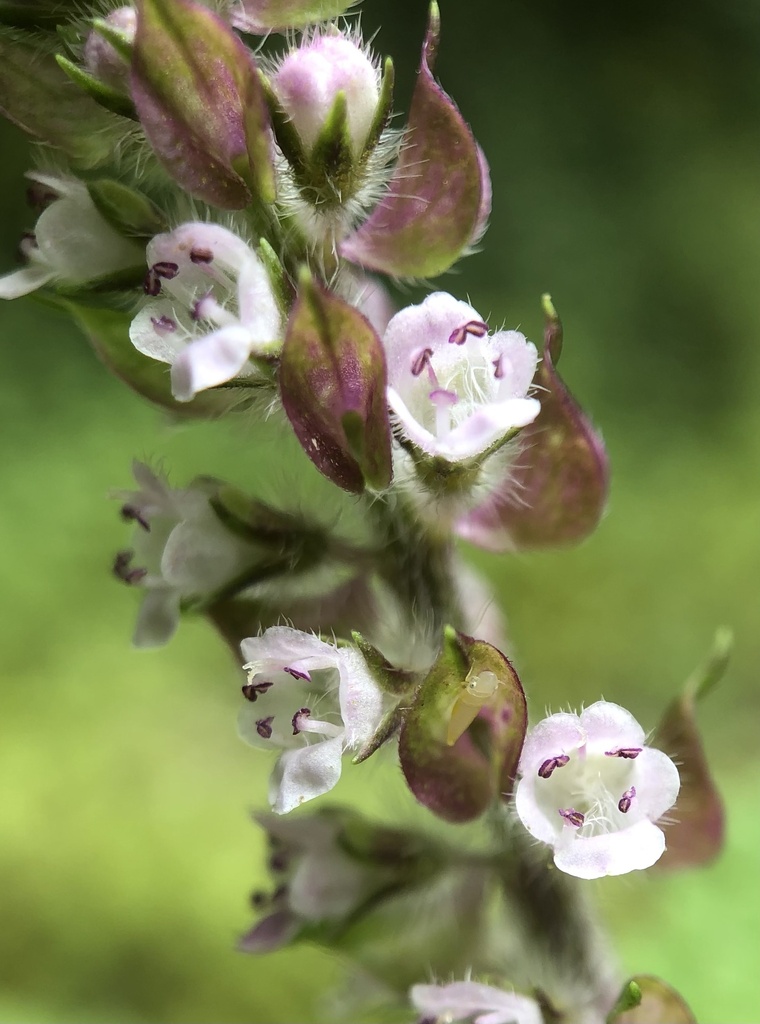
beefsteak plant
Perilla frutescens
Perilla frutescens is a species of Perilla in the mint family Lamiaceae. It is an annual plant native to eastern Russia, South and Southeast Asia, and has been introduced to parts of eastern Asia, Europe, and North America. It prefers subtropical habitats.
An edible plant, perilla is grown in gardens and attracts butterflies. It has a strong mint-like smell. The major volatile compound responsible for this characteristic aroma is perilla ketone concentrated in the leaves.
From the article Perilla frutescens on Wikipedia (CC BY-SA), quoted section by section
Description
Perilla is an annual plant growing 60–90 cm (24–35 in) tall, with stalks which are hairy and square. The leaves are opposite, 7–12 cm (3–4+1⁄2 in) long and 5–8 cm (2–3 in) wide, with a broad oval shape, pointy ends, serrated (saw-toothed) margins, and long leafstalks. The leaves are green with occasional touches of purple on the underside. The flowers bloom on racemes at the end of branches and the main stalk in late summer. The calyx, 3–4 mm (1⁄8–5⁄32 in) long, consist of upper three sepals and the hairy lower two. The corolla is 4–5 mm (5⁄32–3⁄16 in) long with its lower lip longer than the upper. Two of the four stamens are long. The fruit is a schizocarp, 2 mm (1⁄16 in) in diameter, and with reticulate pattern on the outside. Perilla seeds can be soft or hard, being white, grey, brown, and dark brown in colour and globular in shape. 1000 seeds weigh about 4 g (1⁄8 oz). Perilla seeds contain about 38-45% lipid.
Range & habitat
The plant is native to: Bangladesh; India especially, Eastern and Western Himalayas, and Northeast India; Nepal; Myanmar; China especially, South Central China, and Southeast China; Thailand; Laos; Vietnam; Java; Taiwan; Japan; Korea; and Russia, especially, Primorsky Krai; and Khabarovsk Krai. It was introduced to other parts of Asia, namely Inner Mongolia, Cambodia, and parts of Europe such as Germany, Romania, Ukraine and South European Russia. In addition, it was also introduced in several states of the United States and the Ontario province of Canada. After years of spreading in the United States, P. frutescens has been designated as a weed.
Wikipedia: “Distribution and habitat”
At the table
Perilla seeds are rich in dietary fiber and dietary minerals such as calcium, iron, niacin, protein, and thiamine. Perilla leaves are also rich in vitamins A, C and riboflavin.
Wikipedia: “Nutritional value”
Toxicity
Although perilla is widely cultivated as an edible plant for humans, it is toxic to cattle and other ruminants, as well as horses. In grazing cattle, plant ketones cause acute respiratory distress syndrome, also called "panting disease". Contact dermatitis may occur in people handling the leaves or oil. Consumption of large amounts of seeds has resulted in anaphylaxis.
In human culture
Along with other plants in the genus Perilla, the plant is commonly called "perilla". It is also referred to as 'Korean perilla,' due to its extensive cultivation in Korea and use in Korean cuisine. In the United States, the plant is known by many names, such as perilla mint, beefsteak plant, purple perilla, Chinese basil, wild basil, blueweed, Joseph's coat, wild coleus, and rattlesnake weed.
Wikipedia: “Etymology”
Where it lives
Recorded sightings
—
geo-referenced records in GBIF, from museums, herbaria and field observers.
Drag the globe to turn it. Dots are where records exist, not a range map; darker means more records.
In the old herbals & bestiaries


In the stacks
Searching the stacks…
Every page naming Perilla frutescens in the Biodiversity Heritage Library →
This page is assembled live from iNaturalist, GBIF, Wikipedia, the Source Library and the Internet Archive. It is not yet part of the hand-edited codex. iNaturalist taxon 119136.