- Animals
- ›Arthropods
- ›Hexapods
- ›Insects
- ›Winged and Once-winged Insects
- ›Flies
- ›Brachyceran Flies
- ›Cyclorrhaphan Flies
- ›Schizophoran Flies
- ›Calyptrate Flies
- ›Bot Flies, Blow Flies, and Allies
- ›Blow Flies
- ›Calliphorinae
- ›Calliphora
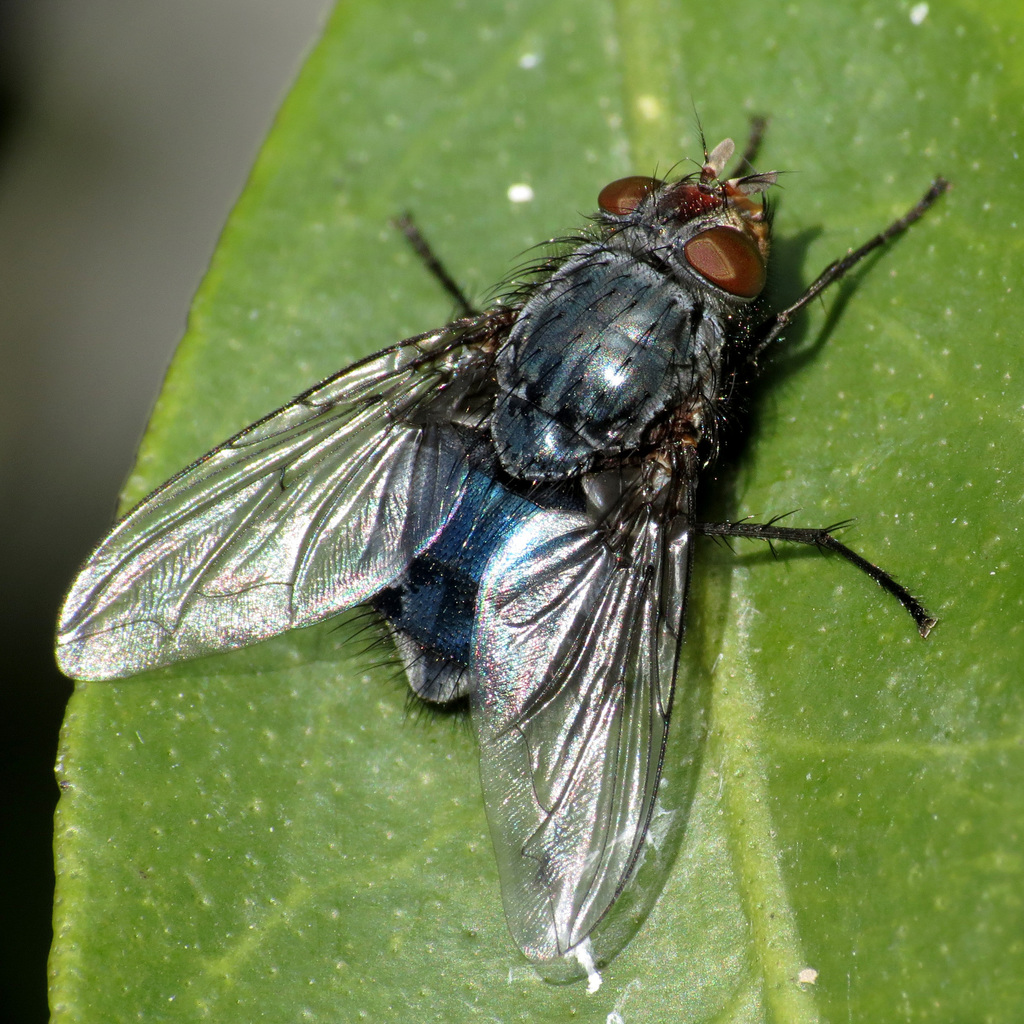
Blue Blowfly
Calliphora vicina
Calliphora vicina is a member of the family Calliphoridae, which includes blow flies and bottle flies. These flies are important in the field of forensic entomology, being used to estimate the time of a person's death when a corpse is found and then examined. C. vicina is currently one of the most entomologically important fly species for this purpose because it arrives at and colonizes a body following death in consistent timeframes.
From the article Calliphora vicina on Wikipedia (CC BY-SA), quoted section by section
Description
Calliphora vicina is known as a blue bottle fly because of the metallic blue-gray coloration of its thorax and abdomen. It is distinguished from the commonly known C. vomitoria by its bright orange cheeks. The blue bottle fly is approximately 10–11 mm in length. The sclerites at the base of the coxa are yellow or orange. By chaetotaxy, the study of bristle arrangement, Calliphorids are characterized by having black bristles on the meron and two to three bristles on the notopleuron. The similarities between the different species of Calliphora can make identification of immature stages nearly impossible. From the first instar to the pupa stage C. vicina is identical to that of C. vomitoria.
Lifecycle. Calliphora vicina goes through five generations in a year at a threshold temperature of 27 °C (81 °F). A female C. vicina can lay up to 300 eggs, on fresh carrion or on open wounds. The larvae go through three instar stages. The first instar hatches in approximately 24 hours after the eggs are laid. It goes through its second instar in 20 hours and its third instar in 48 hours. Under favorable conditions, the larvae feed for about three to four days. When the larvae complete their development, they disperse to find an adequate place to pupate. The C. vicina pupa stage last about 11 days. At 27 °C, C. …
Range & habitat
Calliphora vicina are found throughout the U.S. in urban areas and are most abundant in early spring and fall where the temperatures are around 55–75 °F (13–24 °C). The species predominates in Europe and the New World, but has found its way into other countries via harbors and airports. It was first recorded in South Africa in 1965 when a specimen was collected near Johannesburg, but specimen collections have been few and sporadic since then. It also occurs as an exotic in Australia and New Zealand.
Wikipedia: “Distribution”
What it does
Calliphora vicina play an integral part in postmortem interval determination. Factors such as region, weather temperatures, time of day and conditions under which the body was found all contribute to determining a postmortem interval (PMI). To complete the calculation the entomologist must consider what is commonly known about C. vicina and integrate it with experimental data gathered from a crime scene. The entomologist must know how the blowfly behaves specifically in the area where the body was discovered. This involves recording environment temperatures at the crime scene as well as retrieving a history of the climate in the region. C. vicina in particular is adapted to cooler temperatures, appearing most commonly in winter and less often in the summer months. This puts their flight activity threshold at above 55–60 °F (13–16 °C), a lower temperature than most other blow-flies. Knowing the threshold temperature allows the entomologist to calculate accumulated degree days, which in turn helps determine PMI. Some knowledge regarding C. vicina behavior is well known. Case studies have shown that it is not the first species in arrival, although it does appear one to two days before Phaenicia sericata. Determining PMI is an intricate process because there is still much that we do not know about C. vicina behavior. …
Wikipedia: “Behavior”
Listen
Looking for field recordings…
Where it lives
Recorded sightings
—
geo-referenced records in GBIF, from museums, herbaria and field observers.
Drag the globe to turn it. Dots are where records exist, not a range map; darker means more records.
In the stacks
Searching the stacks…
Every page naming Calliphora vicina in the Biodiversity Heritage Library →
This page is assembled live from iNaturalist, GBIF, Wikipedia, the Source Library and the Internet Archive. It is not yet part of the hand-edited codex. iNaturalist taxon 119115.