- Animals
- ›Arthropods
- ›Hexapods
- ›Insects
- ›Winged and Once-winged Insects
- ›Butterflies and Moths
- ›Owlet Moths and Allies
- ›Underwing, Tiger, Tussock, and Allied Moths
- ›Tiger Moths and Allies
- ›Tiger Moths
- ›Callimorphina
- ›Euplagia
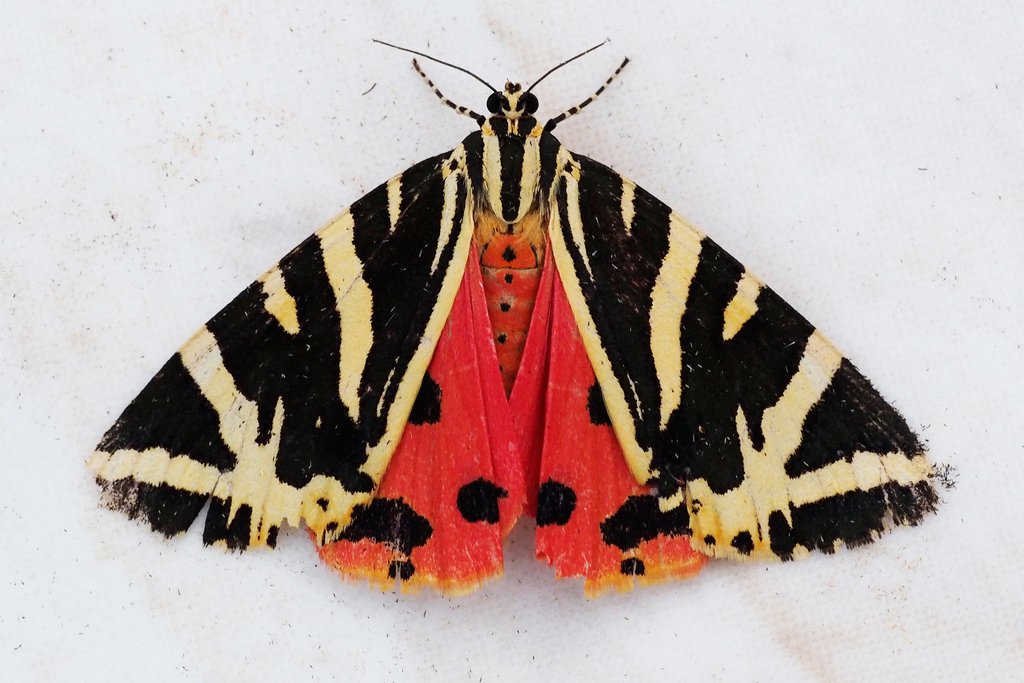
Jersey Tiger
Euplagia quadripunctaria
Euplagia quadripunctaria, the Jersey tiger, or Spanish flag, is a diurnal moth of the family Erebidae. The species was first described by Nikolaus Poda von Neuhaus in 1761. The adult wingspan is 52–65 millimetres (2.0–2.6 in), and they fly from July to September, depending on the location. They tend to fly close to hemp-agrimony, Eupatorium cannabinum. In most of their range, the aposematic adults have red underwings. In the northwest part of their range, the adults are polymorphic for underwing colour, being variously red, orange, or yellow.
The larvae (caterpillars) are polyphagous, feeding from September to May on nettles (Urtica), raspberries (Rubus), dandelion (Taraxacum), white deadnettle (Lamium), ground-ivy (Glechoma), groundsel (Senecio), plantain (Plantago), borage (Borago), lettuce (Lactuca), and hemp-agrimony (Eupratoria). The insect overwinters as a small larva.
From the article Euplagia quadripunctaria on Wikipedia (CC BY-SA), quoted section by section
Range & habitat
Euplagia quadripunctaria is widely distributed in Europe from Estonia and Latvia in the north, to France and southern Great Britain in the west, and the Mediterranean coast and islands in the south. It is also found in western Russia, the southern Urals, Asia Minor, Rhodes and nearby islands, the Near East, Caucasus, southern Turkmenistan, and Iran. Individuals are known to migrate northwards from their regular breeding grounds during the summer.
British Isles. Aside from being frequent in the Channel Islands (whence its common name comes), this species was rarely seen in the British Isles in Victorian times. In 1903, it was described by William Forsell Kirby as "a great rarity in the South of England, except one locality in Devonshire". Since then however it has spread more widely in Devon and Cornwall, and became more frequent in southern England by 2014, especially on the Isle of Wight, in northern Kent, and south London. By 2019, it was widespread and common across southern England, and with scattered records north to the Midlands and East Anglia. The increase has continued since then, with a 78% increase between 2024–2025 alone, and consolidation in East Anglia, the Midlands, and into South Wales.
Wikipedia: “Distribution”
Listen
Looking for field recordings…
Where it lives
Recorded sightings
—
geo-referenced records in GBIF, from museums, herbaria and field observers.
Drag the globe to turn it. Dots are where records exist, not a range map; darker means more records.
In the stacks
Searching the stacks…
Every page naming Euplagia quadripunctaria in the Biodiversity Heritage Library →
This page is assembled live from iNaturalist, GBIF, Wikipedia, the Source Library and the Internet Archive. It is not yet part of the hand-edited codex. iNaturalist taxon 118936.