On eBird ↗
Asian House-Martin
Live sightings near you, the range map, bar charts of when it is seen, and Macaulay Library photos and recordings.
Asian House Martin
Delichon dasypus
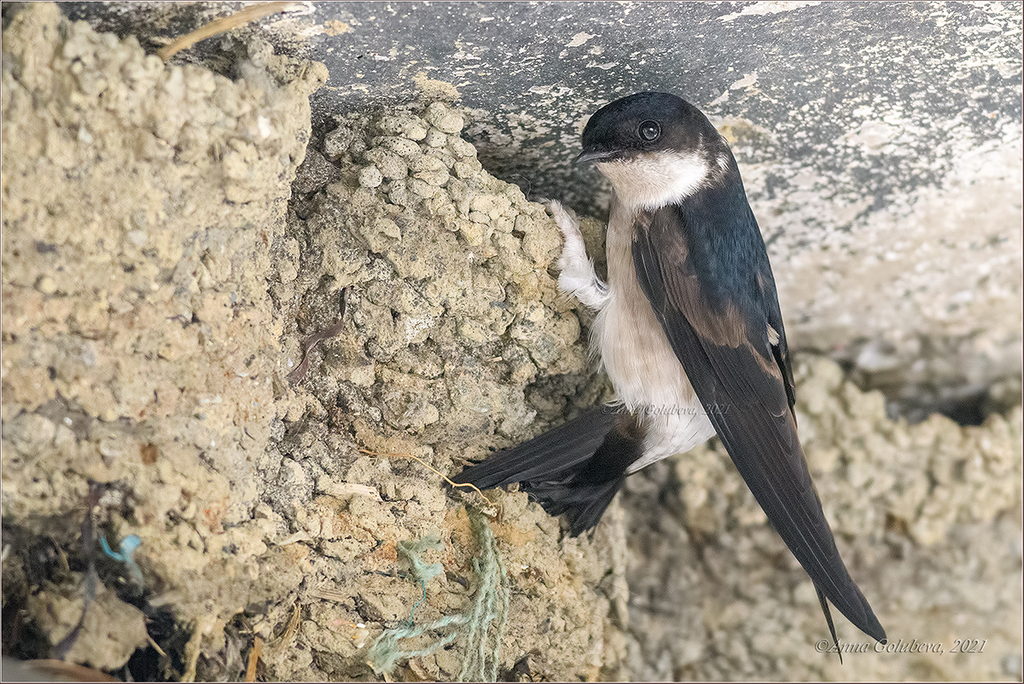
The Asian house martin (Delichon dasypus) is a migratory passerine bird of the swallow family Hirundinidae. It has mainly blue-black upperparts, other than its white rump, and has pale grey underparts. Its three subspecies breed in the Himalayas and in central and eastern Asia, and spend the winter lower in the mountains or in Southeast Asia. This species is locally abundant and is expanding northward in Siberia, so there are no concerns about its conservation status.
This martin breeds in colonies, building mud nests under an overhang on a vertical cliff or the wall of a building. Both sexes build the nest, incubate the three or four white eggs and feed the chicks. The Asian house martin feeds on small insects taken in flight, usually caught high in the air. The presence of terrestrial springtails and Lepidoptera larvae in its diet indicates that food is sometimes picked from the ground.
From the article Asian house martin on Wikipedia (CC BY-SA), quoted section by section
Description
The adult Asian house martin of the nominate subspecies is 12 cm (4.7 in) long, dark steel blue above with a contrasting white rump, grey-washed white underparts, and a slightly forked tail. The tail and upperwings are brownish-black, and the underwings are grey-brown. The legs and feet are brownish-pink and covered with white feathers, the eyes are brown, and the bill is black. There are few differences in appearance between the sexes, although the male is somewhat whiter below than the female, especially in fresh plumage. The juvenile bird is less glossy and has dark brown upperparts, sometimes with a brownish wash to the rump, and grey-white underparts. D. d. cashmiriensis has brighter blue upperparts and a whiter rump than the slightly larger nominate race. The third, smallest, race is D. d. nigrimentalis. All three subspecies can be distinguished from the similar Nepal house martin by the latter species' black chin, black undertail coverts and much squarer tail. The Asian house martin is more similar to the common house martin, but is darker underneath and has a less deeply forked tail. Confusion is most likely between adult male Asian house martins, which have paler underparts, and the eastern race of common house martin, D. …
Range & habitat
The nominate subspecies of the Asian house martin, D. d. dasypus, breeds in the southeast of Russia, the Kuril Islands, Japan and sometimes Korea. It migrates through eastern China to winter in the Malay Peninsula, Borneo, the Philippines, Java and Sumatra; a few birds remain around hot springs in Japan. D. d. cashmeriensis breeds in the Himalayas from Afghanistan east to Sikkim and northwards into Tibet and western and central China. It is found between 1,500–5,000 m (4,900–16,400 ft) altitude, although mainly in the 2,400–4,000 m (7,900–13,100 ft) range. This martin is a short-range migrant, mainly wintering at lower altitudes in the foothills of the Himalayas, but with some birds on the plains of northeastern India and northeastern and southeastern Bangladesh, and smaller numbers further afield in Myanmar and northern Thailand. The third race, D. d. nigrimentalis, breeds in southeastern China and southern Siberia. Its wintering grounds are unknown, but birds in Taiwan just move to lower altitudes in winter. Non-breeding Asian house martins have been recorded as far west as the United Arab Emirates. The range of D. d. cashmeriensis overlaps with that of the Nepal house martin, although they breed at somewhat different altitudes. …
Wikipedia: “Distribution and habitat”
What it does
This martin feeds on insects taken in flight. As with its relatives it tends to feed high in the air, taking mostly small flies, aphids and Hymenoptera such as winged ants. A wide range of other insects are caught, including Lepidoptera, beetles and lacewings. The presence in the diet of terrestrial springtails and Lepidoptera larvae indicates that food is sometimes picked from the ground.
Wikipedia: “Feeding”
Listen
Looking for field recordings…
Where it lives
Recorded sightings
—
geo-referenced records in GBIF, from museums, herbaria and field observers.
Drag the globe to turn it. Dots are where records exist, not a range map; darker means more records.
In the stacks
Searching the stacks…
Every page naming Delichon dasypus in the Biodiversity Heritage Library →
This page is assembled live from iNaturalist, GBIF, Wikipedia, the Source Library and the Internet Archive. It is not yet part of the hand-edited codex. iNaturalist taxon 11876.