- Animals
- ›Chordates
- ›Vertebrates
- ›Birds
- ›Perching Birds
- ›Ovenbirds and Woodcreepers
- ›Typical Ovenbirds
- ›Cichlocolaptes
On eBird ↗
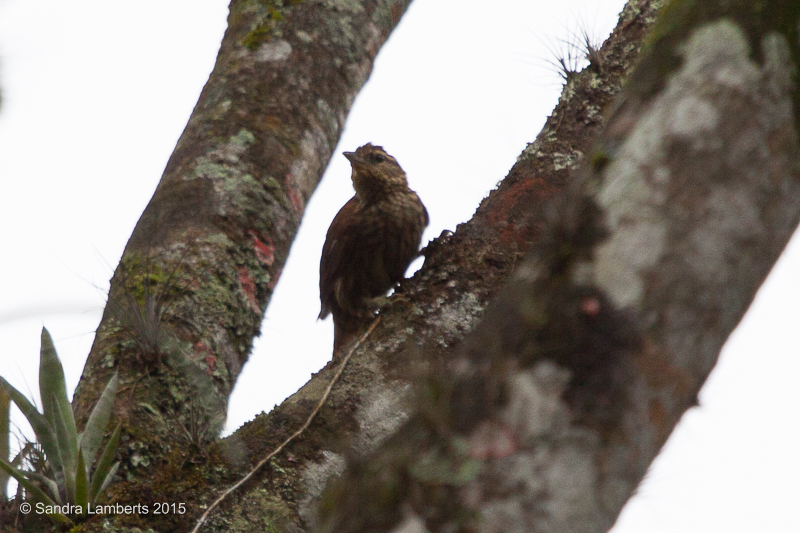
Pale-browed Treehunter
Live sightings near you, the range map, bar charts of when it is seen, and Macaulay Library photos and recordings.
Pale-browed Treehunter
Cichlocolaptes leucophrus
The pale-browed treehunter (Cichlocolaptes leucophrus) is a species of bird in the Furnariinae subfamily of the ovenbird family Furnariidae. It is endemic to Brazil.
From the article Pale-browed treehunter on Wikipedia (CC BY-SA), quoted section by section
Description
The nominate subspecies of the pale-browed treehunter is about 22 cm (8.7 in) long; subspecies C. l. holti is about 18 cm (7.1 in) long. Both subspecies have a long dagger-like bill, and male and female plumages are alike. Adults of the nominate subspecies have a buffish white supercilium, blackish and dull buff lores, and a dark brown band behind the eye on an otherwise duff buff face. Their crown is dark brown whose feathers have obvious buff to rusty-buff shafts. They have an indistinct blackish brown collar with buff streaks. Their back is rufescent brown with long blurry buff streaks and their rump and uppertail coverts are a slightly paler brown with indistinct buff streaks. Their tail is pale rufous or cinnamon. Their wing coverts are brown with indistinct buff streaks and their flight feathers rich brown. Their throat is pale yellowish buff, their breast has strong pale buff and brown streaks, and their belly, flanks, and undertail coverts are like the breast with the streaks progressively fading. Their iris is very dark, their maxilla dusky gray, their mandible a paler brown with gray towards the tip, and their legs and feet variable from greenish gray to pale brownish. Juveniles are much like adults but with less distinct streaking on their underparts. Compared to the nominate subspecies, C. l. …
Range & habitat
The pale-browed treehunter is found in southeastern Brazil. The nominate subspecies occurs from southern Bahia south to Rio de Janeiro state. C. l. holti occurs from São Paulo state south to northeastern Rio Grande do Sul. The species inhabits humid lowland and montane evergreen forest. The nominate subspecies occurs from sea level to 1,500 m (4,900 ft) while C. l. holti reaches only about 1,000 m (3,300 ft).
Wikipedia: “Distribution and habitat”
What it does
The pale-browed treehunter feeds on arthropods. It often, and perhaps usually, forages as a member of a mixed-species feeding flock. It feeds at any level of the forest between its understory and the subcanopy. It forages along larger limbs and branches, probing and gleaning for prey, with a strong preference for seeking it in bromeliads and other epiphytes. It sometimes goes completely into clumps of bromeliads and may hang upside-down to feed.
Wikipedia: “Feeding”
Listen
Looking for field recordings…
Where it lives
Recorded sightings
—
geo-referenced records in GBIF, from museums, herbaria and field observers.
Drag the globe to turn it. Dots are where records exist, not a range map; darker means more records.
In the stacks
Searching the stacks…
Every page naming Cichlocolaptes leucophrus in the Biodiversity Heritage Library →
This page is assembled live from iNaturalist, GBIF, Wikipedia, the Source Library and the Internet Archive. It is not yet part of the hand-edited codex. iNaturalist taxon 11825.