- Animals
- ›Chordates
- ›Vertebrates
- ›Birds
- ›Perching Birds
- ›Ovenbirds and Woodcreepers
- ›Typical Ovenbirds
- ›Pygarrhichas
On eBird ↗
White-throated Treerunner
Live sightings near you, the range map, bar charts of when it is seen, and Macaulay Library photos and recordings.
White-throated Treerunner
Pygarrhichas albogularis
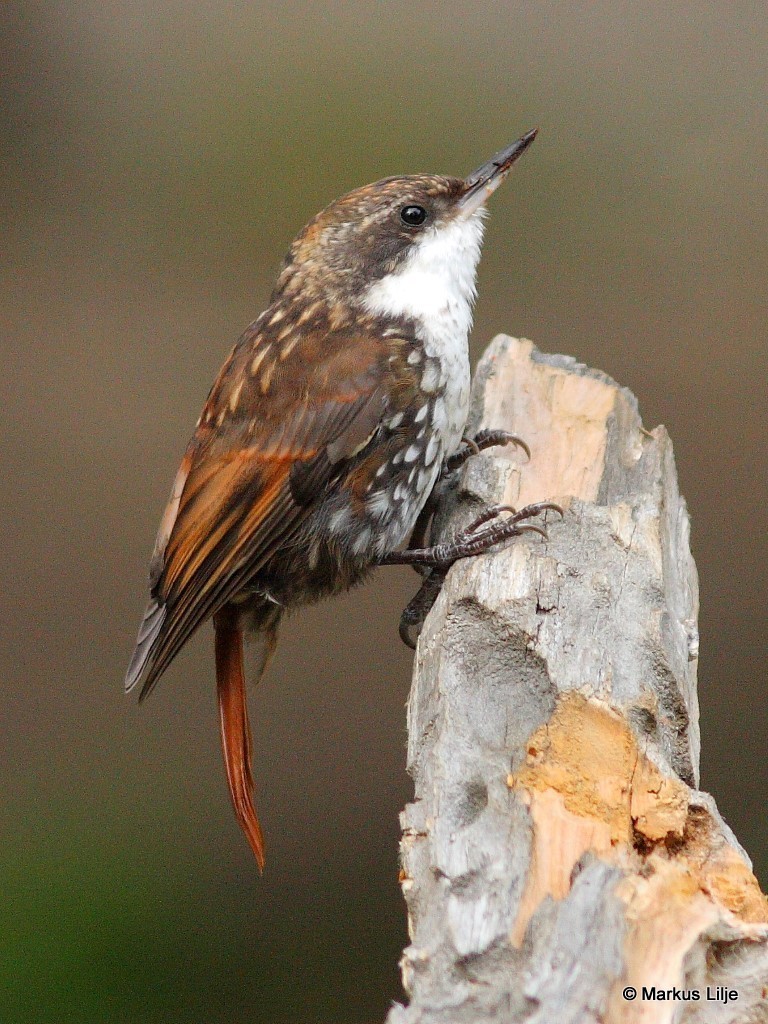
The white-throated treerunner (Pygarrhichas albogularis) is a species of bird in the family Furnariidae. It is the only species in the genus Pygarrhichas. The white-throated treerunner is about 15 cm (5.9 in) long, with a stiff and rounded tail. The upperparts are dark brown, turning red on the lower back and tail and contrasting sharply with the throat and chest of a bright white. The rest of the underparts are coarsely mottled with white. The bill is long, slightly curved upwards. The general appearance is reminiscent of a nuthatch (Sitta spp.), although they are not directly related. Like the Sittidae, Furnariidae tirelessly scours the trunks and branches of old trees for the small arthropods that make up its food, spiraling up the trunks, or sometimes moving head down. The white-throated treerunner consumes small invertebrates found on bark and nests in tree cavities. Outside of the breeding season, it may form mixed-species foraging flocks with other bird species.
The White-throated treerunner inhabits the southern tip of the American continent, in Chile and Argentina, from Santiago and Mendoza to Tierra del Fuego. It seeks out forests with large trees – the old trunks offer suitable nesting sites – whether they are lowland or highland, dense or open. It was described in 1831 by Phillip Parker King, a British explorer of Patagonia and Tierra del Fuego. Its systematic placement has remained unclear within its family, superficial similarities with other Furnariidae gleaning their food from the bark of trees seem to be the result of an evolutionary convergence.
From the article White-throated treerunner on Wikipedia (CC BY-SA), quoted section by section
Description
The white-throated treerunner is 15–16 cm (5.9–6.3 in) long on average, with a weight between 20–27 grams (0.71–0.95 oz). It has an appearance reminiscent of the nuthatch, with its overall look and plumage, unlike other species in the Furnariidae. Wing chord is from 76–86 mm (3.0–3.4 in), tail is 52–65 mm (2.0–2.6 in), and torso from 20–23.7 mm (0.79–0.93 in). The iris is dark brown. It has a long beak, at around 16–23.8 mm (0.63–0.94 in) with a slight upward curve. Its upper mandible is dark gray and lower mandible a whitish-pale gray. The feet are dark gray, blackish or brown. The species is easily recognized by its white throat, contrasting with its upper parts. Its face is blackish-brown and slightly darker than its head crown, which is a dull brown. The back is a paler chestnut-brown, pulling against the red rump and tail. The wing coverts are dark brown, with red or chestnut brown on the feather edges and tail end. The primaries are darker, the remiges black-brown with light edges and inner primaries marked with a short, light red wing bar. The tail is rounded, with rigid rectrices with shortened barbs ending in small spines up to 9 mm (0.35 in) long. A large white zone covers the treerunner's cheek and throat, descending to the middle of the chest. …
Range & habitat
This species lives in central and southern Chile and western Argentina, from Santiago and Mendoza to Tierra del Fuego. It is found in the south of its distribution in the southernmost forest in the world, on Horn Island. It lives from sea level to 1,200 m of altitude, populating forests with large trees, whether dense or not, but avoiding young forests. The white-throated treerunner seeks out forests dominated by "false beech" species of the genus Nothofagus. It exploits the trunks at mid-height of trees up to the top of the canopy as a small woodpecker would. The species is sedentary, but can be erratic outside the breeding season.
Wikipedia: “Distribution and habitat”
At the table
Similar in behavior to nuthatches (Sitta spp.), the white-throated treerunner is a restless bird, moving in a jerky manner and changing direction rapidly. The bird may descend from trunks head first. It scours the trunks and large branches of old trees, often spiraling around the trunks, searching for small insects and their larvae in every crevice for food, sometimes tapping lightly with its bill, much like a woodpecker, or digging out larvae from under the bark with its bill. It may use its tail for support, or it may use its tail as a support for the insects. It may use their tail for support, but it also does a lot of tail-first browsing. It explores trunks quickly and spends more time foraging in smaller branches, looking for prey at the base of leaf petioles. Its diet is little known, consisting of arthropods including adults and larvae of beetles, as well as diptera. A study conducted in the province of Osorno showed that the white-throated treerunner mainly forages on trees such as Coigüe (Nothofagus dombeyi), but also Neuquén Roble (N. obliqua), Ulmo (Eucryphia cordifolia), and more generally on dead trees, even when other tree and shrub species are available. These preferences could be explained by the structure of the bark and the greater abundance of accessible insects. …
Wikipedia: “Food”
In human culture
The white-throated treerunner appears in some traditional Yahgan stories as tatajurj, where it accompanies women and collects epiphytic fungi of the genus Cyttaria (katran in Yagan) from the trunks of Magellanic Beech (N. betuloides), Lenga (N. pumilio), and Ñire (N. antarctica) trees.
Wikipedia: “In culture”
Listen
Looking for field recordings…
Where it lives
Recorded sightings
—
geo-referenced records in GBIF, from museums, herbaria and field observers.
Drag the globe to turn it. Dots are where records exist, not a range map; darker means more records.
In the stacks
Searching the stacks…
Every page naming Pygarrhichas albogularis in the Biodiversity Heritage Library →
This page is assembled live from iNaturalist, GBIF, Wikipedia, the Source Library and the Internet Archive. It is not yet part of the hand-edited codex. iNaturalist taxon 11819.