On eBird ↗
Giant Antpitta
Live sightings near you, the range map, bar charts of when it is seen, and Macaulay Library photos and recordings.
Giant Antpitta
Grallaria gigantea
The giant antpitta (Grallaria gigantea) is a perching bird species in the antpitta family (Grallariidae). Rare and somewhat enigmatic, it is known only from Colombia and Ecuador. It is presumably a close relative of the similar undulated antpitta, G. squamigera, which occurs to the south of G. gigantea. The giant antpitta has three subspecies, one of which might be extinct.
From the article Giant antpitta on Wikipedia (CC BY-SA), quoted section by section
Description
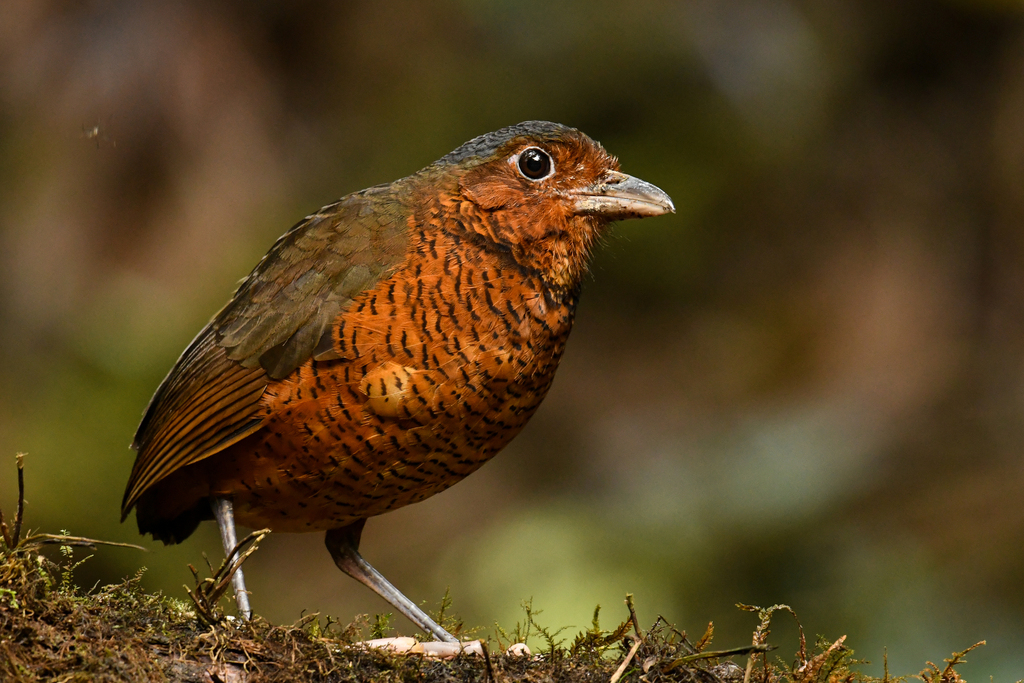
G. gigantea is, as its name suggests, a huge antpitta. Length ranges from 24 to 28 centimetres (9.4 to 11.0 in), and weight is up to 300 grams (10.6 oz), which makes it easily the heaviest of all tracheophone suboscine birds – its nearest rival, the chestnut-throated huet-huet, is not known to exceed 185 grams (6.5 oz). Its back, wings, and the stubby tail are dusky olive-brown. The top of the head is pale to medium grey, running down to the neck. The remaining plumage is deep rufous-brown. The throat and breast feathers are black-edged, resulting in a dark barring in these regions. The bill is dark, strong and heavy; the eyes are likewise dark, while the legs and feet are grey. The song consists of low-pitched fast trills, about 14-21 notes per second. These are maintained for several seconds, during which they rise in pitch and become louder. Trills are repeated after a pause of a few to about a dozen seconds, which varies irregularly throughout the length of the song. The undulated antpitta (G. squamigera) is a bit smaller, with a pale hue to the malar region and a yellower belly. Its song is hard to distinguish, but rather than simply breaking off after a time, it ends with some additional trills, separated by pauses of increasing length.
What it does
In Colombia, historically, the subspecies G. g. lehmanni inhabited both slopes of the Cordillera Central, where specimens were taken in Cauca and Huila Departments before the mid-20th century, one (in 1941) in what today is Puracé National Natural Park. It has not definitely been relocated there, however. In 1988 and 1989, the species was recorded in La Planada Nature Reserve, Nariño Department, but the taxonomic identity of these birds requires verification. In Ecuador, the nominate subspecies was formerly more widespread on the eastern slope of the Andes, but in recent times its presence is only confirmed in western Napo Province. Formerly, it was found (and may still be found in protected habitats) in eastern Carchi and Tungurahua Provinces. Subspecies hylodroma occurs on the western slope of the Andes in the Pichincha and Cotopaxi Provinces. Two old specimens supposedly of hylodroma are from a site called "El Tambo" that has not been decisively relocated (but probably is in western Cañar Province) and from Cerro Castillo in western Pichincha Province; the former is quite some distance away from the species' known range. Its natural habitats are subtropical to temperate moist montane forests, with hylodroma recorded at 1,200–2,000 m (3,900–6,600 ft) ASL, gigantea from above 2,200 m (7,200 ft) ASL, and lehmanni from 3,000 m (9,800 ft) ASL. …
Wikipedia: “Ecology”
Listen
Looking for field recordings…
Where it lives
Recorded sightings
—
geo-referenced records in GBIF, from museums, herbaria and field observers.
Drag the globe to turn it. Dots are where records exist, not a range map; darker means more records.
In the stacks
Searching the stacks…
Every page naming Grallaria gigantea in the Biodiversity Heritage Library →
This page is assembled live from iNaturalist, GBIF, Wikipedia, the Source Library and the Internet Archive. It is not yet part of the hand-edited codex. iNaturalist taxon 117201.