On eBird ↗
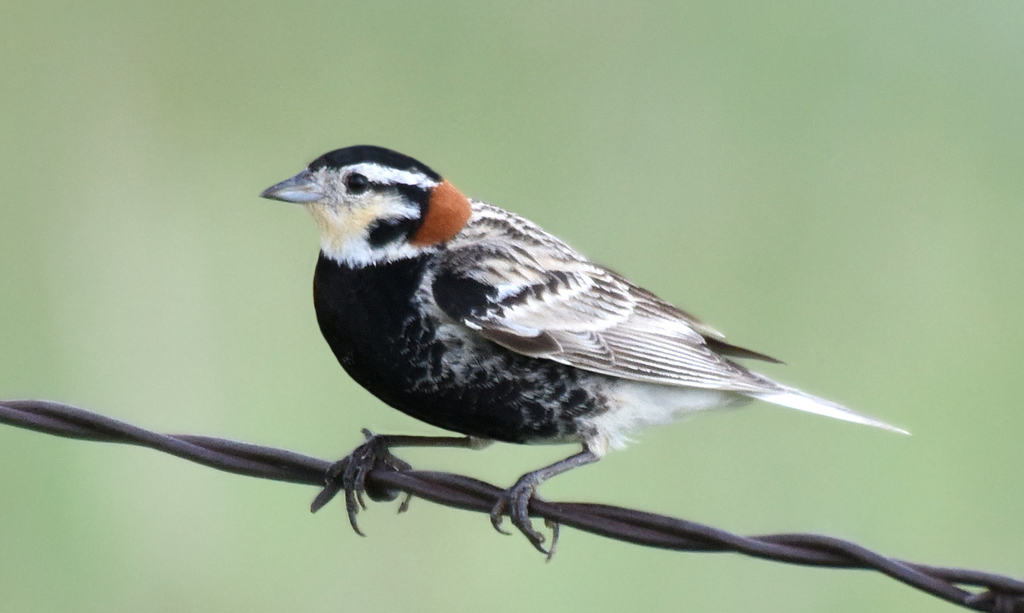
Chestnut-collared Longspur
Live sightings near you, the range map, bar charts of when it is seen, and Macaulay Library photos and recordings.
Chestnut-collared Longspur
Calcarius ornatus
The chestnut-collared longspur (Calcarius ornatus) is a species of bird in the family Calcariidae. Like the other longspurs, it is a small ground-feeding bird that primarily eats seeds. It breeds in prairie habitats in Canada and the northern United States and winters to the south in the United States and Mexico.
From the article Chestnut-collared longspur on Wikipedia (CC BY-SA), quoted section by section
Description
These birds have a short conical bill, a streaked back and a white tail with a dark tip. In breeding plumage, the male has black underparts, a chestnut nape, a yellow throat and a black crown. Other birds have light brown underparts, a dark crown, brown wings and may have some chestnut on the nape. Measurements:
Length: 5.1–6.5 in (13–16.5 cm) Weight: 0.6–0.8 oz (17–23 g) Wingspan: 25–27 cm
Range & habitat
This bird breeds in short and mixed grass prairies in central Canada and the north central United States. In winter, they migrate in flocks to prairies and open fields in the southern United States and Mexico. Like other prairie birds, they have disappeared from some areas because of habitat loss but are still fairly common. Controlled burns may benefit this species as they feed on low-growing plants that are more easily spotted after a fire.
Wikipedia: “Distribution and status”
What it does
These birds forage on the ground, gathering in flocks in winter. They mainly eat seeds, also eating insects in summer. Young birds are mainly fed insects. The female lays 4 or 5 eggs in a grass cup nest in a shallow scrape on the ground. The male sings and flies up to defend his territory. Both parents feed the young birds. The call is a two-syllabled chee dee.
Wikipedia: “Behavior”
Listen
Looking for field recordings…
Where it lives
Recorded sightings
—
geo-referenced records in GBIF, from museums, herbaria and field observers.
Drag the globe to turn it. Dots are where records exist, not a range map; darker means more records.
In the stacks
Searching the stacks…
Every page naming Calcarius ornatus in the Biodiversity Heritage Library →
This page is assembled live from iNaturalist, GBIF, Wikipedia, the Source Library and the Internet Archive. It is not yet part of the hand-edited codex. iNaturalist taxon 117153.