On eBird ↗
Phainopepla
Live sightings near you, the range map, bar charts of when it is seen, and Macaulay Library photos and recordings.
Phainopepla
Phainopepla nitens
The phainopepla or northern phainopepla (Phainopepla nitens) is the most northerly representative of the mainly tropical Central American family Ptiliogonatidae, the silky flycatchers. Its name is from the Greek phain pepla meaning "shining robe" in reference to the male's plumage.
From the article Phainopepla on Wikipedia (CC BY-SA), quoted section by section
Description
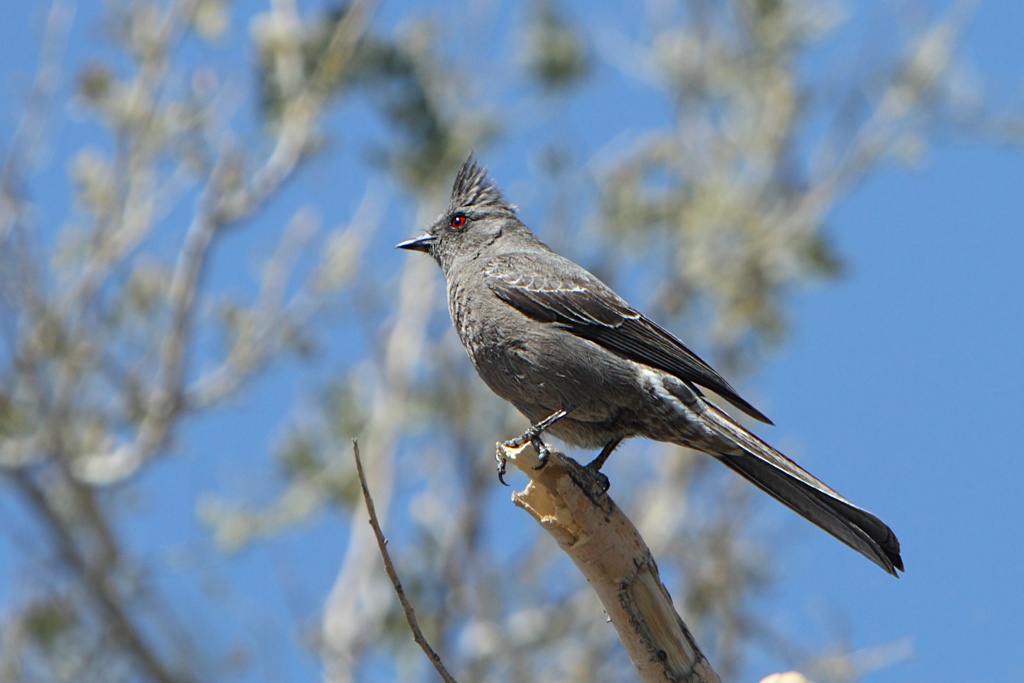
The phainopepla is a striking bird, 16–20 cm (6.3–7.9 in) long with a noticeable crest and a long tail; it is slender, and has an upright posture when it perches. Its bill is short and slender. The male is glossy black and has a white wing patch that is visible when it flies; the female is plain gray and has a lighter gray wing patch. Both sexes have red eyes, but these are more noticeable in the female than the male.
Range & habitat
The phainopepla ranges as far north as central California with the San Joaquin Valley and southern Utah, and south to central Mexico, the interior Mexican Plateau region; the southern edge of the plateau, the transverse mountains is its non-breeding home. It is found in hot areas, including desert oases, and is readily seen in the deserts of Arizona, southern Nevada, and southern California; also the Baja Peninsula, both Baja California-(north), and Baja California Sur where they are the only breeding resident birds. Extreme individuals have travelled as far as Canada, with one bird in 2009 reaching as far north as Brampton, Ontario, Canada.
Wikipedia: “Range and habitat”
What it does
Their diet consists of berries, any small insects, fruits, vegetables. Phainopeplas have a specialized mechanism in their gizzard that shucks berry skins off the fruit and packs the skins separately from the rest of the fruit into the intestines for more efficient digestion.
Symbiosis with desert mistletoe. Phainopepla are closely associated with desert mistletoe, and are the most effective dispersers of its seeds. As a mistletoe specialist, phainopepla have a specialized digestive system, and process berries very quickly without the gizzard crushing the seeds; berries are defecated 12–45 minutes after being eaten. As a result, each bird can process hundreds of berries in a day. Phainopepla derive fewer calories from each berry than non-specialist birds, but this ability to eat and quickly process large numbers of berries allows them to meet their daily caloric requirements, while non-specialist birds may not be able to do so on just mistletoe berries. Phainopepla deposit their feces on tree branches. In doing so, the mistletoe seeds within have a host tree to infect after they sprout.
Wikipedia: “Diet”
Listen
Looking for field recordings…
Where it lives
Recorded sightings
—
geo-referenced records in GBIF, from museums, herbaria and field observers.
Drag the globe to turn it. Dots are where records exist, not a range map; darker means more records.
In the stacks
Searching the stacks…
Every page naming Phainopepla nitens in the Biodiversity Heritage Library →
This page is assembled live from iNaturalist, GBIF, Wikipedia, the Source Library and the Internet Archive. It is not yet part of the hand-edited codex. iNaturalist taxon 117002.