- Animals
- ›Chordates
- ›Vertebrates
- ›Birds
- ›Perching Birds
- ›Ovenbirds and Woodcreepers
- ›Typical Ovenbirds
- ›Roraimia
On eBird ↗
Roraiman Barbtail
Live sightings near you, the range map, bar charts of when it is seen, and Macaulay Library photos and recordings.
Roraiman Barbtail
Roraimia adusta
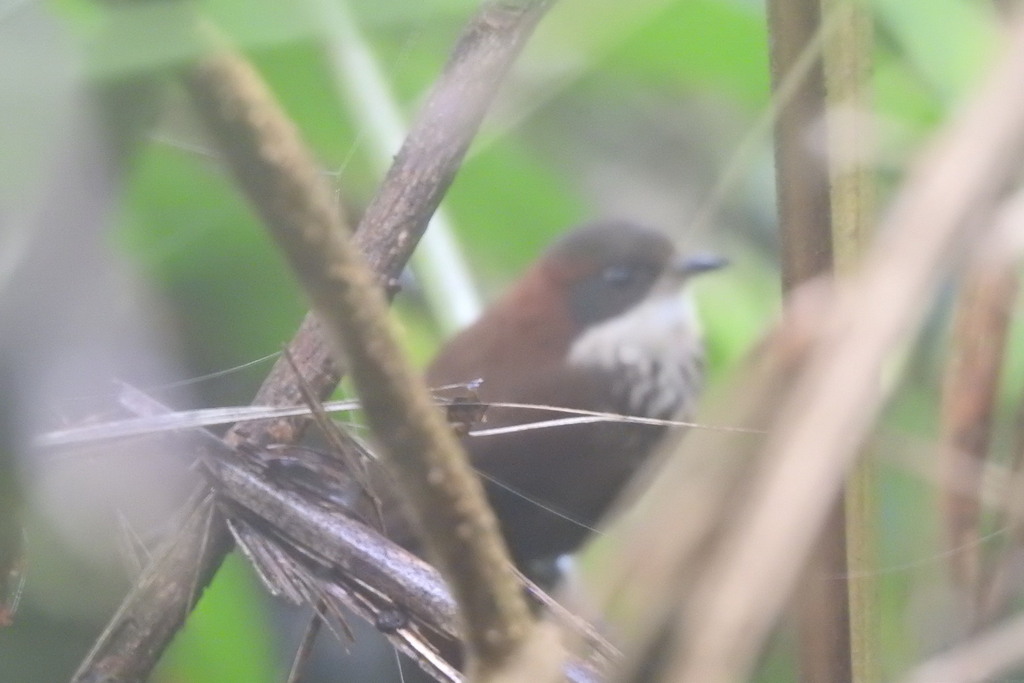
The Roraiman barbtail (Roraimia adusta) is a species of bird in the Furnariidae family. Therein, it is placed in the monotypic genus Roraimia. It is found in highland forests in the tepuis of southern Venezuela, western Guyana and far northern Brazil. Its name refers to Mount Roraima. It is a small bird with rufous upperparts, streaky underparts, a white throat and a black mask.
From the article Roraiman barbtail on Wikipedia (CC BY-SA), quoted section by section
Description
The Roraiman barbtail is 14 to 15 cm (5.5 to 5.9 in) long and weighs 14 to 20 g (0.49 to 0.71 oz). It is a dramatically patterned furnariid that resembles a Margarornis treerunner but is unique in its range. The sexes have the same plumage. Adults of the nominate subspecies R. a. adusta have dark blackish brown lores and ear coverts and a wide bright chestnut supercilium that extends around the nape. Their forehead is bright chestnut, their crown dark brown, and their upperparts chestnut. Their tail is also chestnut; the feathers lack barbs at the end giving a spiky appearance. Their wing coverts are dusky brown with chestnut edges and their flight feathers are brown with a chestnut tinge. Their chin and cheeks are white with a creamy tinge on the lower throat. Their underparts are streaked brown and buff that fade towards the vent area. Their flanks are dark reddish brown and their undertail coverts rufescent brown with reddish streaks. Their iris is brown, their maxilla black, their mandible pale with a black outer third, and their legs and feet brownish gray. Juveniles have much less of a supercilium than adults and a less reddish back and less distinct streaks on their underparts. Subspecies R. a. obscurodorsalis is darker overall than the nominate and has blackish edges on the feathers of its back. R. a. …
Range & habitat
The Roraiman barbtail is found in the tepui region where Venezuela, Guyana, and Brazil meet. The subspecies are found thus:
R. a. obscurodorsalis: Cerro Paraque in the extreme northwestern part of southeastern Venezuela's Amazonas state R. a. mayri: Mount Roraima in southeastern Venezuela's Bolívar state R. a. duidae: Cerro Duida, Cerro Huachamacari, and Serranía Parú in Venezuela's central and southern Amazonas state R. a. adusta: Mount Roraima and nearby tepuis in northern Brazil's Roraima state and Mt. Tewk-quay in western Guyana The Roraiman barbtail inhabits humid montane evergreen forest and elfin forest both primary and secondary. It favors landscapes with much moss and epiphytes. In elevation it overall ranges from 1,000 to 2,500 m (3,300 to 8,200 ft) but in Brazil is found above 1,200 m (3,900 ft).
Wikipedia: “Distribution and habitat”
What it does
The Roraiman barbtail feeds on arthropods. It usually forages singly or in pairs and regularly joins mixed-species feeding flocks. It forages in undergrowth, seldom more than about 6 m (20 ft) above the ground. It gleans prey from moss and epiphytes while hitching and creeping up trunks and along branches and vines.
Wikipedia: “Feeding”
Listen
Looking for field recordings…
Where it lives
Recorded sightings
—
geo-referenced records in GBIF, from museums, herbaria and field observers.
Drag the globe to turn it. Dots are where records exist, not a range map; darker means more records.
In the stacks
Searching the stacks…
Every page naming Roraimia adusta in the Biodiversity Heritage Library →
This page is assembled live from iNaturalist, GBIF, Wikipedia, the Source Library and the Internet Archive. It is not yet part of the hand-edited codex. iNaturalist taxon 11697.