On eBird ↗
Brown Songlark
Live sightings near you, the range map, bar charts of when it is seen, and Macaulay Library photos and recordings.
Brown Songlark
Cincloramphus cruralis
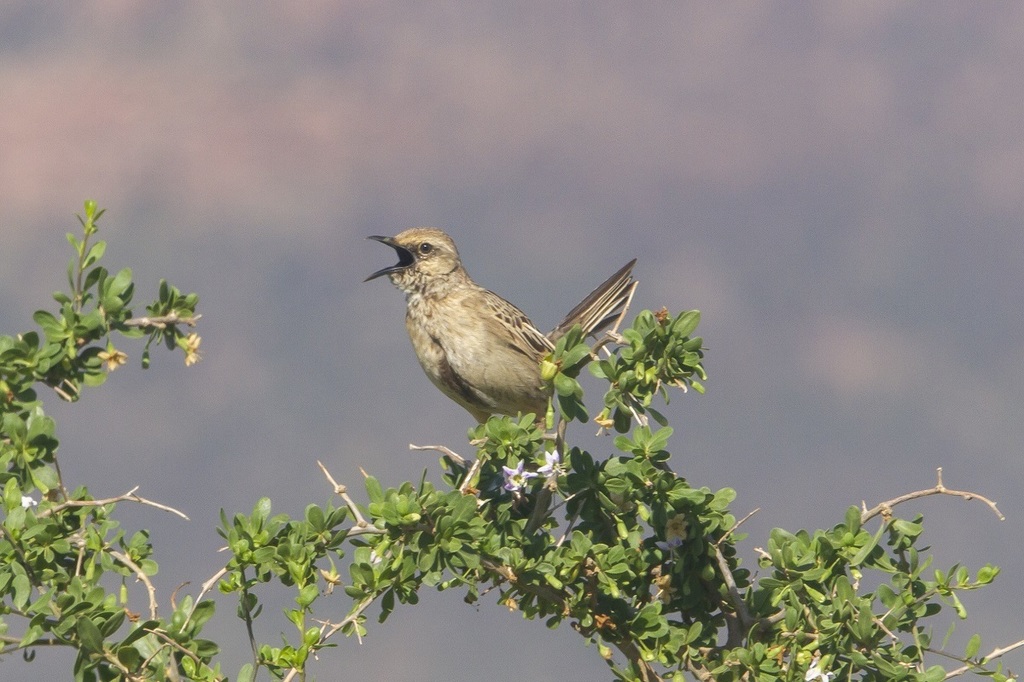
The brown songlark (Cincloramphus cruralis), also Australian songlark, is a small passerine bird found throughout much of Australia. A member of the family Locustellidae, this species is notable for sexual size dimorphism, among the most pronounced in any bird. It is a moderate-sized bird of nondescript plumage; the female brownish above and paler below, the larger male a darker brown.
From the article Brown songlark on Wikipedia (CC BY-SA), quoted section by section
Description
Male brown songlarks are 23–25 cm long versus 18–19 cm for females and may weigh 2.3 times as much. The average weight of males was listed as 74.8 g (2.64 oz) and that of females is 32.4 g (1.14 oz). They are probably the most sexually dimorphic passerine in the world in size difference, as well as likely the largest species in the family Locustellidae. In general, the birds have a dusky pale-streaked with darker brown plumage and pale eyebrows. The underparts are brownish-white in the female, darker brown in the male. Breeding males may display a cinnamon colour. The eyes and bill are black, and the legs grey. Juveniles are smaller and paler with pinkish-brown bills. The call has been described as loud and creaky. The male is the principal singer, calling from perches or when rising above breeding territory.
Range & habitat
The bird is found throughout Australia, except for parts of the far north and Tasmania. There are particularly dense populations in the southern parts of the country. It prefers open pastures and grassy scrub, and feeds on seeds and insects. The species is highly nomadic. Local numbers fluctuate depending on rainfall and the bird will often flee from drought-affected areas. The brown songlark has a large range, between 1,000,000 and 10,000,000 km²; while population size has not been quantified the bird is reported to be common. The IUCN thus lists it as a species of least concern and it is considered "secure" by Australian authorities.
Wikipedia: “Distribution and habitat”
What it does
Nesting occurs from August to December. The nest itself is a deep cup of herbaceous material well concealed in shrubbery or tall grass. There is generally one clutch per breeding season, consisting of 2 to 5 pale pink eggs, 23 mm x 17 mm in size, with reddish brown spots and flecks. Females provide most of the parenting. Foxes and snakes prey upon nests.
Sexual dimorphism. The sexual dimorphism of the species has been the subject of study. Males are highly polygynous and compete directly for mates, giving rise to the pronounced size differential. Preferring open terrain, there is significant habitat homogeneity (sameness) and excellent visibility across brown songlark territories. This allows males to defend large territories and support multiple nesting females. Research has shown an interesting corollary to the dimorphism of the species: though males are larger than females, females hatch from larger eggs and are initially heavier than their brothers. That may provide them an early competitive advantage. Particularly, in periods of low food availability, the greater nutrient reserves of female hatchlings may skew the sex-ratio toward "cheaper" daughters. Three weeks after hatching, male chicks are significantly heavier than the females. After ten days, the male chicks are almost 50% heavier than their sisters. …
Wikipedia: “Reproduction”
Listen
Looking for field recordings…
Where it lives
Recorded sightings
—
geo-referenced records in GBIF, from museums, herbaria and field observers.
Drag the globe to turn it. Dots are where records exist, not a range map; darker means more records.
In the stacks
Searching the stacks…
Every page naming Cincloramphus cruralis in the Biodiversity Heritage Library →
This page is assembled live from iNaturalist, GBIF, Wikipedia, the Source Library and the Internet Archive. It is not yet part of the hand-edited codex. iNaturalist taxon 116872.