On eBird ↗
Sedge Warbler
Live sightings near you, the range map, bar charts of when it is seen, and Macaulay Library photos and recordings.
Sedge Warbler
Acrocephalus schoenobaenus
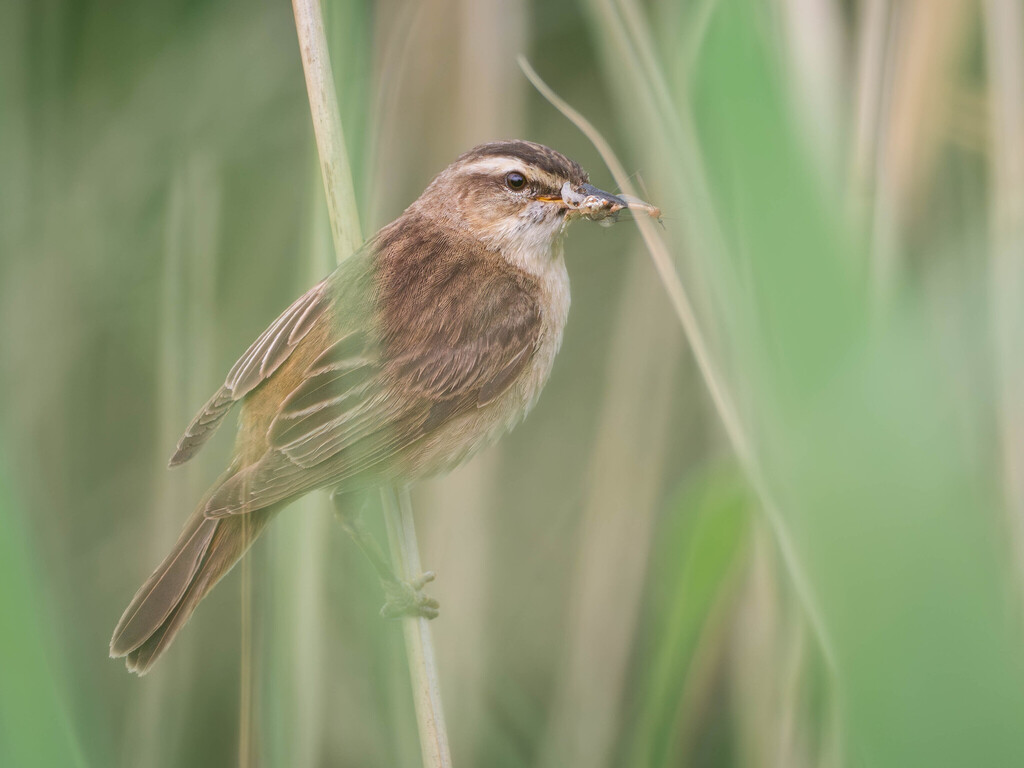
The sedge warbler (Acrocephalus schoenobaenus) is an Old World warbler in the genus Acrocephalus. It is a medium-sized warbler with a brown, streaked back and wings and a distinct pale supercilium. Sedge warblers are migratory, crossing the Sahara to get from their European and Asian breeding grounds to spend winter in Africa. The male's song is composed of random chattering phrases and can include mimicry of other species. The sedge warbler is mostly insectivorous.
From the article Sedge warbler on Wikipedia (CC BY-SA), quoted section by section
Description
This is a medium-sized warbler, 11.5–13 cm (4.5–5.1 in) long and weighing around 12 g (0.42 oz). It has a streaked brown back and wings, and pale underparts. The rump is warm brown and unstreaked, contrasting with the duller wings. The forehead is flattened, the crown is streaked with black, and the bill is strong and pointed. There is a prominent whitish supercilium. The legs are greyish. The plumage of the sexes is identical, although they can be told apart when caught for ringing by the presence of a brood patch or cloacal protuberance. Juvenile birds have dark spots on the breast. They can be easier to confuse with aquatic warblers due to an apparent pale central crown stripe contrasting with the darker edges. Other similar species include moustached warblers and Pallas's grasshopper warblers. The oldest recorded sedge warbler was a bird ringed in Finland which reached the age of 10 years, 1 month. The typical lifespan is 2 years. The song is varied, rushed and chattering, with sweeter phrases and some mimicry, typical of the Acrocephalus warblers. It is composed of phrases in random order, so that it is never the same. Male sedge warblers which have the widest repertoire mate with the largest number of females.
Range & habitat
The sedge warbler has a large range and an estimated Global Extent of Occurrence of 10 million square kilometres, with a large global population including between 8.8 million and 15 million birds in Europe. Data analysis by the British Trust for Ornithology has shown that fluctuations in the sedge warbler population stem from the adult survival rate, due to changes in rainfall on the birds' wintering grounds. Global changes in population have not been measured, but the sedge warbler's status is designated 'of least concern' by BirdLife International.
It breeds across Europe and western and central Asia and is migratory. After feeding up post-breeding, they migrate quickly across southern Europe and the Sahara from August to September. Studies in Nigeria and Uganda suggest that sedge warblers return to spend winter at the same sites, year after year. All sedge warblers spend winter in sub-Saharan Africa, from Senegal in the west to Ethiopia in the east, and as far south as the eastern Cape Province of South Africa and northern Namibia. The routes taken on the southward migration, and their eventual wintering grounds, correspond to the birds' breeding grounds. …
Wikipedia: “Distribution and habitat”
What it does
Prey taken by sedge warblers includes mayflies, dragonflies and damselflies, grasshoppers, bugs, lacewings, moths, beetles and flies. Vegetable material includes elderberries and blackberries. On their wintering grounds food includes non-biting midges and flowers and berries from the toothbrush tree. In late July, prior to migration, it appears that sedge warblers seek out sites with large numbers of plum-reed aphids and stay there longer than at other places; ringing studies show that birds may move considerable distances (e.g. from southern England to northern France) in search of food before beginning their actual migration. In Portugal, the aphid supply dries up too early for sedge warblers to utilise it, so many birds do not stop off there and are already heavy with fat when they pass through. Birds with the heaviest fat reserves built up before migration are capable of non-stop flights from Africa to southern Britain, or from Uganda to Iraq, for example. Some double their normal weight when 'fuelling' for migration. Lighter birds are forced to make the journey in several shorter parts. Sedge warblers feed in low, thick vegetation, especially reeds and rushes, but also in arable fields and around bushes. …
Wikipedia: “Food and feeding”
Listen
Looking for field recordings…
Where it lives
Recorded sightings
—
geo-referenced records in GBIF, from museums, herbaria and field observers.
Drag the globe to turn it. Dots are where records exist, not a range map; darker means more records.
In the stacks
Searching the stacks…
Every page naming Acrocephalus schoenobaenus in the Biodiversity Heritage Library →
This page is assembled live from iNaturalist, GBIF, Wikipedia, the Source Library and the Internet Archive. It is not yet part of the hand-edited codex. iNaturalist taxon 116804.